Louisiana Cottage Food Law Label Requirements
Louisiana cottage food law label requirements come down to one line. State law (R.S. 40:4.9) asks for a label that clearly says the food was not produced in a licensed or regulated facility. That's it. Raw honey doesn't even need that. A good label adds the product name, your name, the ingredients and allergens, which is what federal rules expect on packaged food anyway.
What goes on a Louisiana home food label
Item 1 is the Louisiana rule. Items 2 to 4 are the federal basics for packaged food that turn a sticker into a real label.
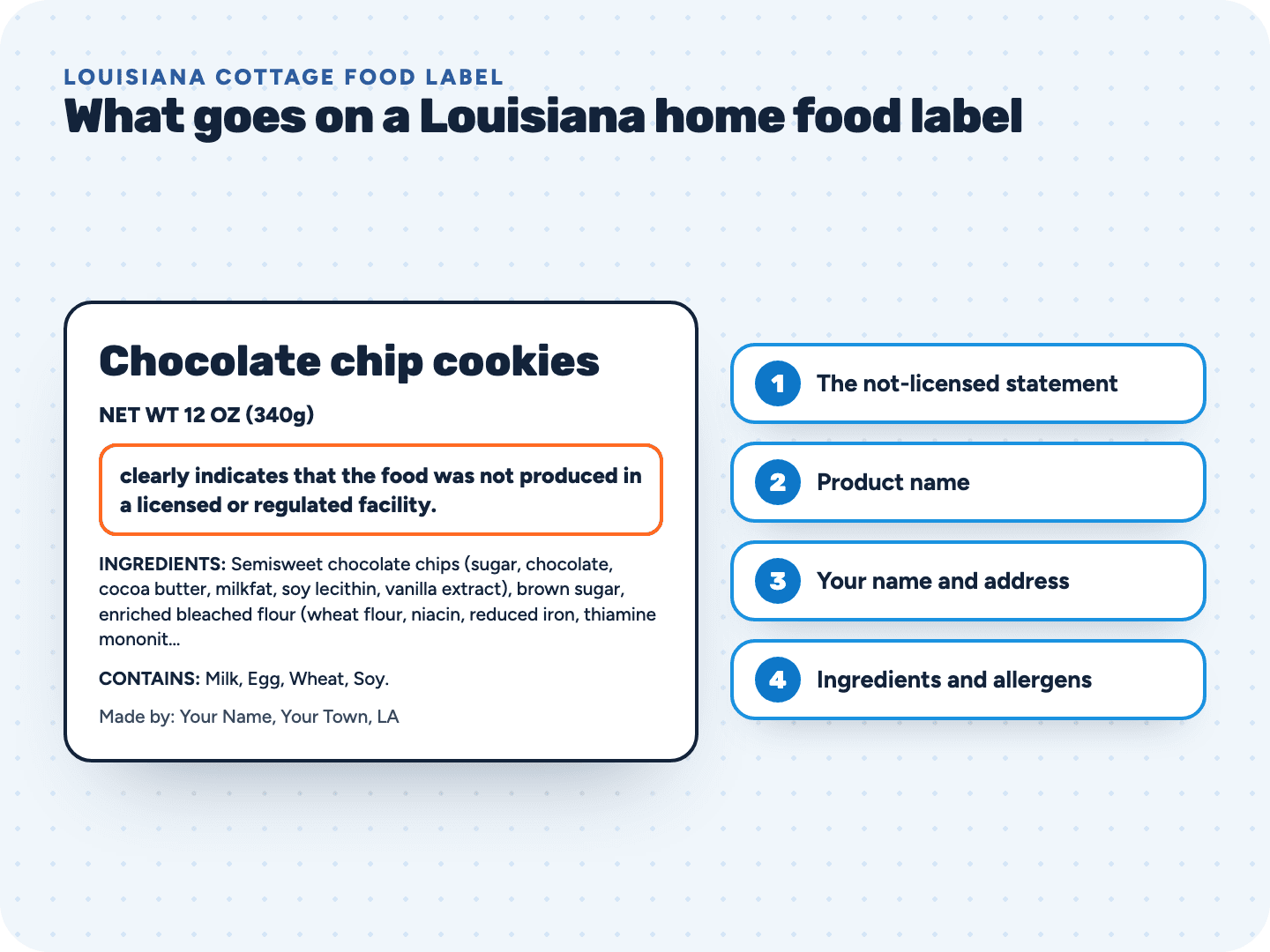
- 1The not-licensed statementLa. R.S. 40:4.9(D)(1)(a)The law asks for a label that "clearly indicates that the food was not produced in a licensed or regulated facility." It gives no fixed wording. A clear choice: "Made in a home kitchen. This food was not produced in a licensed or regulated facility."
- 2Product name21 CFR 101.3The usual name of the food, like "Pecan pralines", "Fig preserves" or "Cajun seasoning".
- 3Your name and address21 CFR 101.5Who made or packed it and where: street, city, state and ZIP. The street can be left off if your business is listed in a current phone or city directory.
- 4Ingredients and allergens21 CFR 101.4All ingredients from most to least by weight, and a Contains line for any of the 9 major allergens, like milk, eggs, wheat, peanuts or tree nuts (pecans count).
- Breads, cakes, cookies and pies have extra rulesBakersYou can't sell them to a store or anyone who resells them, and the home exemption ends if you hire help to make them. Keep flies and vermin out, keep equipment clean, and make custard or cream fillings with pasteurized milk, cooked to at least 145°F for 30 minutes and kept at 45°F or below.
Sales limit, permits and what you can make
Where this comes from
Louisiana label questions
No fixed wording. The label has to clearly say the food was not produced in a licensed or regulated facility. Using those exact words is the safest way to meet it.
The home food law doesn't set up a health permit for low-risk foods. You do need to be registered to collect sales tax, with a current certificate from the parish where you sell. Louisiana Cottage Food Law →
Not under this law. Low-risk foods may not contain animal muscle protein or fish protein, so meat, sausage, crawfish and fish fillings are out.
No. Breads, cakes, cookies and pies made at home can't be sold to a retail business or anyone else for resale.
State law only asks for the not-licensed statement. Federal rules for packaged food expect an ingredient list and allergens, and buyers with allergies look for them. Our tool builds both from your recipe. Start a label →
See your label before you pay anything
Free preview, no account. $29 when you're ready to print.