Sauce Label Maker
Sauce label maker for any jar or bottle: enter your recipe and get the Nutrition Facts, ingredient list and allergen statement, built on the FDA serving size for your kind of sauce. The serving size is where most sauce labels go wrong. Pasta sauce is 125 g (about 1/2 cup), pesto 1/4 cup, dipping sauces 2 tbsp, and soy or teriyaki sauce 1 tbsp.
- Free preview
- $29 per label
- Ready to print
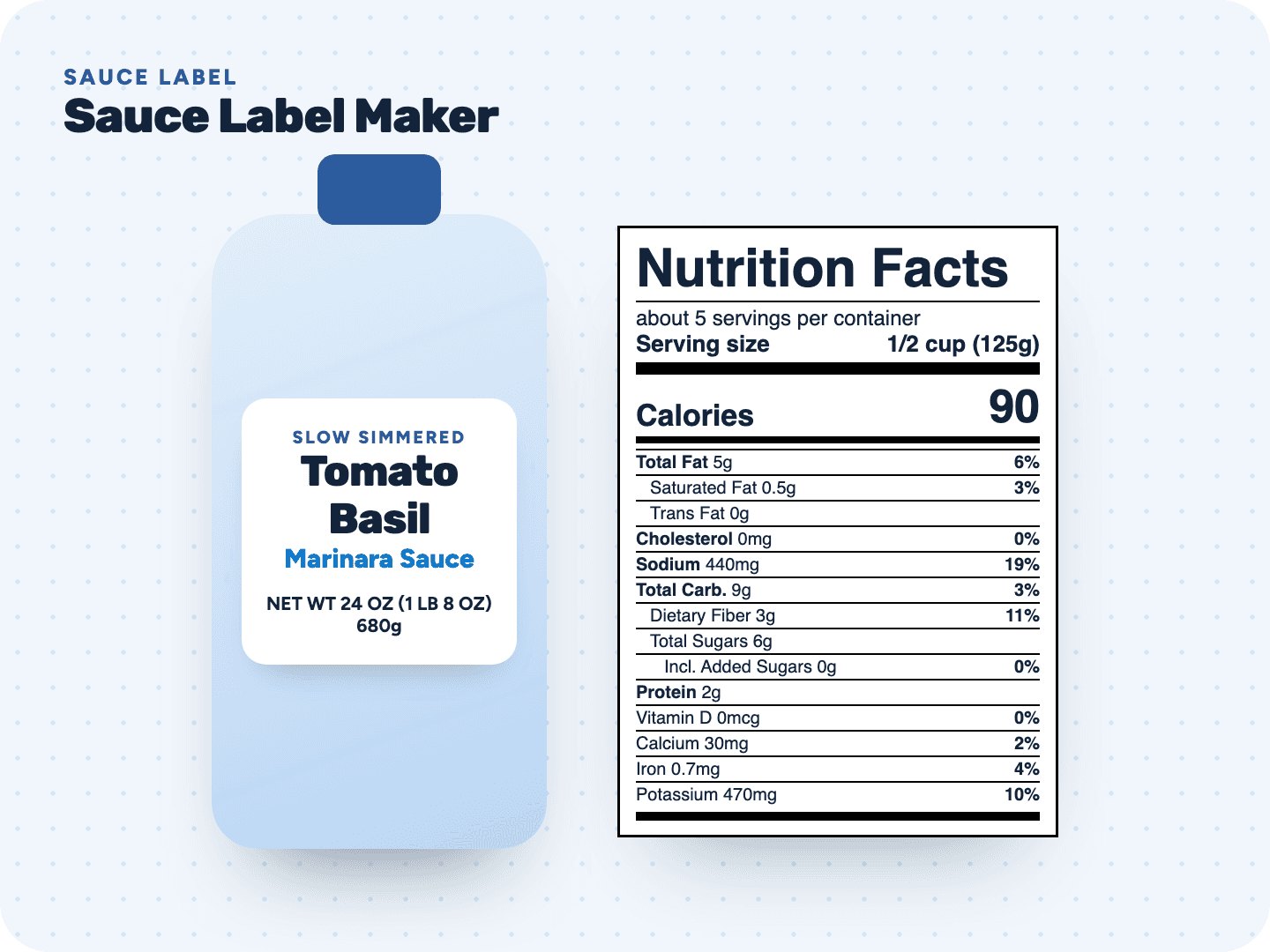
What has to be on your sauce label
The same six parts for every sauce, from marinara to teriyaki. The numbers match the jar.
- 1Product name21 CFR 101.3"Marinara sauce", "Basil pesto", "Teriyaki sauce": the name shoppers know it by, with your style or flavor in front.
- 2Net quantity21 CFR 101.7Thick and chunky sauces by weight (NET WT), thin pourable ones like soy sauce in fl oz, always with the metric amount.
- 3Nutrition Facts21 CFR 101.9Built on the serving size for your type of sauce (see below). Required unless you qualify for the small business exemption.
- 4Ingredient list21 CFR 101.4Every ingredient, heaviest first. Store-bought pesto, broth or soy sauce in your recipe gets its own ingredients in parentheses.
- 5Allergen statementFALCPAPesto: tree nuts and milk. Soy and teriyaki sauce: soy and wheat. Fish sauce or anything with anchovies: fish. Name the nut or fish.
- 6Name and address21 CFR 101.5Who made or packed the sauce, with city, state and ZIP code.
Serving sizes that are different for each sauce
Sauce jars and bottles and the label that fits
A soy sauce bottle and a pasta sauce jar need very different labels. Find your container, then pick that style in the tool.
| Container | Typical label area | Style that usually fits |
|---|---|---|
| 5 fl oz soy or teriyaki bottle | 3 × 1 in | Small package (linear) |
| 8 oz pesto jar | 6 × 2 in | Wide (tabular) |
| 16 oz jar | 6 × 2.5 in | Wide (tabular) |
| 24 oz pasta sauce jar | 3 × 4.5 in | Standard (vertical)Most common |
Start from a marinara that's already filled in
Four pounds of tomatoes simmer down to two 24 oz jars. Enter the weight of the finished batch and the tool spreads the nutrients over what is left in the pot.
| Ingredient | Amount | Unit |
|---|---|---|
| Tomatoes✓ USDA match | 4 | lb |
| Onion✓ USDA match | 1 | cup |
| Olive oil✓ USDA match | 1/4 | cup |
| Tomato paste✓ USDA match | 3 | tbsp |
| Garlic✓ USDA match | 6 | cloves |
| Fresh basil✓ USDA match | 1/2 | cup |
| Salt✓ USDA match | 2 | tsp |
| Dried oregano✓ USDA match | 1 | tsp |
Sauce label questions
Yes. Our blank Nutrition Facts templates are free as fillable PDF, Word, SVG and PNG. Or skip the blank form: open the marinara sample above in the free preview, change it to your recipe and see your finished label before you pay $29 to download. Blank Nutrition Facts Label Template →
The name, net contents in fl oz and mL, Nutrition Facts per 1 tbsp, the ingredient list and "Contains: wheat, soy" for a soy sauce brewed with wheat. A tamari made without wheat lists soy only. Sodium is the line everyone reads, so measure your salt carefully.
It depends on how it is used. A ready-to-serve pasta or marinara sauce is 125 g (about 1/2 cup). Plain tomato sauce or puree sold as a cooking ingredient is 60 g (about 1/4 cup). Pizza sauce is 1/4 cup.
For a simmered sauce, yes. Cooking drives off water, which concentrates everything else. Weigh the finished batch, enter it, and the calories and sodium per serving come out right instead of too low.
Yes, one per recipe, because the ingredients and numbers differ. Bundles keep that cheap: 3 labels for $69, 10 for $199, and the credits never expire.
Make your sauce label now
Free preview, no account. $29 when you're ready to print.