What gluten-free means under FDA rules
FDA names three gluten-containing grains: wheat (any Triticum species, including spelt), rye and barley, plus crossbreeds such as triticale. "Gluten" is the protein in those grains that can harm people with celiac disease.
| Ingredient | Example | Allowed in a gluten-free food? |
|---|---|---|
| A gluten-containing grain | Spelt, rye flakes, barley | No |
| Made from one of those grains, gluten not removed | Wheat flour, barley malt | No |
| Made from one of those grains, processed to remove gluten | Wheat starch | Only if the finished food stays under 20 ppm |
| Grains that are not gluten-containing grains | Rice, corn, buckwheat, oats | Yes, if the finished food stays under 20 ppm |
On top of the ingredient test, any unavoidable gluten in the finished food, for example from shared equipment, must be below 20 ppm. That is 20 milligrams of gluten per kilogram of food.
Gluten-free, no gluten, without gluten: one rule
- Gluten-free
- No gluten
- Free of gluten
- Without gluten
- All four claims must meet the same definition, or the food is misbranded
- The rule covers the claim anywhere in the labeling, not just the front panel
- States can't set a different definition for these claims. The federal rule applies everywhere in the US
Wheat in a gluten-free food: the asterisk rule
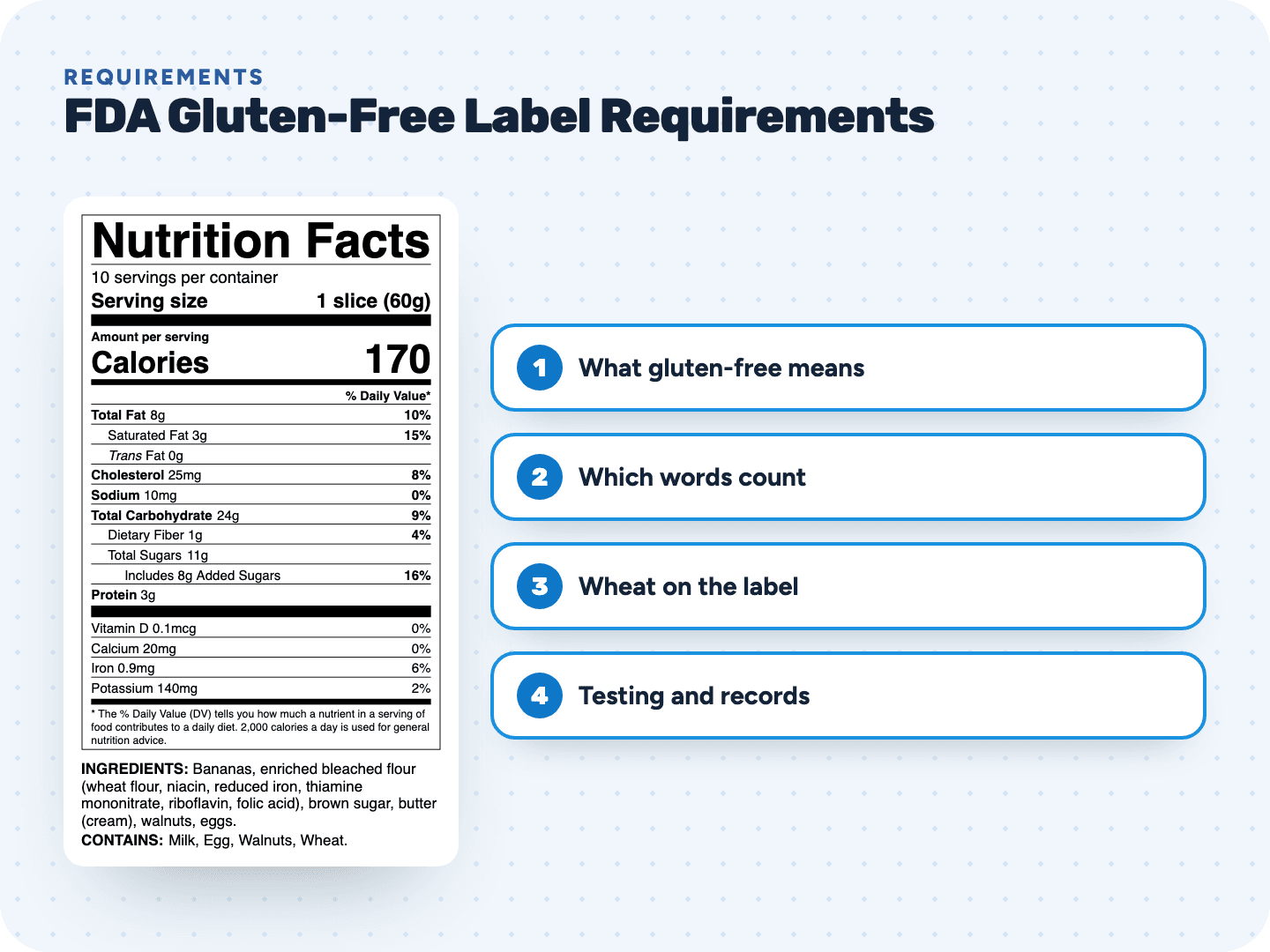
A gluten-free food can contain an ingredient like wheat starch that has been processed to remove gluten. But wheat is a major allergen, so "wheat" still appears in the ingredient list or the Contains statement. When it does, FDA requires an asterisk (or other symbol) right after the word "wheat", pointing to this exact statement close to the ingredient list:
"The wheat has been processed to allow this food to meet the Food and Drug Administration (FDA) requirements for gluten-free foods."
Without that statement, a gluten-free label that mentions wheat is misbranded. The allergen declaration stays: gluten-free does not mean wheat-free.
Testing, records and fermented foods
- FDA does not require you to test your ingredients or finished food for gluten
- You are still responsible for staying under 20 ppm. Supplier certificates and your own testing are common ways to check
- When FDA checks a food, it uses a validated method that can detect 20 ppm in raw and baked foods
Fermented and hydrolyzed foods, such as yogurt, sauerkraut or soy sauce, can't be measured reliably by the usual tests. If you make one and label it gluten-free, you must keep records that show:
- The food met the gluten-free definition before fermentation or hydrolysis
- You evaluated your process for gluten cross-contact
- You put measures in place where you found a risk
- You keep those records for at least 2 years after the food is shipped into interstate commerce, and show them to FDA on request
For distilled foods, such as distilled vinegar, FDA checks that the distilled part contains no protein.
Oats, certification logos and who the rule covers
- Oats are not a gluten-containing grain. Oats labeled gluten-free must contain less than 20 ppm gluten, like any other food
- Oats don't need a certification to carry the claim
- You may show a third-party gluten-free certification logo if its use is truthful and not misleading. FDA does not endorse any certification program
- Foods that are naturally gluten-free, like bottled spring water or rice, may carry the claim. You don't have to use it
- The rule covers FDA-regulated packaged foods, including dietary supplements
- Meat and poultry labeled under USDA rules and most alcoholic beverages (TTB) are outside it
Example: a gluten-free oat raisin cookie
Ingredients: Brown sugar, rolled oats, raisins, butter (cream), brown rice flour, eggs, cinnamon, baking soda, salt. Contains: Milk, Egg.
- No wheat, rye or barley ingredient, so the ingredient test passes
- Oats are the risk: regular oats can pick up wheat or barley in the field and the mill, so bakers often buy oats sold as gluten-free and keep the supplier's certificate
- Milk and eggs are declared. A gluten-free claim never replaces the allergen declaration
- The serving is 1 cookie (30g), the FDA reference amount for cookies
Our tool builds this ingredient list, the Contains line and the Nutrition Facts from your recipe, and it flags wheat whenever a recipe has it. It does not check the gluten-free claim itself: the 20 ppm limit depends on your suppliers and your kitchen, so that part is yours to verify.