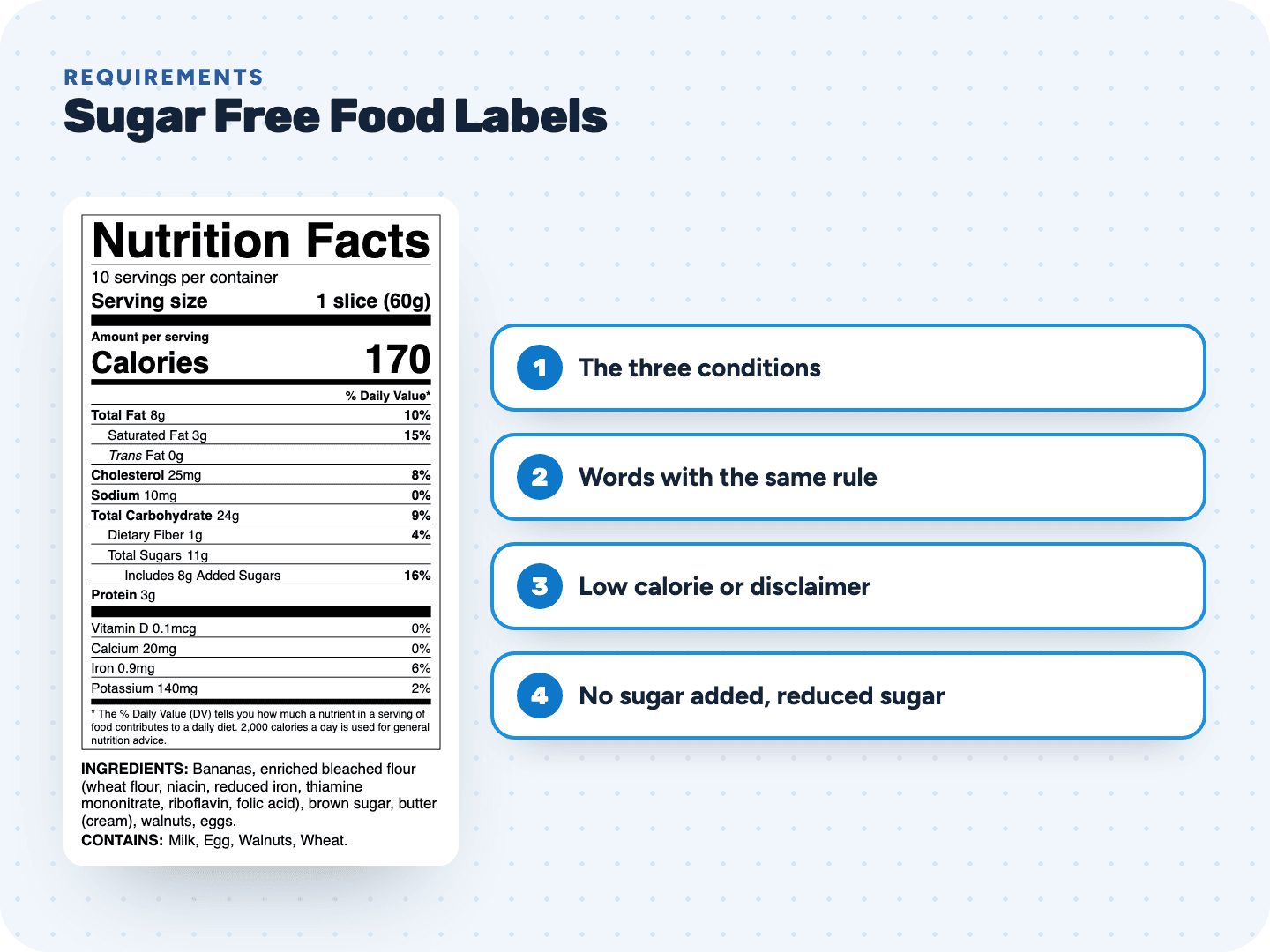
When you may say "sugar free"
FDA treats sugar free as a nutrient content claim with a fixed definition. All three conditions must be true:
- Less than 0.5 g of sugars per reference amount customarily consumed and per labeled serving (meals and main dishes: per labeled serving)
- No ingredient that is a sugar or that people understand to contain sugar, unless it has an asterisk pointing to "adds a trivial amount of sugar", "adds a negligible amount of sugar" or "adds a dietarily insignificant amount of sugar"
- The food is labeled "low calorie" or "reduced calorie", or the claim is followed every time by one of the three disclaimers
Why the disclaimer? FDA found that shoppers read "sugar free" as "fewer calories". A sugar free cookie made with extra fat may have as many calories as the regular one, so the label has to say so.
21 CFR 101.60(c)(1)The definition of sugar free and its three conditions, including the asterisk wording and the disclaimers.
Every wording that counts as sugar free
Switching words doesn't get around the rule. Each of these means sugar free to FDA:
- Sugar free
- Free of sugar
- No sugar
- Zero sugar
- Without sugar
- Sugarless
- Trivial source of sugar
- Negligible source of sugar
- Dietarily insignificant source of sugar
21 CFR 101.60(c)(1)The list of terms that share the sugar free definition.
Low calorie, or the disclaimer
| Your food | What goes with sugar free |
|---|---|
| 40 calories or less per reference amount (and per 50 g if the reference amount is 30 g or 2 tbsp or less) | It qualifies as "low calorie". Label it low calorie and no disclaimer is needed |
| At least 25% fewer calories than a named reference food | Label it "reduced calorie" with the comparison, and no disclaimer is needed |
| Anything else | "Not a reduced calorie food", "not a low calorie food" or "not for weight control", right next to the claim each time it appears |
21 CFR 101.60(b)(2), (b)(4) · 101.60(c)(1)(iii)The low calorie and reduced calorie definitions, and when the sugar free disclaimer is required.
No sugar added, reduced sugar and unsweetened
These sound alike but follow different rules. Pick the one your product really meets.
| Claim | Main conditions |
|---|---|
| Sugar free | Under 0.5 g sugars per reference amount and serving, plus the ingredient and calorie conditions above |
| No sugar added, without added sugar | No sugars or sugar-containing ingredients added (no jam, jelly or juice concentrate); sugars not raised by enzymes; the food it replaces normally has added sugars; and a statement that it is not low calorie (unless it is) that points to the Nutrition Facts |
| Reduced sugar, less sugar | At least 25% less sugar than a named reference food, with the percentage and the gram amounts shown next to the claim |
| Unsweetened, no added sweeteners | A factual statement for foods with a lot of natural sugar, such as juices. The sugar free conditions don't apply to it |
21 CFR 101.60(c)(2), (c)(3), (c)(5)No added sugar, the factual unsweetened statement, and reduced sugar with its comparison rules.
What a sugar claim changes on Nutrition Facts
- Total Sugars and Added Sugars must be listed even below 1 g. Without a claim you could leave them off and use the "Not a significant source" line
- Sugar alcohols such as erythritol or xylitol become a required line when you make a sugar claim and the food contains them
- The small business exemption from Nutrition Facts no longer applies. Any nutrition claim means a full panel
- Calories from sugar alcohols use FDA's own factors: erythritol 0 calories per gram, xylitol 2.4, maltitol 2.1, sorbitol 2.6
21 CFR 101.9(c)(6)(ii) to (iv) · 101.9(c)(1)(i)(F) · 101.9(j)(1)When sugars must be declared, the sugar alcohol line, calorie factors for sugar alcohols, and the claims condition on the small business exemption.
Our tool calculates Total Sugars and Added Sugars from your recipe, with FDA rounding. It does not check sugar claims, and sugar alcohols are not in its ingredient library, so confirm the claim and any sugar alcohol line yourself before you print.
Start a label →Sugar free label checklist
0 of 7 checkedSaved on this device