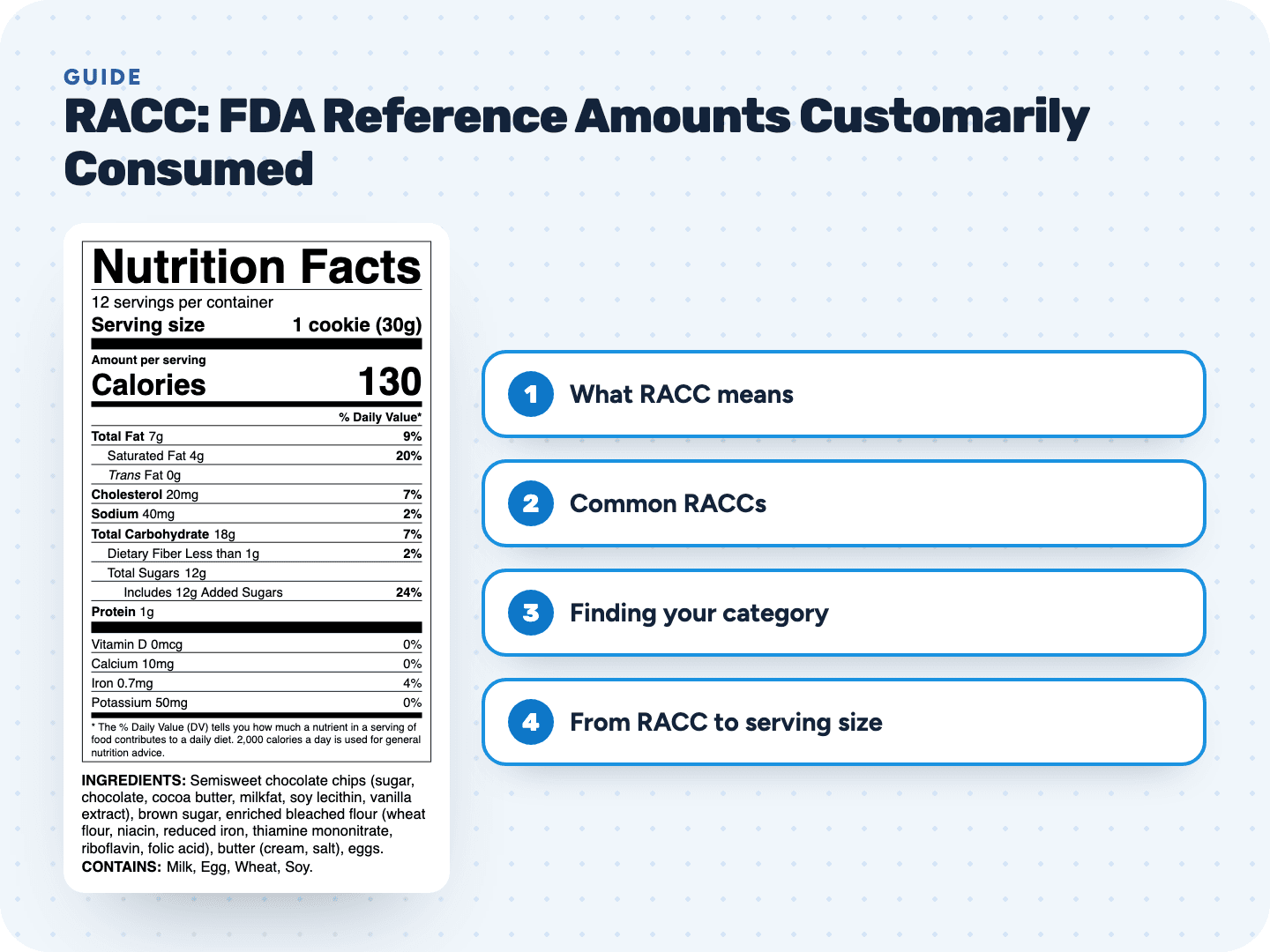
What a reference amount customarily consumed is
FDA built the RACCs from national food consumption surveys, looking at what people 4 years and older actually eat per eating occasion. The result is one number per product category: 30 g for cookies, 1 tbsp for jam, 360 mL for a soft drink. Every maker of that kind of food starts from the same number, which is why serving sizes are comparable between brands.
- Edible portion only: pits, shells and bones don't count toward the reference amount
- Based on the main use: milk is counted as a drink, not as something you pour on cereal
- Foods used as an ingredient but also eaten as bought, like butter, are based on the form you buy
- A low-calorie or imitation version gets the same reference amount as the food it replaces
RACC table for the products small brands make most
Table 2 of 21 CFR 101.12 covers the general food supply. These are the categories our customers use most often:
| Product category | Reference amount | Example label statement |
|---|---|---|
| Cookies | 30 g | __ piece(s) (__ g) |
| Brownies | 40 g | __ piece(s) (__ g) |
| Grain-based bars: granola, breakfast and rice cereal bars | 40 g | __ piece(s) (__ g) |
| Bagels, muffins (not English muffins) | 110 g | __ piece(s) (__ g) |
| Breads and rolls (not sweet quick breads) | 50 g | __ piece(s) (__ g) |
| Chips, pretzels, popcorn, snack mixes | 30 g | 1 oz (28g/visual unit of measure) for bulk |
| Nuts and seeds | 30 g | __ tbsp(s) (__ g); __ cup(s) (__ g) |
| Nut and seed butters | 2 tbsp | 2 tbsp (__ g) |
| Honey, jams, jellies, fruit butters | 1 tbsp | 1 tbsp (__ g) |
| Barbecue sauce, dips, salsa | 2 tbsp | 2 tbsp (__ g); 2 tbsp (30 mL) |
| Hot sauces, mustards, horseradish | 1 tsp | 1 tsp (__ g); 1 tsp (5 mL) |
| Pesto, pizza sauce, Alfredo sauce | 1/4 cup | 1/4 cup (__ g); 1/4 cup (60 mL) |
| Spaghetti sauce and other major entree sauces | 125 g | __ cup (__ g); __ cup (__ mL) |
| Soft drinks, energy drinks, sports drinks, water | 360 mL | 12 fl oz (360 mL) |
| Juices, nectars, fruit drinks | 240 mL | 8 fl oz (240 mL) |
| Syrups | 30 mL | 2 tbsp (30 mL) |
| Most candies | 30 g | __ piece(s) (__ g) |
| Seasoning oils, like chili oil or sesame oil | 1 tbsp | 1 tbsp (__ g) |
| Spices and herbs | 1/4 tsp or 0.5 g | 1/4 tsp (__ g) |
Most reference amounts are for the food ready to eat. For a dry mix or concentrate without its own line, the reference amount is the amount needed to make one reference amount of the prepared food. A dry soup mix, for example, uses the amount that makes 245 g of soup.
Which RACC category does your product belong to?
The table's category names are broad. FDA publishes a guidance document, Reference Amounts Customarily Consumed: List of Products for Each Product Category, with examples for every line. A few that settle common questions:
- Trail mix bars and multi-grain bars belong with granola bars: 40 g
- Energy drinks and sports drinks sit with soft drinks: 360 mL, not the 240 mL for juice
- Guacamole and salsa count as dips: 2 tbsp
- Hot sauce is a minor condiment (1 tsp), not a dipping sauce
- Flavored nut butter spreads go with nut butters: 2 tbsp
- Biscotti and rugelach are cookies: 30 g
The guidance itself says its lists are not all-inclusive. If your product isn't named, pick the category whose description and use fit it best. FDA can also set or change a reference amount, on its own or in response to a petition, and the regulation lists what such a petition must contain.
From RACC to FDA serving size
The RACC is a weight or volume. Your label needs a household measure: cups, tablespoons, teaspoons, pieces, slices or fractions, with the metric amount in parentheses. How you get there depends on the shape of your product.
| Product shape | How the serving size is set | Rule |
|---|---|---|
| Pieces, unit weighs 50% or less of the RACC | The number of whole pieces closest to the RACC | 21 CFR 101.9(b)(2)(i)(A) |
| Pieces, over 50% but under 67% | Your choice: 1 or 2 pieces | 21 CFR 101.9(b)(2)(i)(B) |
| Pieces, 67% up to under 200% | 1 piece | 21 CFR 101.9(b)(2)(i)(C) |
| Pieces, 200% up to 300% | The amount closest to the RACC, plus a second column per piece | 21 CFR 101.9(b)(2)(i)(D) |
| Large units you cut, like a pie or cake | The fraction closest to the RACC: halves, thirds, quarters, fifths, sixths, or those split further by 2 or 3 | 21 CFR 101.9(b)(2)(ii) |
| Bulk foods, like granola, flour or sauce | The household measure closest to the RACC | 21 CFR 101.9(b)(2)(iii) |
- Cups in 1/4 or 1/3 cup steps
- Tablespoons as 1, 1 1/3, 1 1/2, 1 2/3, 2 or 3
- Teaspoons as 1/8, 1/4, 1/2, 3/4, 1 or 2
- Exactly halfway between two sizes? Round up to the next one
- No cup, spoon or piece fits? Ounces in 0.5 oz steps with a visual unit. FDA's example: 1 oz (28 g/about 1/2 pickle)
For labeling, FDA fixes the conversions: a teaspoon is 5 mL, a tablespoon 15 mL, a cup 240 mL, a fluid ounce 30 mL and an ounce 28 g. The gram amount in parentheses is rounded to a whole gram, except below 5 g.
Single-serving and dual column packages
The RACC also decides how you label a package sold on its own, like one big cookie or one bottle of iced tea.
| Package holds | Brownie example (RACC 40 g) | Label |
|---|---|---|
| Under 200% of the RACC | A 70 g brownie, wrapped and sold alone | 1 serving: the whole brownie |
| 200% up to and including 300% | A 100 g brownie, wrapped and sold alone | Dual column: per serving and per package |
| Over 300% | A 400 g tray of brownie bites | Servings per container from the serving size |
Between 150% and 200%, FDA allows an extra, voluntary column per household measure next to the per-package column. The dual column rule has its own exceptions, for example for packages small enough to use the tabular or linear format.
Dual Column Nutrition Label →Servings per container
Divide the package by the serving size, then round the way FDA says. When the result is rounded, the label says "about".
Worked example: a bag of oatmeal raisin cookies
A small bakery sells oatmeal raisin cookies of 15 g each in a 9 oz (255 g) bag. Here is how the RACC turns into the label, and what our tool printed for this recipe:
- Category: cookies, RACC 30 g
- One cookie weighs 15 g, which is 50% of the RACC: the rule for 50% or less applies
- Whole cookies closest to 30 g: 2 cookies, exactly 30 g
- Serving size on the label: 2 cookies (30g)
- 255 g ÷ 30 g = 8.5 servings, rounded to the nearest whole number: about 9
If the same bakery made 45 g cookies, each cookie would be 150% of the RACC, so the serving size becomes 1 cookie. Sell one 75 g cookie in its own wrapper and it holds 250% of the RACC: that package needs a dual column panel.
Why the RACC matters for claims
Nutrient content claims like "low sodium" and health claims are tested against the reference amount, not only against your serving size. If your product meets a claim only because of the reference amount, the claim must say so.
Our tool doesn't check claims. Before you print a claim, work through the claim rules for your product.
Nutrient Content Claims →How our tool applies the reference amounts
- Pick a product type (hot sauce, BBQ sauce, salsa or dip, jam or spread, cookies, granola or cereal, snacks, candy or drinks) and the FDA reference amount appears next to the serving weight field
- One click fills in the reference weight, or you weigh your own serving
- A note appears when your serving is less than half or more than twice the reference amount
- Type the household measure, such as "2 cookies" or "1 oz, about 20 pretzels", and the tool writes the serving statement with grams rounded the FDA way
- Enter what one package holds and the tool works out servings per container, with "about" when it rounds
- For drinks, the Liquid box (on by default) declares the serving in mL
- The Dual column format covers packages that hold 2 to 3 times the reference amount
The calculation report then shows the serving size you chose and how every value on the panel was rounded, so a buyer or inspector can follow your numbers.
Start your label free →