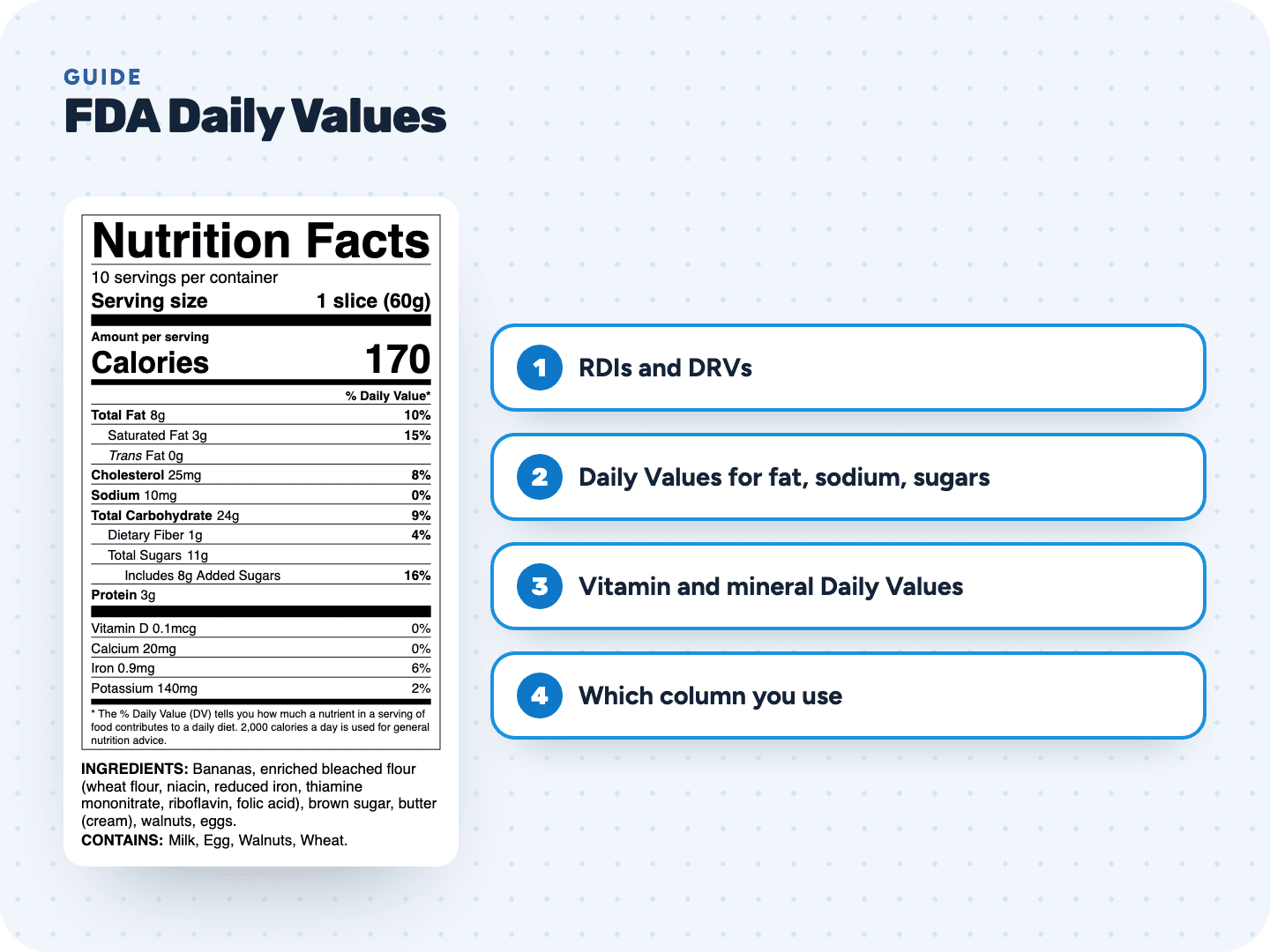
Daily Value is one word for two FDA tables
The label only says "% Daily Value", but the regulation keeps two separate lists. Vitamins and minerals have Reference Daily Intakes (RDIs). Fat, saturated fat, cholesterol, carbohydrate, sodium, fiber, protein and added sugars have Daily Reference Values (DRVs). Both sit in 21 CFR 101.9, and both come in four columns: one per group of people.
| List | Covers | Where it lives |
|---|---|---|
| Reference Daily Intakes (RDIs) | 27 vitamins and minerals, plus protein for infants and for pregnant and lactating women | 21 CFR 101.9(c)(8)(iv) |
| Daily Reference Values (DRVs) | Fat, saturated fat, cholesterol, total carbohydrate, sodium, dietary fiber, protein, added sugars | 21 CFR 101.9(c)(9) |
Daily Values for fat, carbs, sodium, fiber, protein and added sugars
| Food component | Adults and children 4+ | Infants through 12 months | Children 1 through 3 | Pregnant and lactating women |
|---|---|---|---|---|
| Fat | 78 g | 30 g | 39 g | 78 g |
| Saturated fat | 20 g | N/A | 10 g | 20 g |
| Cholesterol | 300 mg | N/A | 300 mg | 300 mg |
| Total carbohydrate | 275 g | 95 g | 150 g | 275 g |
| Sodium | 2,300 mg | N/A | 1,500 mg | 2,300 mg |
| Dietary fiber | 28 g | N/A | 14 g | 28 g |
| Protein | 50 g | N/A | 13 g | N/A |
| Added sugars | 50 g | N/A | 25 g | 50 g |
For adults, children 4 and older, and pregnant and lactating women, the values for fat, saturated fat, carbohydrate, fiber, protein and added sugars rest on a reference intake of 2,000 calories. The toddler column rests on 1,000 calories, which is why its fat, saturated fat, fiber and added sugars are half the adult figure. Trans fat and total sugars are not in the table: they have no Daily Value, so those lines never get a percentage.
Daily Values for all 27 vitamins and minerals
| Nutrient | Unit | Adults and children 4+ | Infants through 12 months | Children 1 through 3 | Pregnant and lactating women |
|---|---|---|---|---|---|
| Vitamin D | mcg | 20 | 10 | 15 | 15 |
| Calcium | mg | 1,300 | 260 | 700 | 1,300 |
| Iron | mg | 18 | 11 | 7 | 27 |
| Potassium | mg | 4,700 | 700 | 3,000 | 5,100 |
| Vitamin A | mcg RAE | 900 | 500 | 300 | 1,300 |
| Vitamin C | mg | 90 | 50 | 15 | 120 |
| Vitamin E | mg | 15 | 5 | 6 | 19 |
| Vitamin K | mcg | 120 | 2.5 | 30 | 90 |
| Thiamin | mg | 1.2 | 0.3 | 0.5 | 1.4 |
| Riboflavin | mg | 1.3 | 0.4 | 0.5 | 1.6 |
| Niacin | mg NE | 16 | 4 | 6 | 18 |
| Vitamin B6 | mg | 1.7 | 0.3 | 0.5 | 2.0 |
| Folate | mcg DFE | 400 | 80 | 150 | 600 |
| Vitamin B12 | mcg | 2.4 | 0.5 | 0.9 | 2.8 |
| Biotin | mcg | 30 | 6 | 8 | 35 |
| Pantothenic acid | mg | 5 | 1.8 | 2 | 7 |
| Phosphorus | mg | 1,250 | 275 | 460 | 1,250 |
| Iodine | mcg | 150 | 130 | 90 | 290 |
| Magnesium | mg | 420 | 75 | 80 | 400 |
| Zinc | mg | 11 | 3 | 3 | 13 |
| Selenium | mcg | 55 | 20 | 20 | 70 |
| Copper | mg | 0.9 | 0.2 | 0.3 | 1.3 |
| Manganese | mg | 2.3 | 0.6 | 1.2 | 2.6 |
| Chromium | mcg | 35 | 5.5 | 11 | 45 |
| Molybdenum | mcg | 45 | 3 | 17 | 50 |
| Chloride | mg | 2,300 | 570 | 1,500 | 2,300 |
| Choline | mg | 550 | 150 | 200 | 550 |
| Protein | g | N/A | 11 | N/A | 71 |
- The unit is part of the rule: vitamin A in mcg RAE, niacin in mg NE and folate in mcg DFE
- Vitamin D is declared in mcg. IU is optional and only in parentheses after the mcg amount
- The number of decimals in the table sets how precisely you state the amount, so zinc goes in whole milligrams and copper in tenths. Extra decimals are allowed when the amount would otherwise look like zero
- Vitamin D, calcium, iron and potassium are required on every Nutrition Facts label. Any of the others becomes required once it is added as a nutrient or named in a claim, and may be listed voluntarily when it occurs naturally
Which Daily Value column applies to your product
The column is chosen by who the food is for. Foods made specifically for infants, for children 1 through 3, or for pregnant and lactating women use their own column. Everything else, which is nearly every cookie, sauce, drink and snack a small brand sells, uses the adult column.
Our label maker uses the adults and children 4+ column for every label. Labels for foods aimed at infants or children 1 through 3, with their own Daily Values and formats, are not something our tool makes.
How to calculate percent Daily Value
The math is one line: amount per serving ÷ Daily Value × 100. The rounding is where people slip, because FDA uses two different step sizes:
| Nutrients | %DV rounding | Start from |
|---|---|---|
| Fat, saturated fat, cholesterol, sodium, carbohydrate, fiber, added sugars, protein | Nearest whole percent | The amount on the label or the exact amount, your choice |
| Vitamins and minerals, up to 10% | Nearest 2% | The amount per serving |
| Vitamins and minerals, above 10% up to 50% | Nearest 5% | The amount per serving |
| Vitamins and minerals, above 50% | Nearest 10% | The amount per serving |
Protein is the odd one out. Its %DV is optional on most foods, but required when you make a protein claim. It is not simply grams ÷ 50: you first multiply the grams by the protein's digestibility-corrected amino acid score (PDCAAS), so a lower quality protein earns a lower percentage.
Worked example: lentil soup, 1 cup
A pot of lentil soup with carrots, onion, celery, spinach, olive oil, cumin and salt, sold in a 32 oz jar. Soups have a reference amount of 245 g (21 CFR 101.12(b), Table 2), so the serving is 1 cup (245g) and the jar holds about 3.5 servings. Here is every %DV on the label, worked out by hand:
| Nutrient | Per serving | ÷ Daily Value | Exact % | On the label |
|---|---|---|---|---|
| Total fat | 3 g | 78 g | 3.8% | 4% |
| Sodium | 360 mg | 2,300 mg | 15.7% | 16% |
| Total carbohydrate | 20 g | 275 g | 7.3% | 7% |
| Dietary fiber | 4 g | 28 g | 14.3% | 14% |
| Calcium | 30 mg | 1,300 mg | 2.3% | 2% (2% steps) |
| Potassium | 280 mg | 4,700 mg | 6.0% | 6% (2% steps) |
| Iron | 2.1 mg | 18 mg | 11.7% | 10% (5% steps) |
Iron shows the trap. 11.7% looks like it should be 12%, but above 10% a mineral moves in 5% steps, so the label says 10%. Fiber at 14.3% is a nutrient with a DRV, so it simply rounds to the nearest whole percent.
The jar size matters too. A 32 oz jar holds about 370% of the reference amount, so one column is enough. A 24 oz jar of the same soup would hold about 280%, and from 200% up to 300% the label needs a second column for the whole jar.
Daily Values on a Supplement Facts panel
Supplements use the same Daily Values, but the percentages are rounded differently. Every %DV on Supplement Facts goes to the nearest whole percent, vitamins included, and the result can run far past 100%.
| Nutrition Facts | Supplement Facts | |
|---|---|---|
| Vitamin and mineral %DV | Steps of 2%, 5% or 10% | Nearest whole percent |
| Tiny amounts | A vitamin or mineral under 2% may show as 0% | "Less than 1%" or "<1%" for a listed DRV nutrient that rounds to 0% |
| Calculated from | The label amount or the exact amount (DRV nutrients) | The unrounded amount, except fat, saturated fat, cholesterol, sodium, potassium, carbohydrate and fiber may use the label amount |
| Footnotes | One footnote explaining what % Daily Value means | A symbol on fat, carbs, fiber, protein and added sugars for the 2,000 calorie line, and "Daily Value not established" for ingredients without one |
Example from our Supplement Facts mode, one capsule: vitamin D 50 mcg (2,000 IU) is 250%, vitamin B12 500 mcg is 20,833%, magnesium 100 mg is 24% and zinc 15 mg is 136%. On a Nutrition Facts label the same magnesium would read 25%, because there it rounds in 5% steps.
How our label maker applies the Daily Values
- Nutrition Facts: the adult Daily Values above, with each %DV taken from the rounded amount on the label, so anyone can check it with a calculator
- When a nutrient shows as "Less than 1g" or "Less than 5mg", the %DV comes from the exact amount instead
- Vitamin D, calcium, iron and potassium in 2%, 5% and 10% steps, exactly as 101.9(c)(8)(iii) sets out
- Supplement Facts: all 27 vitamins and minerals with their RDIs, in the order FDA sets, each %DV to the nearest whole percent, with the ** and † footnotes added for you
- The calculation report lists every nutrient with its exact amount, its rounded amount and its %DV, so a store or inspector can follow each number
Adding vitamins or minerals to a conventional food, like a fortified bar? FDA then requires those nutrients on the Nutrition Facts label too. Our Nutrition Facts labels carry the four required ones: vitamin D, calcium, iron and potassium.
Calculate your %DV free →