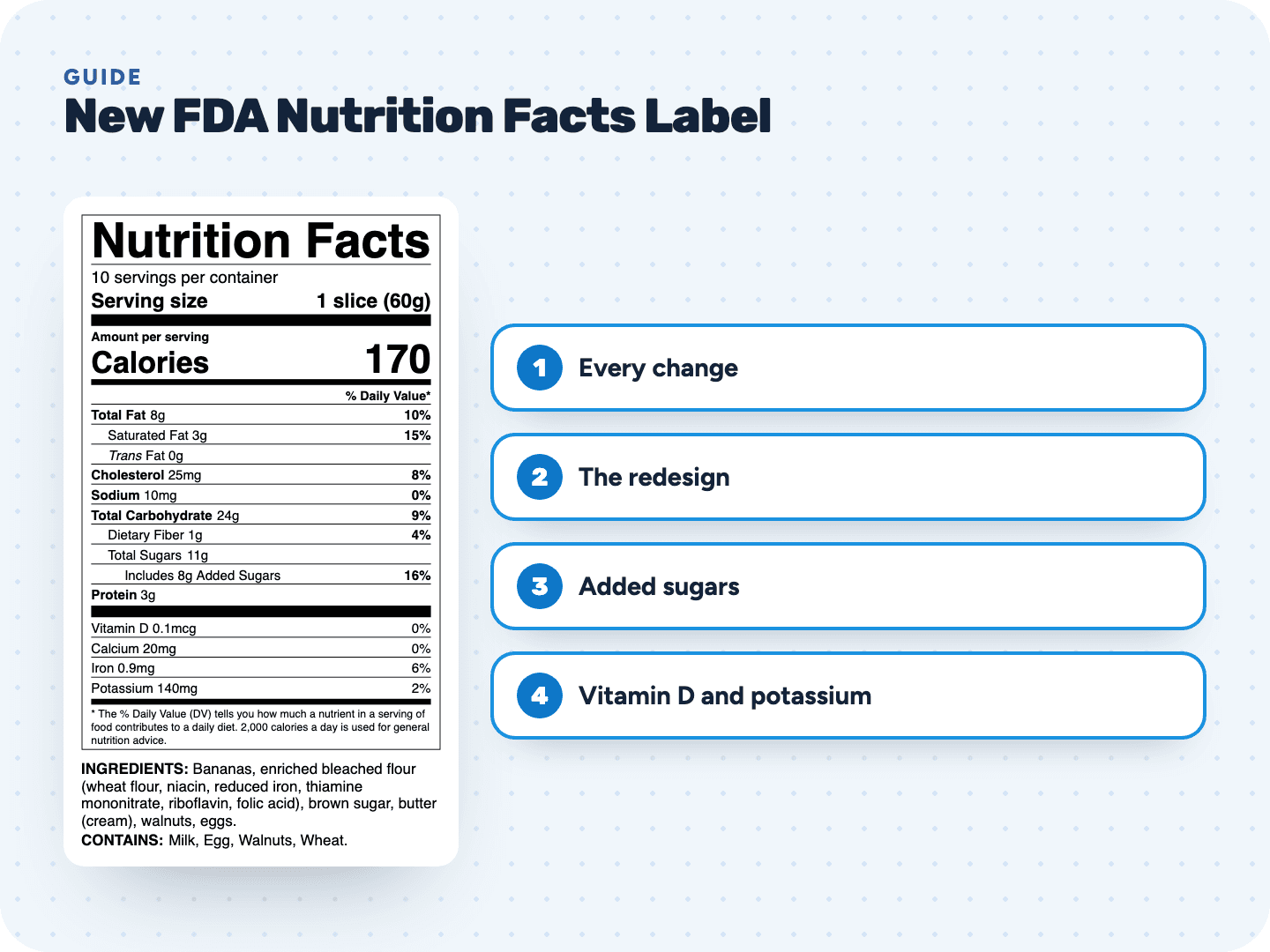
Every change at a glance
The new label keeps the familiar black-and-white box. What changed is inside it. Here is the old label next to the new one, part by part:
| Part | Old label | New label |
|---|---|---|
| Calories | Regular type, with "Calories from fat" beside it | Large, bold type; "Calories from fat" is gone |
| Serving size | Regular type | Bold, larger type |
| Servings per container | Regular type | Larger type, right under the heading |
| Sugars | One line: "Sugars" | "Total Sugars", plus "Includes 16g Added Sugars" with a % Daily Value |
| Vitamins and minerals | Vitamin A, vitamin C, calcium and iron, as a percentage only | Vitamin D, calcium, iron and potassium, in mcg or mg and as a percentage |
| Daily Values | Older values for fat, sodium, fiber, carbs and more | New values (see the table below) |
| Footnote | Based on a 2,000 calorie diet, plus a table of values for 2,000 and 2,500 calories | One short statement about what % Daily Value means |
The redesign: bigger calories, bolder serving size
On the old label, calories and servings sat in the same small type as everything else. The redesign made the numbers shoppers look for first impossible to miss:
| Line | Old minimum | New minimum |
|---|---|---|
| "Calories" | 8 point | 16 point, bold |
| The calorie number | 8 point | 22 point, bold |
| Servings per container | 8 point | 10 point |
| Serving size | 8 point | 10 point, bold |
Calories from fat was dropped because the type of fat matters more than the amount. Total fat, saturated fat and trans fat all stay. "Sugars" became "Total Sugars", with added sugars indented right below it.
Added sugars get their own line
The added sugar line on the FDA nutrition label separates the sugar you put in from the sugar the ingredients bring with them. Our banana muffin has 21 g of total sugars per muffin. The bananas and milk bring some of it; the white and brown sugar in the recipe add 16 g. So the label says: Total Sugars 21g, Includes 16g Added Sugars, 32%.
- Counts as added: table sugar, brown sugar, syrups, honey, and sugars from concentrated juice beyond what the same amount of 100% juice would have
- Doesn't count: the natural sugars in fruit, milk and other whole ingredients
- Added sugars have a Daily Value of 50 g, so they get a % Daily Value; total sugars don't
Vitamin D and potassium in, vitamins A and C out
The four required vitamins and minerals are now vitamin D, calcium, iron and potassium, in that order. Each shows the actual amount and a % Daily Value. The old label showed a percentage only.
| Our banana muffin | Amount | % Daily Value |
|---|---|---|
| Vitamin D | 0.3mcg | 0% |
| Calcium | 30mg | 2% |
| Iron | 1.5mg | 8% |
| Potassium | 200mg | 4% |
Vitamins A and C are now optional. They become required only when you add them as a nutrient or make a claim about them.
New Daily Values change your percentages
Same muffin, same grams, different percentages. Because several Daily Values moved, the % Daily Value column of an old label is wrong even when the amounts are right:
| Nutrient | Old Daily Value | New Daily Value | Muffin, old % | Muffin, new % |
|---|---|---|---|---|
| Total fat (9g) | 65 g | 78 g | 14% | 12% |
| Sodium (270mg) | 2,400 mg | 2,300 mg | 11% | 12% |
| Total carbohydrate (44g) | 300 g | 275 g | 15% | 16% |
| Dietary fiber (2g) | 25 g | 28 g | 8% | 7% |
| Added sugars (16g) | None | 50 g | Not on the label | 32% |
| Calcium (30mg) | 1,000 mg | 1,300 mg | 4% | 2% |
| Potassium (200mg) | 3,500 mg | 4,700 mg | 6% | 4% |
Saturated fat (20 g), cholesterol (300 mg), protein (50 g) and iron (18 mg) kept their Daily Values. Vitamin D moved from 400 IU to 20 mcg.
FDA Daily Values →Serving sizes that match what people eat
Serving sizes come from FDA reference amounts, and several changed to reflect how much people actually eat and drink. FDA's own examples:
| Food | Old reference amount | New reference amount |
|---|---|---|
| Ice cream | 1/2 cup | 2/3 cup |
| Soda | 8 fl oz | 12 fl oz (360 mL) |
| Yogurt | 8 oz | 6 oz (170 g) |
A bigger reference amount means bigger numbers per serving. If your product is in one of the changed categories, an old label understates calories and nutrients per serving.
Package size: one serving, or two columns
The new rules look at how much of the reference amount the whole package holds:
| Package holds | Label | FDA's examples |
|---|---|---|
| Less than 200% of the reference amount | The whole package is one serving | 20 oz soda, 15 oz can of soup |
| 200% to 300% | Two columns: per serving and per package | 24 oz soda bottle, a pint of ice cream |
Do the math for soda: the reference amount is 12 fl oz. A 20 oz bottle is 167% of it, so the label shows one serving. A 24 oz bottle is exactly 200%, so it needs both columns.
Updating an old label, step by step
Faster: type your recipe into our label maker. It uses the new format, the new Daily Values and the current reference amounts by default, and the preview is free.
A new nutritional label template
Want to fill in the numbers yourself? Our free blank template follows the new layout: fillable PDF, Word, SVG and PNG, with the current footnote and the vitamin D and potassium lines in place.
Download the blank Nutrition Facts label →