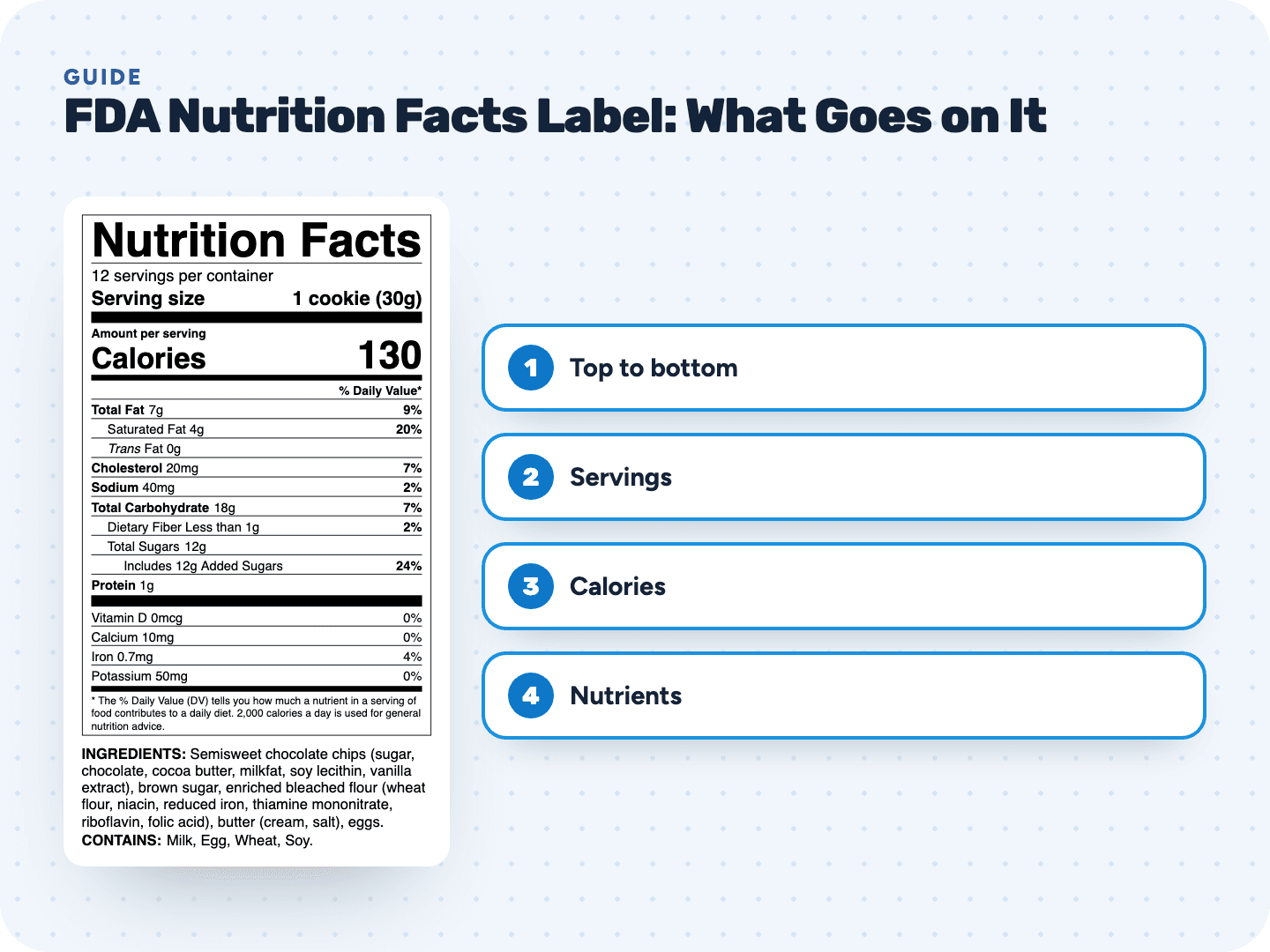
The label, top to bottom
Every Nutrition Facts panel follows the same order, so once you can read one, you can read them all. Here is a peanut butter cookie, sold 12 to a box.
- Servings: how many are in the package, and how big one is
- Calories: the energy in one serving, in the biggest number on the panel
- Nutrients: fat, cholesterol, sodium, carbohydrate, sugars, protein, then vitamin D, calcium, iron and potassium
- % Daily Value: how much one serving adds toward a day's worth
- Footnote: what % Daily Value means
Step 1: servings and serving size
The serving size reflects how much people typically eat at once. It isn't advice on how much to eat. The FDA sets a reference amount for each type of food, and your serving is built from it.
For cookies, the reference amount is 30 g. Our cookie weighs 30 g, so one serving is 1 cookie. Any piece that weighs at least 67% but less than 200% of the reference amount counts as one serving. With 12 cookies in the box, there are 12 servings per container.
Step 2: calories
Calories are usually worked out from the nutrients: 4 calories per gram of protein and carbohydrate, 9 per gram of fat. The FDA says to use the actual amounts, before any rounding.
Our cookie: 2.9 g protein × 4 + 15.8 g carbohydrate × 4 + 7.9 g fat × 9 = 145.9 calories by that rule. The FDA also accepts the food-specific calorie factors behind USDA's data, and those are what our label maker adds up per ingredient: 140.8 calories. Above 50 calories, the label rounds to the nearest 10, so the label says 140.
Step 3: the nutrients, from recipe to label
The FDA groups the nutrients in two. Get less of saturated fat, sodium and added sugars. Get more of dietary fiber, vitamin D, calcium, iron and potassium. Here is how the cookie's raw numbers become label numbers:
| Nutrient | From the recipe | On the label | Why |
|---|---|---|---|
| Total fat | 7.9 g | 8g | 5 g or more: nearest gram |
| Saturated fat | 2.9 g | 3g | Under 5 g: nearest 0.5 g |
| Trans fat | 0.01 g | 0g | Under 0.5 g: zero |
| Cholesterol | 14.7 mg | 15mg | Nearest 5 mg |
| Sodium | 94 mg | 95mg | 5 to 140 mg: nearest 5 mg |
| Dietary fiber | 0.6 g | Less than 1g | From 0.5 g to under 1 g |
| Added sugars | 8.9 g | 9g | Nearest gram |
| Iron | 0.5 mg | 0.5mg | Milligrams, with a decimal for small amounts |
Step 4: % Daily Value
The % Daily Value compares one serving to a full day's amount. The FDA's rule of thumb: 5% or less is low, 20% or more is high. The cookie's 18% for added sugars is close to high; its 2% for fiber is low.
| Nutrient | Daily Value |
|---|---|
| Total fat | 78 g |
| Saturated fat | 20 g |
| Cholesterol | 300 mg |
| Sodium | 2,300 mg |
| Total carbohydrate | 275 g |
| Dietary fiber | 28 g |
| Added sugars | 50 g |
| Protein | 50 g |
| Vitamin D | 20 mcg |
| Calcium | 1,300 mg |
| Iron | 18 mg |
| Potassium | 4,700 mg |
Total sugars have no Daily Value, so that line never shows a percentage. For vitamins and minerals the percentage rounds in steps of 2% up to 10%, so the cookie's iron (2.8%) shows as 2%.
Step 5: the footnote
At the bottom, the standard footnote reads: The % Daily Value (DV) tells you how much a nutrient in a serving of food contributes to a daily diet. 2,000 calories a day is used for general nutrition advice.
It's the same on almost every package. Leave it out and the label is incomplete.
One column or two
Package size decides the layout, measured against the reference amount for your food:
| Package holds | Label shows |
|---|---|
| Less than 200% of the reference amount | The whole package as one serving |
| 200% to 300% | Two columns: per serving and per package |
| More than 300% | Per serving, with servings per container |
Mistakes beginners make
- Picking a serving size that makes the numbers look better, instead of the FDA reference amount
- Rounding each ingredient first and adding the rounded numbers. Add the actual amounts, then round once
- Forgetting that honey, maple syrup and other sweeteners in a recipe count as added sugars
- Putting a % Daily Value next to total sugars
- Dropping lines that come out to zero. Core nutrients stay on the label as 0g or 0mg
Make yours from a recipe
- Type your recipe in cups, spoons, ounces or grams
- Confirm each ingredient's match to USDA FoodData Central data, or add the values from your supplier's label
- Pick your serving size with help from the FDA reference amounts
- Get the rounded label, % Daily Values and allergens, free to preview
- Download a print-ready PDF, SVG or PNG for $29 per label