What the FDA Food Labeling Guide is
It is FDA's summary of the statements that must appear on food labels, written as the questions food makers ask most, each with a short answer and the regulation behind it.
- It's free on fda.gov
- It's nonbinding: it shows FDA's current thinking, and you may use another approach that meets the law
- FDA does not pre-approve food labels, guide or no guide
- FDA says it's the food industry's job to keep up with the labeling rules
Which parts are out of date
FDA flags two chapters as under revision. Both still read fine as background, but the current rules are elsewhere:
| Topic in the guide | Why it's dated | Use instead |
|---|---|---|
| Food allergen labeling | Written before sesame became a major allergen and before the tree nut list changed | FDA Allergen Q&A, Edition 5, and 21 U.S.C. 343(w) |
| Nutrition labeling | Predates the current Nutrition Facts label, with added sugars and new Daily Values | 21 CFR 101.9 as it reads today |
Step 1: the name and the net weight
The guide starts on the front of the package, and so should you. We'll build a real label as we go: lemon poppy seed muffins, sold four to a pack.
- Name: "Lemon poppy seed muffins", in bold on the front
- Net quantity: "Net Wt 12 oz", near the bottom of the front panel
Step 2: the ingredient list
List by weight, heaviest first. Break out ingredients that have their own ingredients. Small amounts can go at the end:
Ingredients: Wheat flour, sugar, eggs, buttermilk, canola oil, lemon juice. Contains 2% or less of: poppy seeds, baking powder (sodium acid pyrophosphate, sodium bicarbonate, cornstarch, monocalcium phosphate), lemon zest, salt.
Step 3: allergens
"Wheat flour", "eggs" and "buttermilk" already name wheat, eggs and milk, so the list alone would comply. We add a Contains line anyway, because shoppers look for it. Once you add one, it must name all of them:
Contains: wheat, eggs, milk.
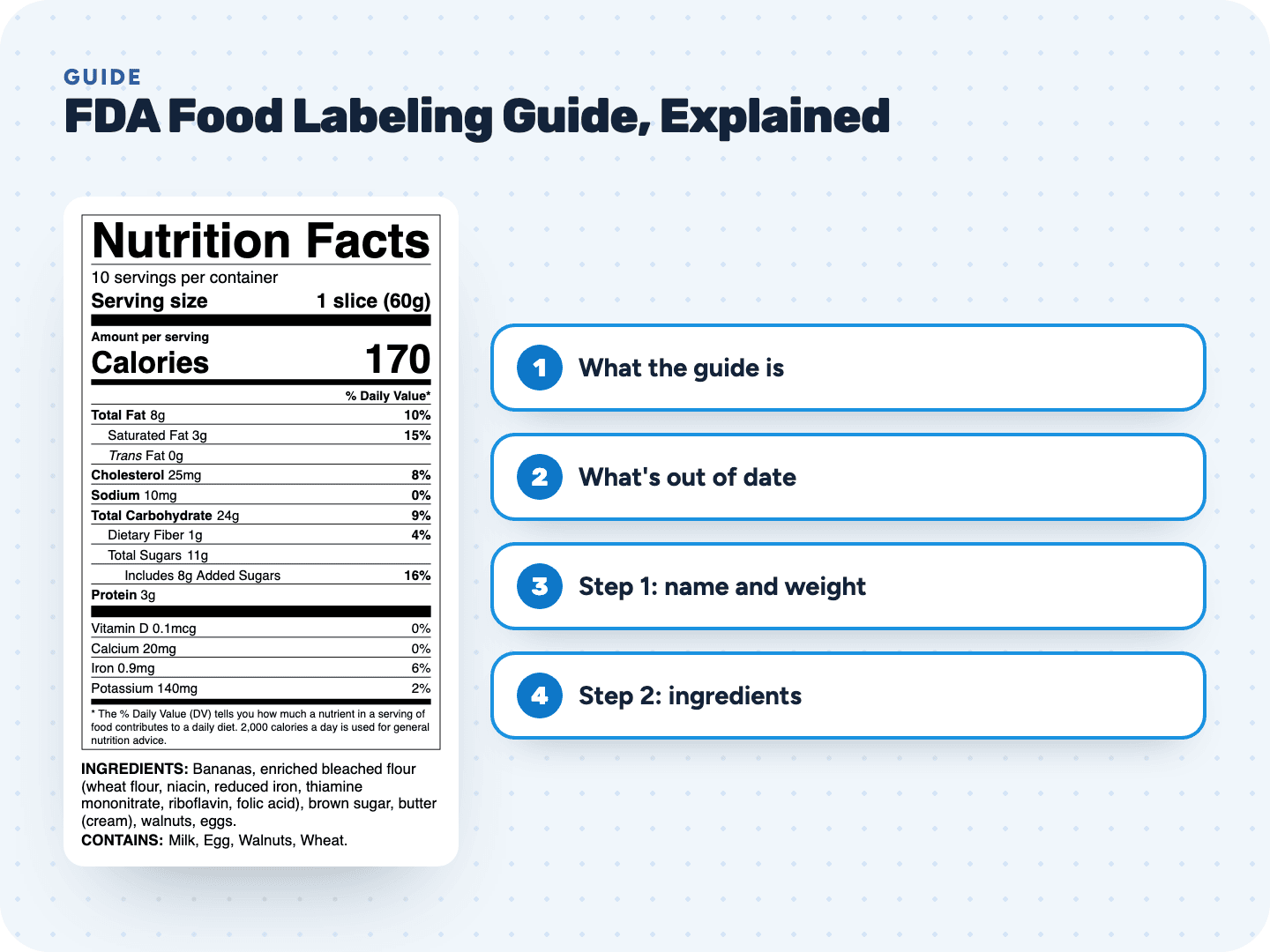
Step 4: Nutrition Facts
Here the guide is out of date, so go to the regulation. For a muffin, the work is: find the reference amount for its category, decide the serving, total the nutrients from the recipe, then round.
- Serving size from the FDA reference amounts in 21 CFR 101.12
- Calories and 14 nutrients, rounded by the rules in 21 CFR 101.9(c)
- The current format, with added sugars and the updated footnote
Step 5: claims, only if you make them
The guide's claims section matters the moment you print words like "low fat", "high fiber" or "good source of calcium". Each has a definition you must meet.
| Claim type | Example | Rules |
|---|---|---|
| Nutrient content claim | "Low sodium", "Good source of fiber" | 21 CFR 101.13 and Subpart D |
| Health claim | Calcium, vitamin D and osteoporosis | 21 CFR 101.14 and Subpart E |
| Structure/function (supplements) | "Supports healthy bones" | 21 CFR 101.93 |
One more reason to be careful: a nutrition claim cancels the small business exemption from Nutrition Facts.
Step 6: who made it
Finish with your business name and address. If a co-packer bakes the muffins for you, write "Distributed by" or "Manufactured for" before your name.
Co-Packer →What the guide doesn't cover
- Organic claims: USDA's National Organic Program, 7 CFR Part 205
- Meat, poultry and processed egg products: USDA's Food Safety and Inspection Service
- Home-kitchen food sold under a cottage food law: your state
How to use the guide well
That last step is where our calculation report helps: it lists your recipe, the USDA source for each ingredient and how every number was rounded, ready for a store, co-packer or inspector.