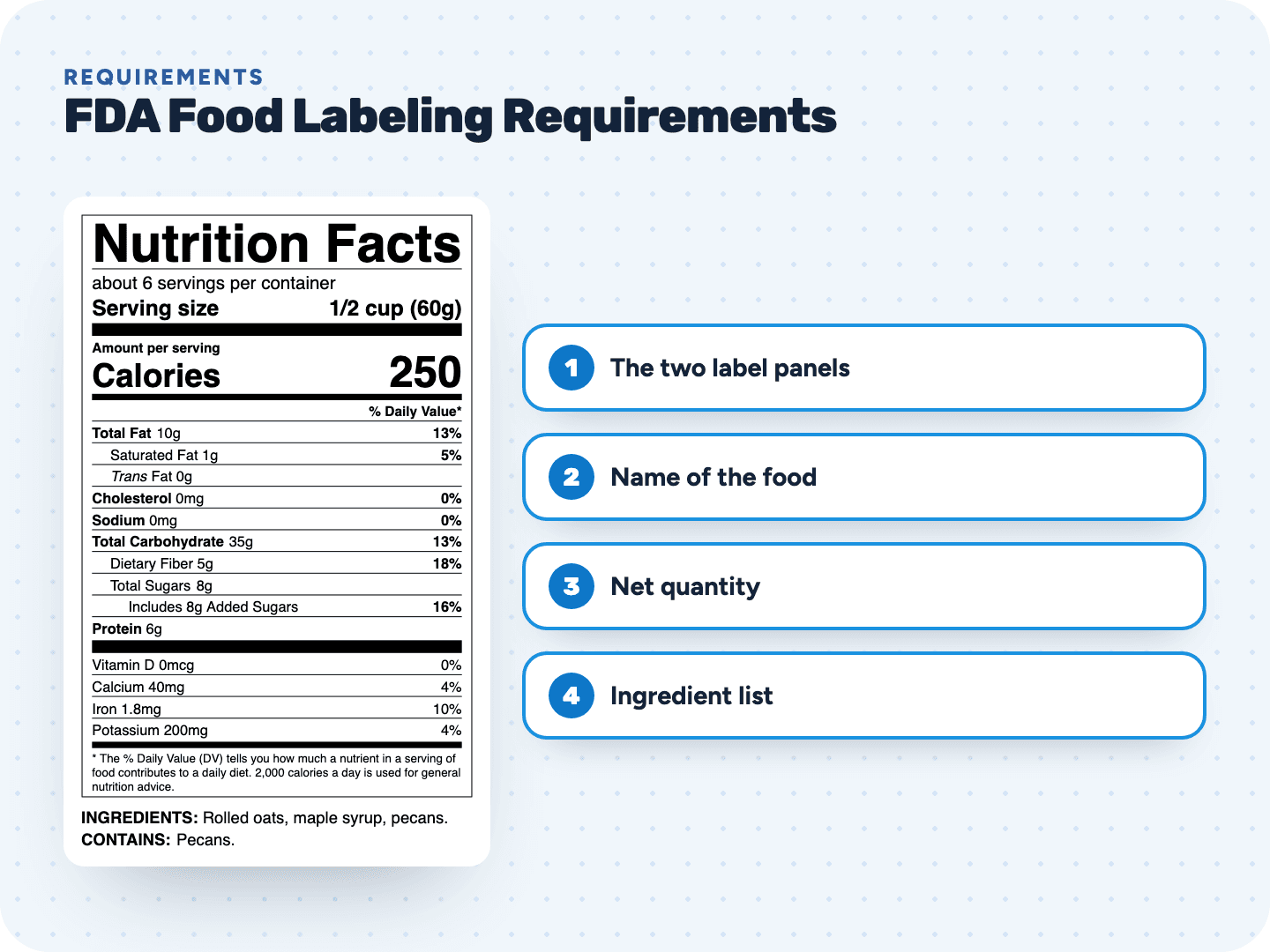
The two panels that matter
FDA rules talk about two areas of your package. Get these right first, because every other rule points back to them.
- Principal display panel: the part of the label shoppers are most likely to see on the shelf, usually the front
- Information panel: the panel right next to it, on its right as you face the front
- If that right-hand panel is unusable (a folded flap, a can end), the next panel to the right takes its place
- Everything required goes on one of these two panels, in letters at least 1/16 inch tall
Name of the food (statement of identity)
The front of the package must say what the food is. Use the name set by a federal rule if there is one. If not, use the common or usual name, like "Strawberry jam". If there is none, use a clear descriptive name.
- On the front panel, in bold type
- In a size that relates to the biggest text on that panel
- Parallel to the base of the package as it sits on the shelf
- Include the form if it comes in several, like "sliced", "diced" or "whole", unless the shopper can see it
- A copy of another food that is nutritionally inferior must say "imitation"
Net quantity of contents
State how much food is in the package, by weight for solids and thick foods, by fluid measure for liquids. Use ounces, and add pounds in parentheses from 1 pound up: "Net Wt 20 oz (1 lb 4 oz) 567 g", with the metric amount the Fair Packaging and Labeling Act asks for. Weight needs the words "net weight" or "Net wt."
- On the front panel, in the bottom 30% of it (not required if the panel is 5 sq in or smaller)
- Bold and easy to read, with clear space around it
- No words that inflate the amount, like "jumbo quart" or "full gallon"
- Wrappers and packaging don't count toward the weight
| Front panel area | Minimum letter height |
|---|---|
| 5 sq in or less | 1/16 inch |
| Over 5 to 25 sq in | 1/8 inch |
| Over 25 to 100 sq in | 3/16 inch |
| Over 100 to 400 sq in | 1/4 inch |
| Over 400 sq in | 1/2 inch |
Ingredient list
Any food made from two or more ingredients needs an ingredient list. A single-ingredient food, like pure honey, doesn't.
- Every ingredient by its common or usual name, from most to least by weight
- Ingredients that have their own ingredients show them in parentheses, like "chocolate chips (sugar, chocolate, cocoa butter, soy lecithin)"
- Ingredients at 2% or less may go at the end after a phrase like "Contains 2% or less of"
- Use specific names, not group names, except for spices, flavorings and some colors
Major food allergens
If the food contains milk, eggs, fish, crustacean shellfish, tree nuts, peanuts, wheat, soybeans or sesame, the label must say so. Name the allergen in the ingredient list, like "whey (milk)", or add a "Contains" line right after the list in the same type size.
Nutrition Facts panel
Most packaged food needs a Nutrition Facts panel on the front or the information panel. Small businesses can be exempt, but only while the label, labeling and ads make no nutrition claim at all.
- Retail exemption: you sell direct to consumers and have no more than $500,000 in total sales or $50,000 in food sales a year
- Low-volume exemption: fewer than 100 full-time equivalent employees and fewer than 100,000 units of that product sold in the US a year, with a notice to the FDA
- No notice needed under 10 full-time equivalent employees and under 10,000 units a year (importers excepted)
- One claim like "low fat" or "good source of fiber" cancels the exemption
Name and place of business
The label must name the manufacturer, packer or distributor and say where they are. Shoppers and inspectors use it to reach you.
- A company uses its actual corporate name; a person or partnership uses the name the business runs under
- If someone else makes the food for you, qualify your name: "Manufactured for", "Distributed by" or similar
- Street address, city, state and ZIP code
- The street address may be left out if it is listed in a current city or phone directory