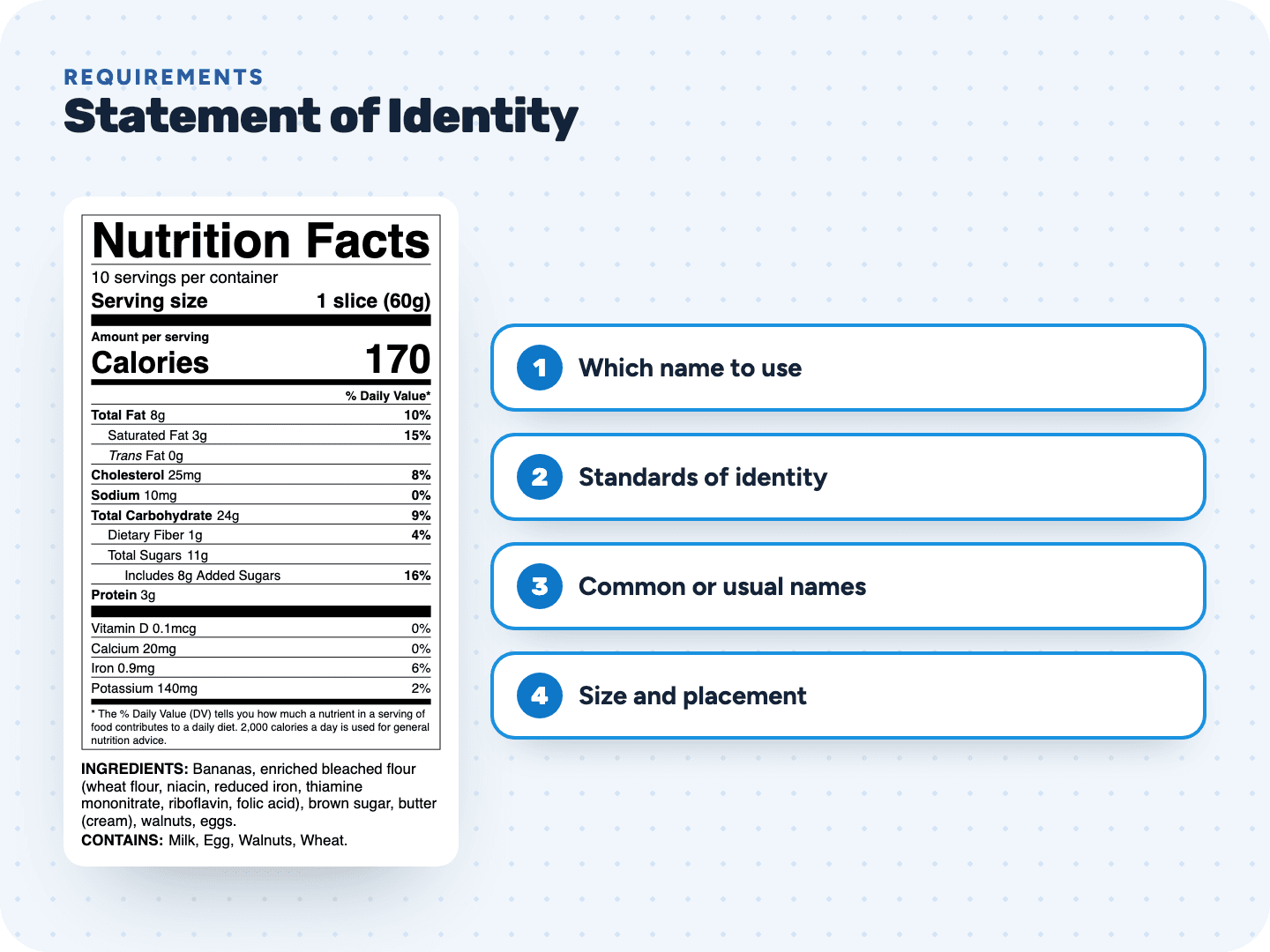
Which name to use: the order FDA sets
| Step | Use this name | Example |
|---|---|---|
| 1 | The name a federal law or regulation specifies for the food (a standard of identity) | "Mayonnaise", "Vanilla extract", "Milk chocolate" |
| 2 | If there is no such name: the common or usual name of the food | "Banana bread", "Granola", "Hot sauce" |
| 3 | If there is no common name: an appropriately descriptive term, or a fanciful name commonly used by the public when the nature of the food is obvious | "Toasted coconut date bites" |
You only move down a step when the step above has no answer. A food that has a common or usual name must use it; FDA considers it misleading to give a food with an established name a new one.
Standardized foods: the name is fixed
FDA's food standards fill 21 CFR parts 130 to 169, from milk and cream to food dressings and flavorings. If your product falls under one, the name in the standard is the statement of identity, and the standard spells out what the food must be to carry that name. Calling a spread "jam" or a sauce "mayonnaise" means checking the standard first.
| Standardized name | Where the standard is |
|---|---|
| Fruit preserves and jams | 21 CFR 150.160 |
| Milk chocolate | 21 CFR 163.130 |
| Mayonnaise | 21 CFR 169.140 |
| Vanilla extract | 21 CFR 169.175 |
A food that complies with every requirement of the standard that names it is not an imitation.
Writing a good common or usual name
Most small-batch foods are not standardized, so the common or usual name does the work. FDA's general principle: the name should identify or describe the basic nature of the food, or its characterizing properties or ingredients, as simply and directly as possible.
- Use the same name the rest of the market uses for the same food
- Do not pick a name that could be confused with a different food
- Name the characterizing ingredient when it defines the food: "Pumpkin bread", not just "Bread"
- If the amount of a characterizing ingredient affects the price or what buyers expect, the name may have to state its percentage
How to print it: bold, big enough, level
- On the principal display panel, and on every alternate principal display panel
- In bold type
- In a size reasonably related to the most prominent printed matter on that panel
- In lines generally parallel to the base the package rests on as displayed
The regulation gives no fixed letter height. FDA's Food Labeling Guide puts a number on it: "Generally, this is considered to be at least 1/2 the size of the largest print on the label." So if your brand name is 1 inch tall, a product name around 1/2 inch tall stays within that guidance.
The same guide says brand names are not statements of identity and should not be unduly prominent compared to the product name. A huge logo with a tiny product name is the classic mistake.
Sliced, diced or whole: the form is part of the name
When a food is sold in different forms, the form belongs in the statement of identity: "Sliced almonds", "Diced mango", "Whole cashews". Print the form in letters of a reasonably similar size to the rest of the name.
The exception: if shoppers can see the form through the package, or the label shows it with an appropriate picture, you may leave the form out of the name. A clear bag of whole cashews already tells them.
Flavor names: natural, flavored or artificial
Once the label names or pictures a flavor, that flavor becomes the characterizing flavor, and its name goes with the name of the food on the principal display panel in letters no shorter than half the height of the food name. Which words you add depends on where the flavor comes from:
| What gives the flavor | How it is named | The regulation's own example |
|---|---|---|
| No artificial flavor (the general rule) | The flavor name | "vanilla" |
| Natural flavor from the ingredient, but too little of the ingredient itself (or none) for a food people expect it in | Flavor name followed by "flavored", optionally preceded by "natural" | "strawberry flavored shortcake" |
| Any artificial flavor that simulates or reinforces it | "artificial" or "artificially flavored" with the flavor name | "artificially flavored strawberry" |
Our tool does not check flavor names or any other claim on your front panel. Get the flavor wording right before the artwork goes to print.
When the word "imitation" is required
A food that substitutes for and resembles another food, but is nutritionally inferior to it, is an imitation. Its label must say "imitation" followed right away by the name of the food it imitates, in type of the same size and prominence.
- Nutritionally inferior means less of an essential nutrient that the original has in a measurable amount: 2% or more of the Daily Value of protein, potassium or a vitamin or mineral per reference amount
- Less fat or fewer calories does not count as inferior, as long as the food carries Nutrition Facts and any calorie reduction follows FDA's rules for it
- A look-alike that is not nutritionally inferior can skip "imitation" if it uses an honest common or usual name or descriptive term
Statement of identity for dietary supplements
A dietary supplement must say "dietary supplement" as part of its statement of identity. You may replace the word "dietary" with the dietary ingredients, or with a descriptive term for their type. The regulation's examples:
- Dietary supplement
- Calcium supplement
- Herbal supplement with vitamins