Weight, fluid measure or count?
| The food is | Declare it by | Example |
|---|---|---|
| Solid, like cookies, granola or fudge | Weight | Net Wt 8 oz (227 g) |
| Semisolid or viscous, like peanut butter or honey | Weight | Net Wt 12 oz (340 g) |
| A mix of solid and liquid, like salsa or beans in water | Weight | Net Wt 16 oz (1 lb) 454 g |
| Liquid, like cold brew or lemonade | Fluid measure | 12 fl oz (355 mL) |
| Fresh fruit or vegetables customarily sold by dry measure | Dry measure is allowed | 1 dry pint |
| Units where a count alone says too little | Count plus weight or size | 12 cookies, Net Wt 9 oz (255 g) |
Two exceptions keep this from being purely mechanical. Where there is a firmly established consumer usage and trade custom of declaring a liquid by weight, or a solid by fluid measure, that custom may be used. And pickles and pickle products, including relishes, are always declared by liquid measure, except one or two whole pickles in a clear plastic bag, which may be declared by count.
Ounces, pounds and metric: the dual declaration
| Package holds | How to write it | Rule |
|---|---|---|
| Under 1 lb | Net Wt 8 oz (227 g) | Ounces only, plus metric |
| 1 lb up to under 4 lb | Net Wt 28 oz (1 lb 12 oz) 794 g | Ounces first, then pounds and ounces (or decimal pounds) in parentheses |
| 4 lb or more | Net Wt 4 lb (1.81 kg) | Pounds, with any remainder in ounces or fractions of a pound |
| Under 1 gal of liquid | Net 32 fl oz (1 qt) 946 mL | Fluid ounces first; from 1 pint, the largest whole units in parentheses |
| 1 gal or more of liquid | Net contents 2.5 gallons (9.46 L) | Gallons, with any remainder in smaller units |
The metric amount comes from the Fair Packaging and Labeling Act, which asks for the most appropriate units of both the inch/pound system and the SI metric system. FDA's regulation treats the metric statement as allowed on the front panel, and FDA's Food Labeling Guide says labels must show both, in either order, before or after or above or below the U.S. units. Foods packaged at the retail store level are exempt from the metric part.
Heads up, two of FDA's own documents format pound amounts differently. The regulation's example is "Net Wt. 24 oz (1 lb 8 oz)", ounces first. FDA's Food Labeling Guide also shows "Net wt 1 lb 8 oz (680g)". Our examples follow the regulation.
Wording: "Net Wt", "fl oz" and allowed abbreviations
- For weight, the term "net weight" is required. The regulation's examples: "Net wt. 6 oz" or "6 oz Net wt."
- For liquids and counts, "net" or "net contents" is optional: "6 fl oz" is enough
- Ounce of weight and fluid ounce are told apart by the words with them, so write "fl oz" for liquids
- The declaration may run over more than one line
- Fractions: halves, quarters, eighths, sixteenths or thirty-seconds, reduced to lowest terms. Decimals go to two places at most
- No words that make the amount sound bigger, like "jumbo quart" or "full gallon"
| Word | Only abbreviation allowed |
|---|---|
| weight | wt |
| ounce | oz |
| pound | lb |
| gallon | gal |
| pint | pt |
| quart | qt |
| fluid | fl |
Periods and plural forms are optional.
Where it goes and how much space it needs
- On the principal display panel, and repeated on every alternate principal display panel
- As a distinct item within the bottom 30% of the panel, in lines generally parallel to the base
- Clear space above and below at least equal to the height of its letters
- Clear space left and right at least twice the width of the letter "N" in the type you use
- Bold, easy to read, and in clear contrast to everything else on the package
Tiny labels get one break: when the whole principal display panel measures 5 square inches or smaller, the declaration can sit anywhere on it, provided every other net quantity rule is met. A supplemental net quantity statement may appear elsewhere on the package, but it may not use exaggerating terms either.
Minimum type size by panel area
The letter height depends on the area of your principal display panel. Measure capital letters if you type in all caps; with lowercase letters, measure the lowercase "o". In a fraction, each number must be at least half the minimum height.
| Principal display panel area | Printed letters at least | Embossed or molded at least |
|---|---|---|
| 5 sq in (32 sq cm) or less | 1/16 inch (1.6 mm) | 1/8 inch |
| Over 5 to 25 sq in (161 sq cm) | 1/8 inch (3.2 mm) | 3/16 inch |
| Over 25 to 100 sq in (645 sq cm) | 3/16 inch (4.8 mm) | 1/4 inch |
| Over 100 to 400 sq in (2580 sq cm) | 1/4 inch (6.4 mm) | 5/16 inch |
| Over 400 sq in | 1/2 inch (12.7 mm) | 9/16 inch |
The embossed column applies when the declaration is blown, embossed or molded into glass or plastic instead of printed: add 1/16 inch to each minimum. Letters also may not be more than 3 times as high as they are wide, so very condensed fonts are out.
What counts in the net weight
Only the food. Leave out the container, the lid, wrappers and anything else packed with it. FDA's guide describes the method: subtract the average weight of the empty container, lid and wrappers from the average weight of the filled package.
- Water or another liquid added to the food in the container is usually included in the net weight
- Where the packing liquid is normally thrown away, as with olives or mushrooms, the drained weight is given
- Whipped cream and other foods in pressurized cans: declare what comes out when used as directed, and the propellant counts
- Liquids are measured at a set temperature: at the frozen temperature for frozen food sold and eaten frozen, 40 °F (4 °C) for refrigerated food, and 68 °F (20 °C) for everything else
Accuracy matters. FDA allows reasonable variations from moisture loss or gain in good distribution practice and from unavoidable deviations in good manufacturing practice, but variations from the stated quantity may not be unreasonably large. A declaration with small fractions of an ounce allows smaller variations than one without.
Multipacks and random-weight packages
A multiunit retail package holds two or more identical, individually labeled units, like four bars in a sleeve. Its outside label states the number of units, the quantity of each, and the total in ounces or fluid ounces in parentheses, for example 4 bars of 1.5 oz each with a total of 6 oz. An open multipack where shoppers can see the units and read each label does not need this.
Random-weight packages are packs of the same food with varying weights, like cut cheese or fudge slabs weighed one by one. Over 1 pound, the label may give pounds with decimals; at 1 pound or less, decimal pounds may replace ounces. Here the texts differ: FDA's regulation allows two decimal places, while the Fair Packaging and Labeling Act allows up to three and makes the metric statement optional for random packages.
Your net weight and your Nutrition Facts
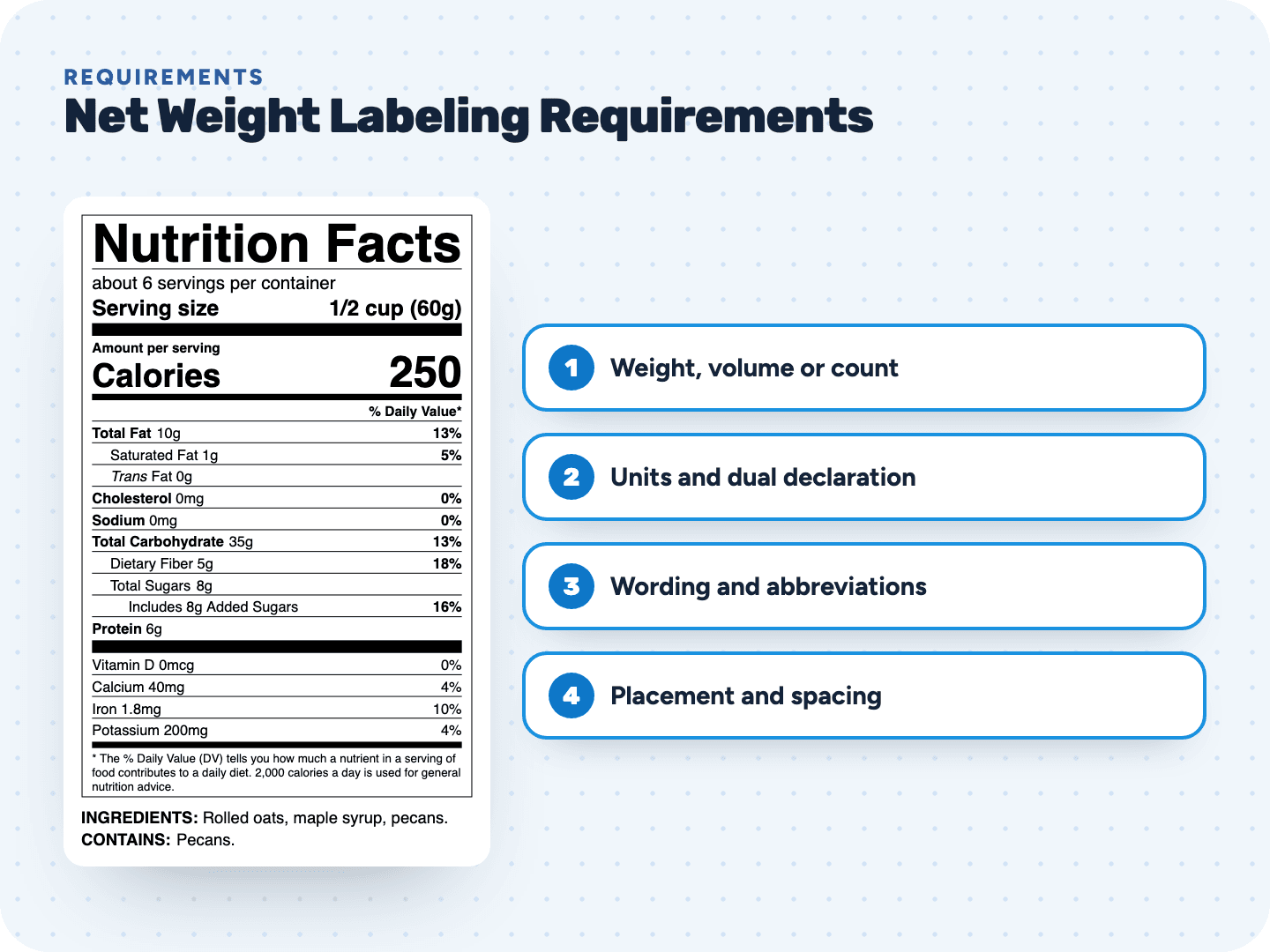
Your net weight feeds straight into the Nutrition Facts panel. Type your net weight into "one package holds", in ounces or grams, and our tool works out servings per container from your serving size. Change the bag size, and the panel follows.
Start a label →The net weight line itself belongs on your front panel artwork. Our free ingredient label and cottage food label templates come with a Net Wt field, so a simple one-label package can carry the name, net weight, ingredients and your address together.
Ingredient Label Template →