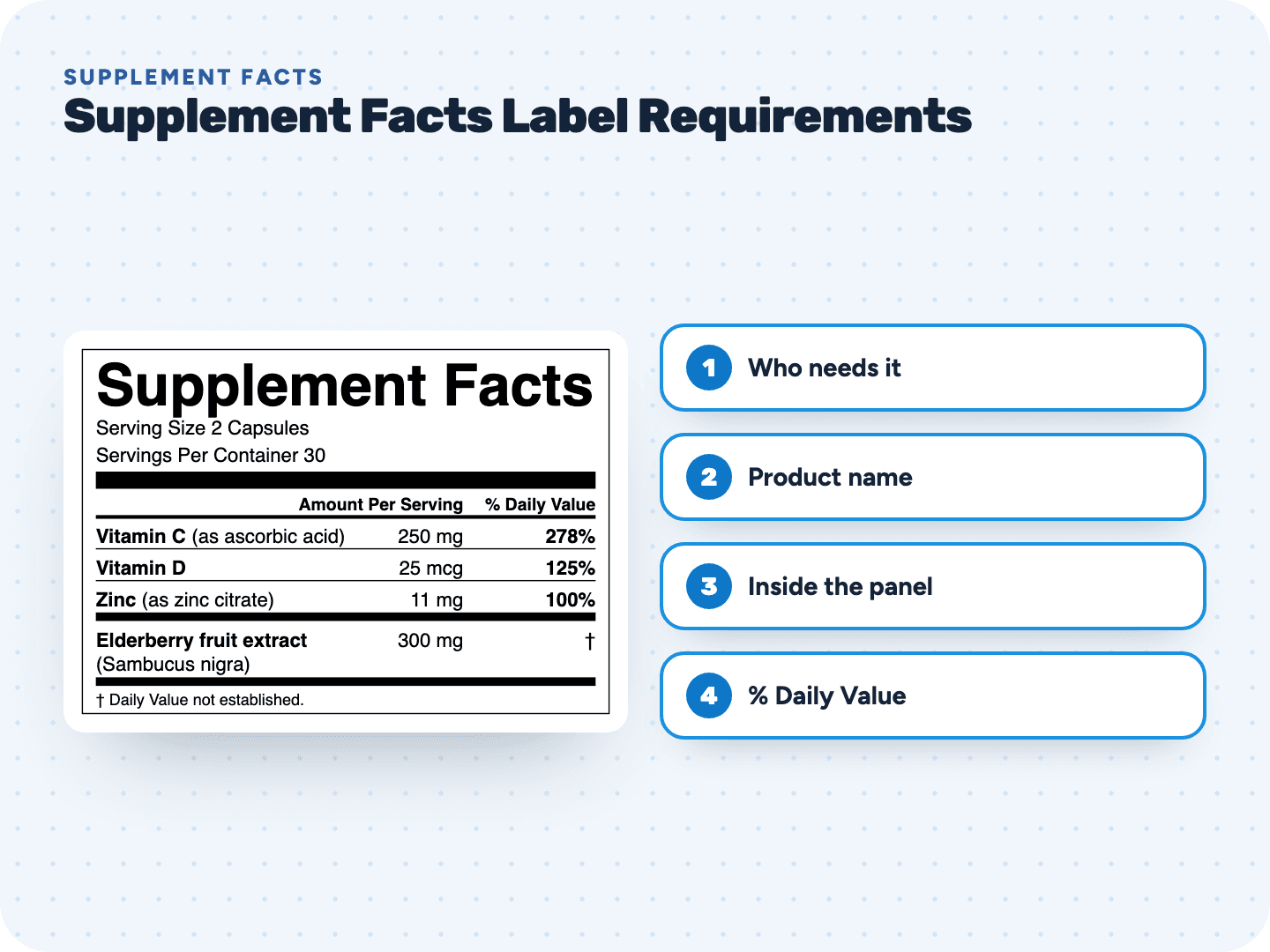
Who needs a Supplement Facts panel
Every dietary supplement offered for sale, unless it fits an exemption. The exemptions are the same small business ones that apply to food, and they disappear as soon as the label makes a nutrition claim.
- Retailers selling direct to consumers with no more than $500,000 in total sales or $50,000 in food sales a year
- Low-volume products from small companies that have filed the required notice with the FDA (the smallest firms may not need one)
- Bulk shipments meant only for making or repacking other supplements
The name: "dietary supplement"
The statement of identity must include the words "dietary supplement". You may replace "dietary" with the ingredient or the type of product.
Statement of Identity →- "Vitamin D3 dietary supplement"
- "Calcium supplement"
- "Herbal supplement with vitamins"
What goes inside the panel
- Serving Size, in a unit that fits the form: "1 capsule", "2 tablets", "1 packet"
- Servings Per Container, unless the net quantity already states it
- A heading like "Amount Per Serving", or "Each Tablet Contains"
- Nutrients with a Daily Value, like vitamin C or calcium, in the FDA's set order
- Only nutrients actually present: amounts that would round to zero are left off
- The weight of the nutrient itself, not its source: the calcium, not the calcium carbonate
You may name the source in parentheses, like "Calcium (as calcium carbonate)". Then it doesn't need repeating in the ingredient list.
% Daily Value and the footnotes
- Rounded to the nearest whole percent
- For nutrients with a DRV, use "Less than 1%" or "<1%" when the amount must be listed but rounds to 0%
- A symbol after the %DV of fat, saturated fat, carbohydrate, fiber, protein or added sugars leads to "Percent Daily Values are based on a 2,000 calorie diet."
- Ingredients without a Daily Value get a symbol that leads to "Daily Value not established."
Botanicals, blends and other ingredients
Dietary ingredients without a Daily Value, like ashwagandha root extract or fish oil, go below the heavy bar. List each by its common name with its weight per serving in metric units. Botanicals name the part of the plant used.
A proprietary blend gets its own name, like "Energy Blend", with the total weight of the blend. The ingredients inside are listed under it from most to least by weight. Their individual amounts are not required.
Below the panel, an ingredient list starts with "Ingredients", or "Other ingredients" when sources are already named inside the panel. It covers everything else: capsule shell, fillers, binders, colors, flavors and sweeteners.
Format and how it differs from Nutrition Facts
- "Supplement Facts" is the largest type in the panel, full width where practical
- The panel is boxed with hairlines; one easy-to-read type style; black or one color on a light background
- At least 8 point type, with 6 point allowed for column headings and footnotes
- Hairlines between ingredients and heavy bars in set places
| Nutrition Facts | Supplement Facts | |
|---|---|---|
| Nutrients at zero | Core nutrients listed, even at "0g" | Left off |
| Ingredients with no Daily Value | Not allowed in the panel | Listed below the heavy bar |
| Serving size unit | Household measure, like cups or pieces | Tablets, capsules, packets, teaspoonfuls |
Structure/function claims and allergens
A claim like "supports healthy bones" needs this disclaimer, in bold type at least 1/16 inch tall, next to the claim or linked to it with a symbol:
"This statement has not been evaluated by the Food and Drug Administration. This product is not intended to diagnose, treat, cure, or prevent any disease."
FDA Supplement Disclaimer →- Notify the FDA no later than 30 days after you first market a product with such a statement
- A disease claim turns the product into a drug in FDA's eyes, unless it is an authorized health claim
- Major allergens can be declared in the Supplement Facts panel or the ingredient list; a Contains line is optional, but must list all of them if used