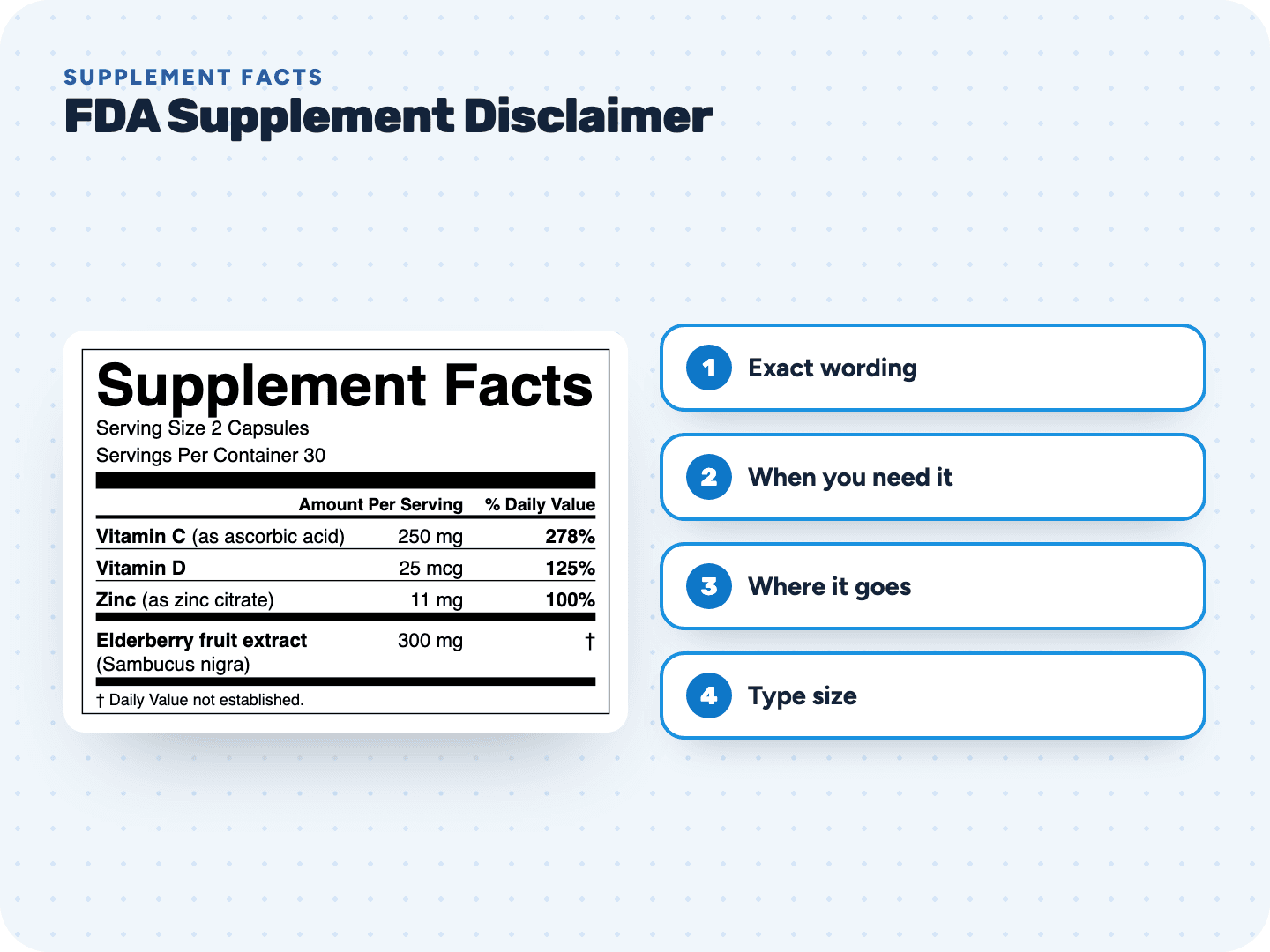
The exact wording: singular and plural
There are two versions, and both are set word for word in the regulation. Use the first for one claim:
"This statement has not been evaluated by the Food and Drug Administration. This product is not intended to diagnose, treat, cure, or prevent any disease."
When the label or labeling has more than one claim, you can either give each claim its own singular disclaimer, or use one plural disclaimer for all of them:
"These statements have not been evaluated by the Food and Drug Administration. This product is not intended to diagnose, treat, cure, or prevent any disease."
FDA's Dietary Supplement Labeling Guide is blunt about edits: "You may not modify the wording of these disclaimers." So no shortening, no "FDA has not evaluated this", no swapping "product" for your brand name.
When the disclaimer is required, and when it isn't
The disclaimer is tied to one group of claims: the ones section 403(r)(6) of the FD&C Act allows on supplements. Other label claims follow their own rules.
| What's on the label | Disclaimer? |
|---|---|
| A structure/function claim, like "fiber maintains bowel regularity" | Yes |
| A general well-being claim | Yes |
| A benefit tied to a classical nutrient deficiency disease, like vitamin C and scurvy | Yes |
| A nutrient content claim, like "high in vitamin C" | No, it has its own rules |
| An authorized health claim about reducing the risk of a disease | No, it has its own rules |
| No claim at all, just the name and the Supplement Facts panel | No |
| A structure/function claim on a regular food, not a supplement | No |
Where the disclaimer goes
You get two options, and the second one comes with a box:
| Option | How it works |
|---|---|
| Right next to the claim | Directly adjacent to the statement, with nothing in between |
| Linked by a symbol | End each claim with a symbol, like an asterisk. Put the same symbol next to the disclaimer, and set the disclaimer off in a box |
- Every panel with a claim needs its own disclaimer. A claim on the front and one on the side means the disclaimer on both
- The same goes for labeling beyond the bottle: the regulation names pamphlets and catalogs, page by page
Bold, and at least 1/16 inch
The regulation asks for boldface type in letters no smaller than one-sixteenth of an inch. The statute adds that the disclaimer must be prominently displayed. Those are the only size rules, so a disclaimer can be larger.
Point sizes in design software don't map neatly onto letter height, so check a printed proof with a ruler rather than trusting the font menu. Small bottles are where this goes wrong: a two-sentence statement at 1/16 inch takes real space, so plan for it before the artwork is final.
What the disclaimer doesn't do
- It doesn't make a disease claim acceptable. FDA gives "reduces the pain and stiffness associated with arthritis" as a disease claim; adding a disclaimer doesn't change that, and a product making it is regulated as a drug
- It doesn't replace proof. You need substantiation that the claim is truthful and not misleading before you use it
- It doesn't replace the notice to FDA, which has a 30-day deadline counted from the day the product first goes on the market with the claim
Three label lines people mix up
| Line | What it is | Where it goes |
|---|---|---|
| The FDA supplement disclaimer | Required with each structure/function claim | Next to the claim, or boxed and linked by a symbol |
| "† Daily Value not established." | A footnote for ingredients without a Daily Value | Inside the Supplement Facts box, at the bottom |
| "Percent Daily Values are based on a 2,000 calorie diet." | A footnote for fat, carbohydrate, fiber, protein and similar | Inside the Supplement Facts box, when those are listed |
What our tool prints, and what you add
Our Supplement Facts mode makes the panel, the Other ingredients line and the Contains line for allergens, with both footnotes when they apply. It does not print the FDA supplement disclaimer and it does not review your claims. The disclaimer belongs next to your claims, which live on your front or side panel, so you or your designer place it there.