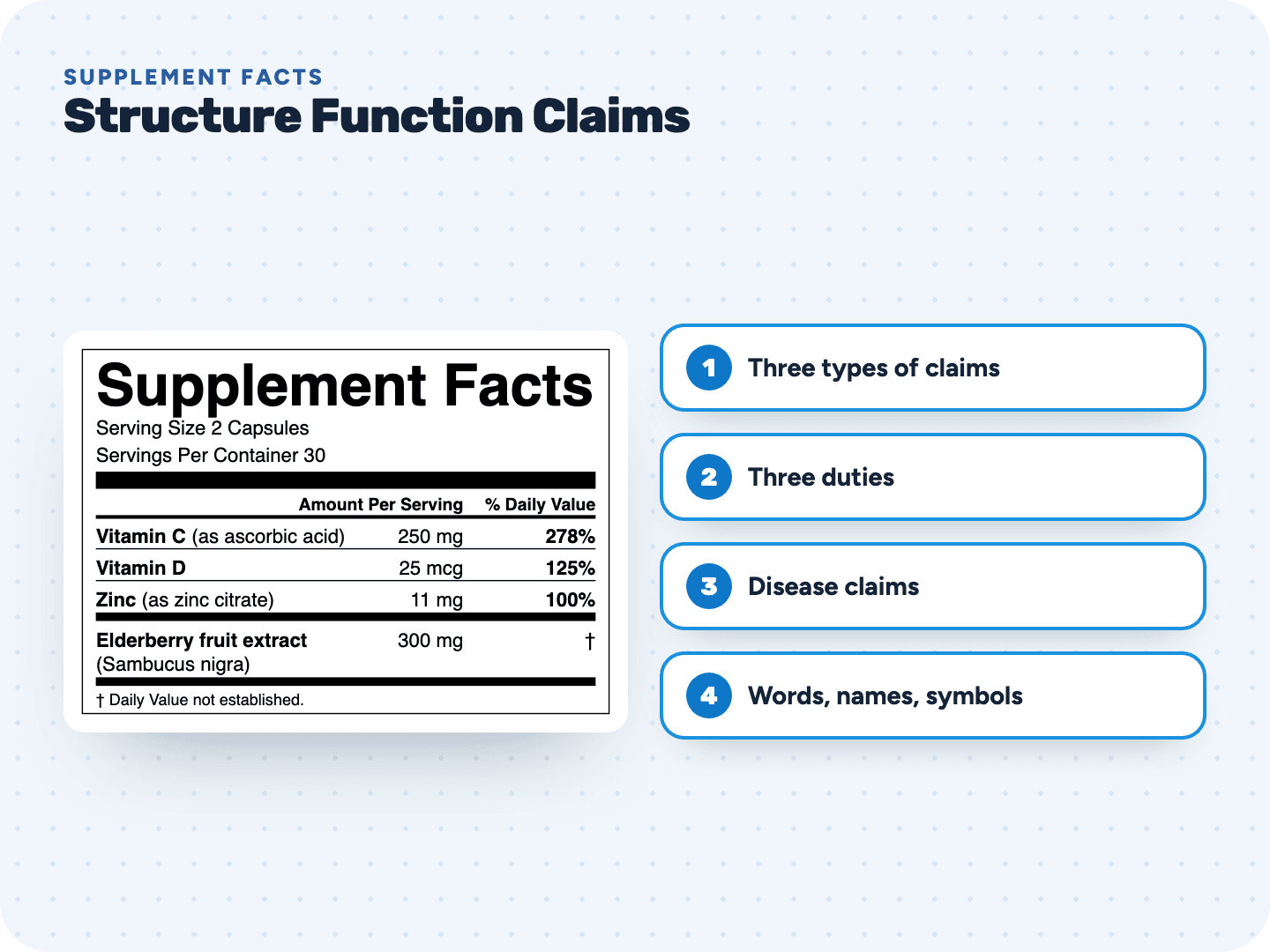
The three claims section 403(r)(6) allows
The Dietary Supplement Health and Education Act of 1994 (DSHEA) added section 403(r)(6) to the FD&C Act. It covers three kinds of statements, and all three follow the same rules.
| Type | What the law says it does | FDA's examples |
|---|---|---|
| Structure/function | "describes the role of a nutrient or dietary ingredient intended to affect the structure or function in humans" or "characterizes the documented mechanism" by which it maintains that structure or function | "calcium builds strong bones", "fiber maintains bowel regularity", "antioxidants maintain cell integrity" |
| General well-being | "describes general well-being from consumption of a nutrient or dietary ingredient" | None given |
| Nutrient deficiency disease | "claims a benefit related to a classical nutrient deficiency disease and discloses the prevalence of such disease in the United States" | Vitamin C and scurvy |
That last one is the only place a supplement may name a disease, and only a classical deficiency disease. The claim must also say how common the disease is in the United States.
Three things you must do for every claim
| Duty | What it means |
|---|---|
| Substantiation | Before the claim goes on a label, hold evidence showing it is truthful and not misleading |
| Disclaimer | Print the FDA disclaimer, in bold, with the claim: "This statement has not been evaluated by the Food and Drug Administration. This product is not intended to diagnose, treat, cure, or prevent any disease." |
| Notification | Send FDA a notice within 30 days of the supplement first going on the market with the claim |
None of the three is an approval. FDA does not pre-approve structure function claims, and it says that a reply to your notification, or no reply, is not a statement that the product meets other legal requirements.
Structure function claim or disease claim?
This line matters more than any other. FDA defines a disease as damage to an organ, part, structure or system of the body so that it doesn't function properly, or a state of health leading to that. A claim that a product diagnoses, mitigates, treats, cures or prevents a disease, said outright or implied, turns the supplement into a drug under FDA rules. The one way out is an authorized health claim that the product meets.
21 CFR 101.93(g) lists ten criteria. FDA's small entity compliance guide gives examples on both sides:
| Criterion | Acceptable, per FDA | Disease claim, per FDA |
|---|---|---|
| 1. Effect on a disease | "protective against the development of cancer"; "relieves crushing chest pain (angina)" | |
| 2. Signs or symptoms of a disease | "maintain cholesterol levels that are already in the normal range" | "reduces cholesterol"; "inhibits platelet aggregation" |
| 3. Conditions of a natural state, like aging | "mild memory loss associated with aging"; "noncystic acne" | "cystic acne"; "severe depression associated with the menstrual cycle" |
| 4. Name, formulation, citations, pictures | Pictures of healthy organs | "CircuCure"; the heart symbol; EKG tracings |
| 5. Product class | "diuretic that relieves temporary water-weight gain" | Analgesics, antibiotics, antidepressants, antivirals, vaccines |
| 6. Substitute for a therapy | Claiming to replace a drug that treats a disease | |
| 7. Augments a therapy | Nutritional support that doesn't imply disease | Naming a specific drug or therapy it boosts |
| 8. Body's response to disease | "supports the immune system" | "supports the body's antiviral capabilities" |
| 9. Side effects of a therapy | Making up for a nutrient a drug depletes | "to maintain the intestinal flora in people on antibiotics" |
| 10. Anything else suggesting a disease effect | Decided on wording and context |
Words, product names and symbols
- No magic words. FDA says "support", "maintain", "promote" or "regulate" can still imply a disease claim, depending on context
- A product name counts as a claim. A name that contains a disease, or part of one, or a word like cure, treat or prevent, is a disease claim
- Context decides borderline names: a sleep-themed name can read as an insomnia claim unless the label makes clear it's about occasional sleeplessness
- Saying the product contains an ingredient well known as a drug, like aspirin, implies a disease claim
- A picture of a healthy organ is fine; a picture of diseased tissue is an implied disease claim
- The "Rx" symbol or the word "prescription" misbrands the product when the label as a whole suggests it is a prescription drug
How to notify FDA
The deadline is 30 days, counted from the first time the supplement is marketed with the claim. FDA takes it through its online portal, the Centralized Online Submission Module (COSM), and also accepts written submissions. The notice includes:
- The name and address of the manufacturer, packer or distributor
- The exact text of the claim
- The dietary ingredient or supplement the claim is about, if the text doesn't already say
- The name of every product that carries the claim, brand name included
- A signature from someone who certifies that the notice is complete and accurate, and that the firm has substantiation
Using the same claim on several products or brands? List each one by name. FDA says a generic phrase like "for other brands/other products" is not permitted.
FDA says review generally takes up to a month. If it objects, it usually sends a "courtesy letter". If it doesn't object, it generally doesn't reply at all. Notifications and courtesy letters are posted in public dockets on regulations.gov, so competitors can read your claim text.
Structure function claims on regular foods
Regular foods can make structure function claims too, with two differences. The claim has to come from the food's nutritive value, while a supplement may also claim non-nutritive effects. And a food maker doesn't notify FDA or print a disclaimer.
FDA expects to draw the line between structure/function and disease claims in a similar way for both. A cereal can talk about what its fiber does for regularity, but it can't say it treats a disease.
Where our label maker fits
Your claims live on the front and side panels. Our tool builds the regulated part: the Supplement Facts panel with your vitamins, botanicals and blends, the Other ingredients line and the allergen Contains line. It does not write, check or approve claims, and it does not add the disclaimer. Settle your claim wording, put the disclaimer next to it in your artwork, and send the notice to FDA.
Start a label →