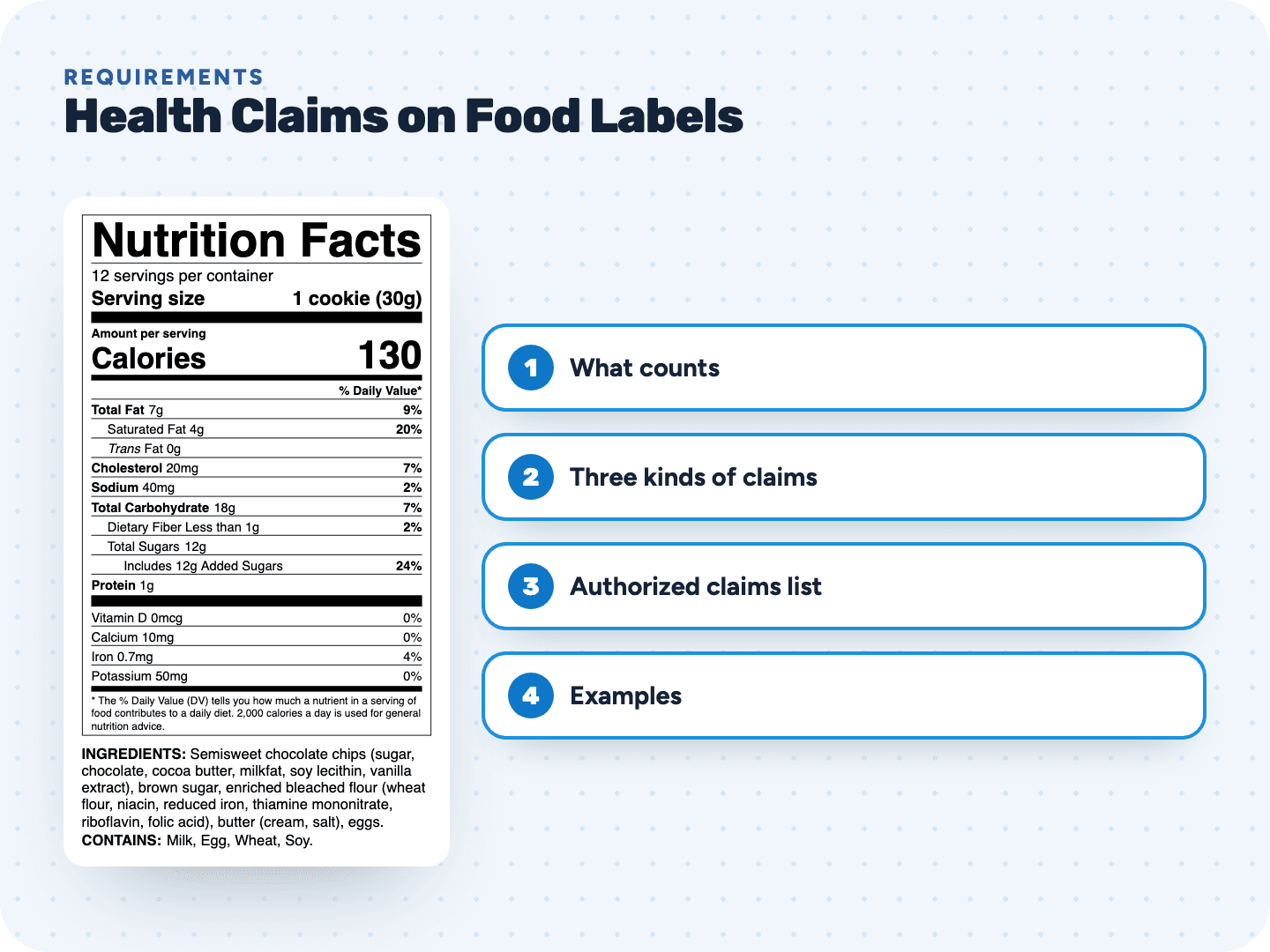
What counts as a health claim
A health claim has two parts: a substance (a food, a food component or a dietary ingredient) and a disease or health-related condition. Drop either part and it is something else, like dietary guidance or a structure/function claim.
The claim does not have to be spelled out. FDA counts implied claims too, and names the forms they take:
- A brand name with a word like "heart" in it
- A heart symbol or another symbol that suggests a health benefit
- References to third parties
- Vignettes: pictures or scenes that suggest the link
Authorized, authoritative statement and qualified health claims
| Kind | How it is allowed | Evidence behind it |
|---|---|---|
| Authorized (NLEA) | An FDA regulation in 21 CFR 101.72 to 101.83 sets the claim and its conditions | Significant scientific agreement among qualified experts |
| Authoritative statement (FDAMA) | A firm notifies FDA; the claim may be used 120 days later unless FDA says the notification is incomplete. Not available for dietary supplements | An authoritative statement of the National Academy of Sciences or a federal scientific body |
| Qualified | FDA issues a letter of enforcement discretion with the exact qualifying language; any product meeting the letter's conditions may use it | Credible but limited evidence, below significant scientific agreement |
Health claim examples in FDA's own words
Most authorized claims come with model wording you can use as is. Two examples:
Qualified health claims carry a sentence that tells shoppers the evidence is limited. For yogurt and type 2 diabetes, FDA said it intends to consider enforcement discretion for this wording:
FDA's list of qualified health claims covers topics such as cancer, cardiovascular disease, cognitive function, diabetes, hypertension, neural tube defects, peanut allergy and urinary tract infection. Each letter sets its own wording and the foods it applies to, so read the letter for your claim.
Conditions every health claim must meet
| Food type | Disqualified above (fat, sat fat, cholesterol, sodium) | Measured |
|---|---|---|
| Most foods | 13.0 g, 4.0 g, 60 mg, 480 mg | Per reference amount, per serving, and per 50 g for small reference amounts |
| Main dish products | 19.5 g, 6.0 g, 90 mg, 720 mg | Per labeled serving |
| Meal products | 26.0 g, 8.0 g, 120 mg, 960 mg | Per labeled serving |
- The food naturally provides at least 10% of the Daily Value of vitamin A, vitamin C, iron, calcium, protein or fiber per reference amount, before any nutrients are added (dietary supplements and some specific claims excepted)
- All required parts of the claim appear together, with nothing in between
- A heart symbol or other graphic claim has the full claim, or a reference statement, right next to it
- The label does not present the food as made for infants and toddlers under 2, unless the claim's regulation allows it
- A Nutrition Facts panel is on the label, and the small business exemption from it no longer applies
Short on space on the front? The principal display panel may carry a reference statement instead, with the blanks filled in, and the full claim elsewhere on the label or labeling. FDA's example:
Worked check: can a low sodium salsa carry the sodium claim?
The sodium and high blood pressure claim needs a food that qualifies as "low sodium". On our nutrient content claims page, a fresh salsa with 3/4 tsp salt per batch reaches that: 70 mg per 2 tbsp (36 g) and 95 mg per 50 g. Now the general conditions:
| Condition | Our salsa | Result |
|---|---|---|
| Low sodium (140 mg per reference amount and per 50 g) | 70 mg and 95 mg | Meets it |
| Disqualifying levels | 0 g fat, 0 mg cholesterol, 70 mg sodium | Under all four |
| 10% Daily Value of protein, fiber, calcium or iron | 0 g protein, 0% fiber, 0% calcium, 0% iron | Not from these |
| 10% Daily Value of vitamin A or vitamin C | Not on a Nutrition Facts panel | Needs another source |
So the claim rests on vitamin A or vitamin C. Our labels don't calculate those two, so you would need lab results or another reliable data source before printing the claim.
Dietary guidance and structure/function claims
| Statement type | Example | Premarket review by FDA? |
|---|---|---|
| Health claim | Calcium and osteoporosis | Yes, in one of the three forms above |
| Dietary guidance | A general category of foods, like fruits and vegetables, and good health | No, but it must be truthful and not misleading |
| Structure/function | "Calcium builds strong bones" | No |
On conventional foods, structure/function claims must come from the food's nutritive value, and no FDA notification or disclaimer is needed. Dietary supplements follow a separate set of rules for the same kind of claim.
Where our tool fits
Every health claim needs a correct Nutrition Facts panel, and the claim conditions are checked against its numbers. Nutrition Label Studio makes that panel from your recipe and shows each value before and after FDA rounding. It does not check or write health claims: the claim wording goes on your artwork, and the conditions are yours to confirm.
Make the Nutrition Facts panel from your recipe →