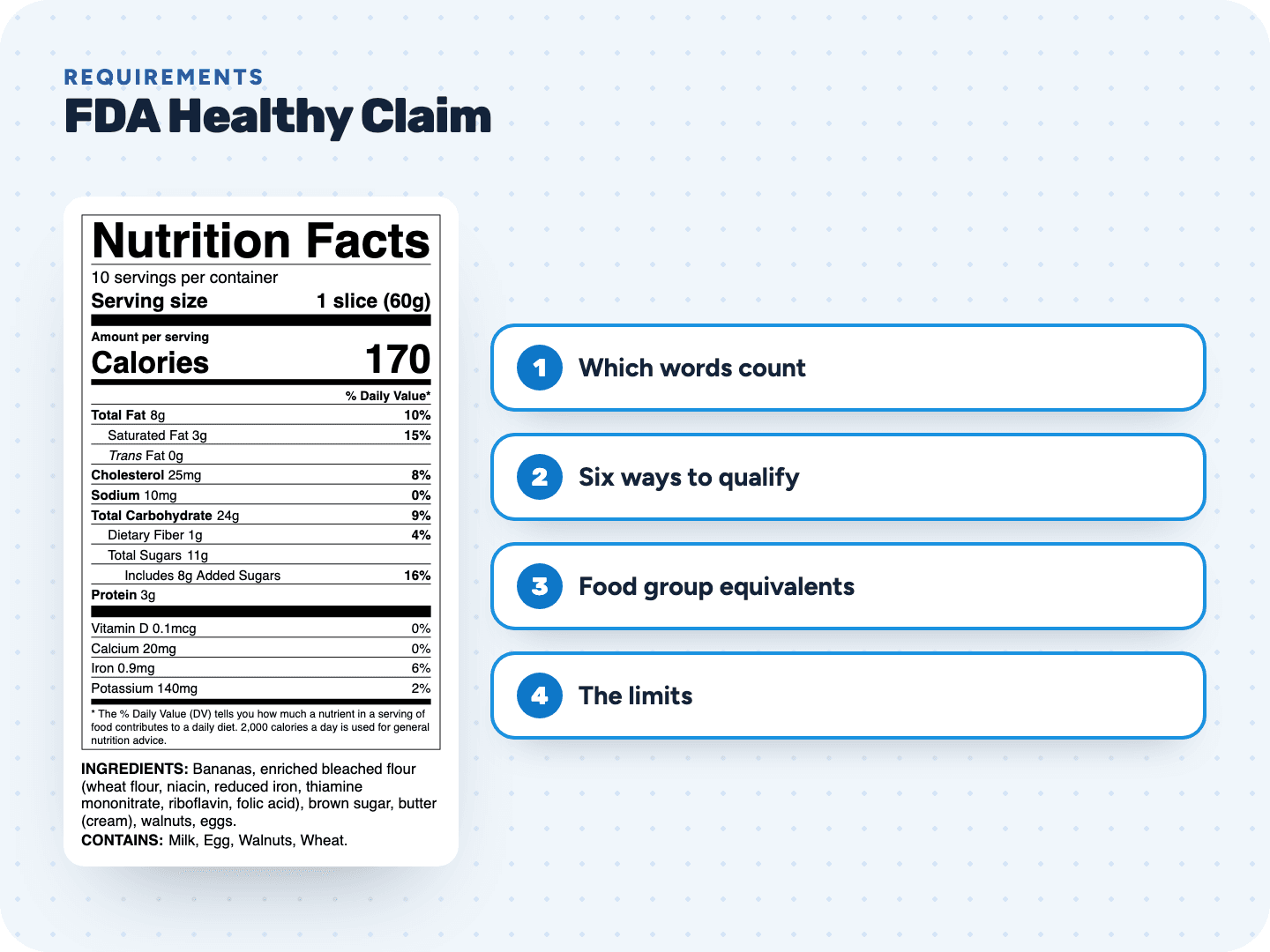
Which words count as the "healthy" claim
The rule covers "healthy" and its derivatives when they suggest the food helps build a diet that matches dietary recommendations. "Healthier" on a front panel follows the same definition as "healthy".
Six ways a food can qualify
| Path | Who it is for | Checked |
|---|---|---|
| Foundation foods | Foods made only of vegetables, fruit, whole grains, fat-free or low-fat dairy, lean meat, seafood, eggs, beans, peas, lentils, nuts or seeds, with nothing added except water | Qualifies as is |
| Individual food, larger reference amount | One food group, reference amount over 50 g or over 3 tbsp | Per reference amount |
| Individual food, small reference amount | One food group, reference amount of 50 g or less, or 3 tbsp or less | Per 50 g of food |
| Mixed product | At least 1 food group equivalent in total, with at least 1/4 from two groups | Per reference amount |
| Main dish | At least 2 food group equivalents, with at least 1/2 from two groups | Per labeled serving |
| Meal | At least 3 food group equivalents, with at least 1/2 from three groups | Per labeled serving |
| Water, tea and coffee | Less than 5 calories | Per reference amount and per serving |
How much food is one food group equivalent
| Food group | 1 food group equivalent | FDA's examples |
|---|---|---|
| Vegetable | 1/2 cup equivalent | 1/2 cup cooked green beans; 1 cup raw spinach |
| Fruit | 1/2 cup equivalent | 1/2 cup strawberries; 1/2 cup 100% orange juice; 1/4 cup raisins |
| Grains | 3/4 oz equivalent whole grain | 1 slice of bread; 1/2 cup cooked brown rice |
| Dairy | 2/3 cup equivalent | 2/3 cup fat free milk; 1 oz nonfat cheese |
| Game meat | 1 1/2 oz equivalent | 1 1/2 oz venison |
| Seafood | 1 oz equivalent | 1 oz tuna |
| Egg | 1 oz equivalent | 1 large egg |
| Beans, peas, lentils | 1 oz equivalent | 1/4 cup black beans |
| Nuts, seeds, soy products | 1 oz equivalent | 1/2 oz walnuts |
Limits for added sugars, sodium and saturated fat
| Individual food | Must contain at least | Added sugars at most | Sodium at most | Saturated fat at most |
|---|---|---|---|---|
| Vegetable product | 1/2 cup eq. vegetable | 2% DV | 10% DV | 5% DV |
| Fruit product | 1/2 cup eq. fruit | 2% DV | 10% DV | 5% DV |
| Grain product | 3/4 oz eq. whole grain | 10% DV | 10% DV | 5% DV |
| Dairy product | 2/3 cup eq. dairy | 5% DV | 10% DV | 10% DV |
| Game meat | 1 1/2 oz eq. | 2% DV | 10% DV | 10% DV |
| Seafood | 1 oz eq. | 2% DV | 10% DV | 5% DV, not counting fat inherent in seafood |
| Egg | 1 oz eq. | 2% DV | 10% DV | 10% DV |
| Beans, peas, lentils | 1 oz eq. | 2% DV | 10% DV | 5% DV |
| Nuts, seeds, soy products | 1 oz eq. | 2% DV | 10% DV | 5% DV, not counting fat inherent in nuts, seeds and soybeans |
| 100% oil | None | 0% DV | 0% DV | 20% of total fat |
| Oil-based spread (fat only from oil) | None | 0% DV | 10% DV | 20% of total fat |
| Oil-based dressing (at least 30% oil) | None | 2% DV | 10% DV | 20% of total fat |
FDA's own conversions: 2% DV of added sugars is 1 g, 5% is 2.5 g and 10% is 5 g. 10% DV of sodium is 230 mg. 5% DV of saturated fat is 1 g and 10% is 2 g.
| Combination food | Added sugars at most | Sodium at most | Saturated fat at most |
|---|---|---|---|
| Mixed product (per reference amount) | 10% DV | 15% DV | 10% DV |
| Main dish (per labeled serving) | 15% DV | 20% DV | 15% DV |
| Meal (per labeled serving) | 20% DV | 30% DV | 20% DV |
For the three combination foods, saturated fat that is inherent in seafood, nuts, seeds and soybeans does not count toward the limit.
Example: the same oats, two different answers
Both recipes start with 3 cups rolled oats, 1/2 cup almonds and 1/2 cup raisins. Breakfast cereal that weighs 43 g or more per cup has a 60 g reference amount, so we used a 60 g serving.
| Recipe | Path | Added sugars per 60 g | Healthy? |
|---|---|---|---|
| Muesli: oats, almonds, raisins, nothing else | Foundation foods: whole grain, nuts and fruit with nothing added | 0 g (0% DV) | Yes, without checking limits |
| Granola: the same plus 1/4 cup brown sugar, 1/4 cup canola oil, 1/2 tsp salt | Mixed product or grain product: limits apply | 6 g (12% DV) | No: added sugars are over 10% DV |
| Granola with 2 tbsp brown sugar instead | Same | 3 g (6% DV) | Passes the added sugars limit |
The lighter granola still has two more checks. Sodium is 150 mg (7% DV), under both the grain limit of 10% and the mixed product limit of 15%. Saturated fat shows as 1 g (5% DV), which is right at the 5% grain product limit, so look at the unrounded value in the calculation report before you decide. The serving must also hold the food group equivalents, and your recipe records have to show that.
What the update changed
The earlier definition limited total fat, saturated fat, cholesterol and sodium, and asked for 10% DV or more of one or more of these: vitamin A, vitamin C, calcium, iron, protein, fiber. The updated one swaps that for food groups plus limits on added sugars, sodium and saturated fat.
| Now qualifies, per FDA | No longer qualifies, per FDA |
|---|---|
| Water | Fortified white bread |
| Avocados | Highly sweetened yogurt |
| Nuts and seeds | Highly sweetened cereal |
| Higher fat fish, such as salmon | |
| Olive oil |
Old or new definition: which one applies to your label
eCFR now shows only the updated criteria. But FDA gave manufacturers a compliance period of three years from the rule's effective date, and said it will not enforce the new criteria before that compliance date. Until then, a label may follow either definition. Compliance is judged by the date the label is put on the product.
One FDA page still lags behind: its general overview of label claims describes "healthy" in terms of total fat, saturated fat, cholesterol and sodium, which is the earlier definition. For anything you print for the long run, go by 21 CFR 101.65(d) as it stands now.
There is no official "healthy" symbol yet. FDA has been researching one and says:
Records you must keep
If your ingredient list and label don't already prove the food group equivalents, you must keep written records that do: recipes, formulations, database analyses or batch records. Keep them for two years or more after the food is introduced into interstate commerce, and make them available to FDA when asked, including during an inspection.
Foundation foods with nothing added, and water, tea and coffee, don't need these records.
Two more rules: a food labeled "healthy" needs a Nutrition Facts panel, and the "See nutrition information for ___ content" statement that other nutrient claims trigger does not apply to the healthy claim.
Our calculation report, with your recipe, each ingredient's USDA match and the rounding behind every number, makes a good start for these records. The food group equivalents are still yours to document.
What our tool checks for an FDA healthy label
Nutrition Label Studio gives you added sugars, sodium and saturated fat with their % Daily Values, so the three limits are a quick comparison. It does not check the healthy claim or count food group equivalents, and it does not print the word "healthy" on your label. That goes on your artwork once you have confirmed the food qualifies.
Check your numbers: make a label from your recipe →