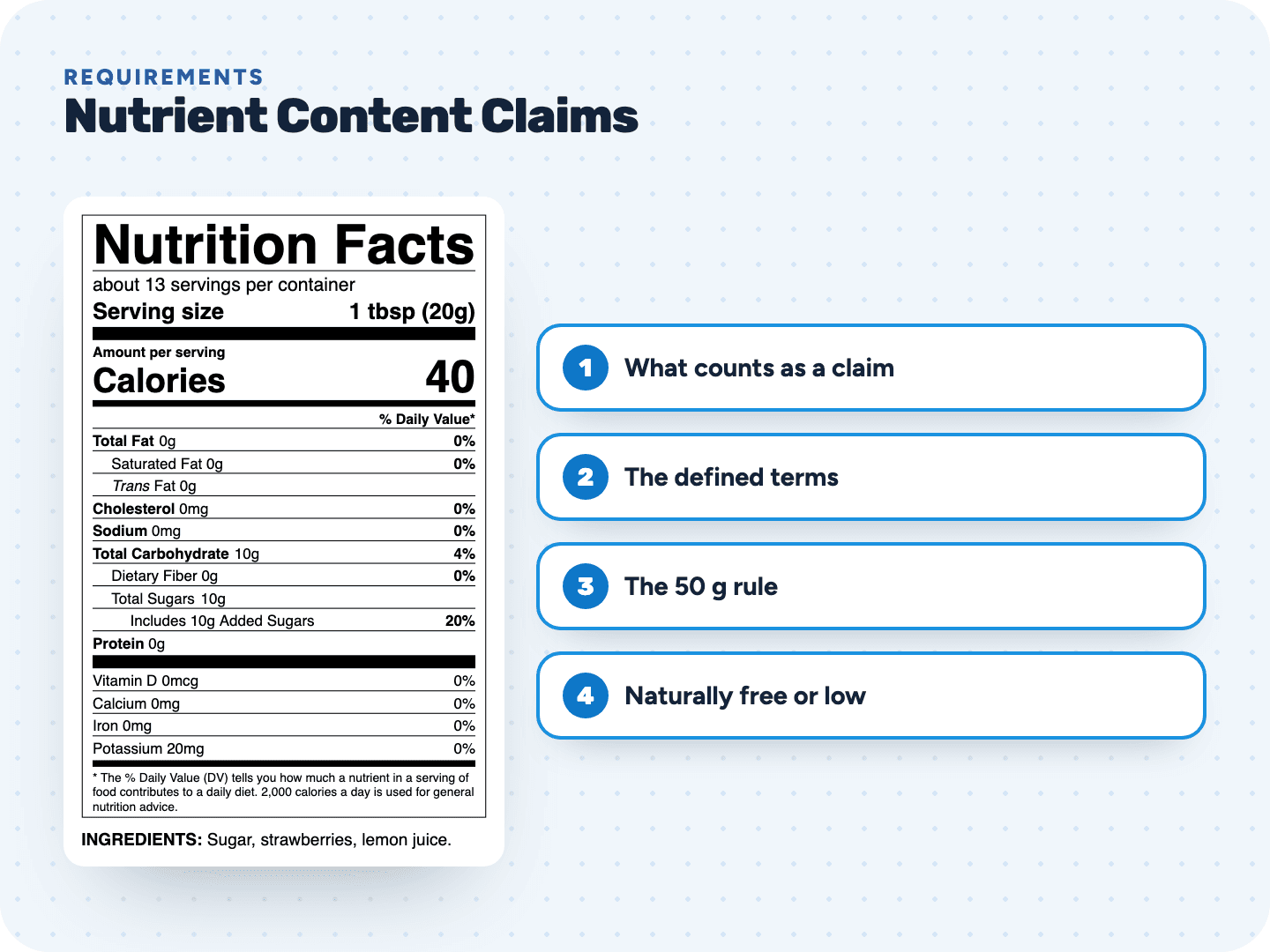
What counts as a nutrient content claim
FDA splits these claims in two. An expressed claim states a level directly. An implied claim suggests a level without naming it, through an ingredient or a phrase.
| Type | What it looks like | FDA's own examples |
|---|---|---|
| Expressed | A direct statement about the level of a nutrient | "low sodium", "contains 100 calories" |
| Implied, by ingredient | Wording that suggests a nutrient is absent or present in a certain amount | "high in oat bran" |
| Implied, by healthy eating | Wording that suggests the food helps maintain healthy dietary practices because of its nutrients | "healthy" |
Numbers inside the Nutrition Facts panel are not claims. Repeat the same number on the front, like "8 g fiber" next to the product name, and it becomes one, with all the rules on this page.
Nutrient content claim terms and their limits
The limits below are per reference amount customarily consumed (RACC), the FDA amount behind your serving size. "Free" claims must also be met per labeled serving. For foods with a small reference amount, "low" claims are checked per 50 g as well (see the next section).
RACC: FDA Reference Amounts Customarily Consumed →| Claim | Main condition | Rule |
|---|---|---|
| Calorie free | Less than 5 calories | 21 CFR 101.60(b)(1) |
| Low calorie | 40 calories or less | 21 CFR 101.60(b)(2) |
| Fat free | Less than 0.5 g fat, and no added fat ingredient without an asterisk note | 21 CFR 101.62(b)(1) |
| Low fat | 3 g fat or less | 21 CFR 101.62(b)(2) |
| Sodium free | Less than 5 mg sodium, and no salt ingredient without an asterisk note | 21 CFR 101.61(b)(1) |
| Very low sodium | 35 mg sodium or less | 21 CFR 101.61(b)(2) |
| Low sodium | 140 mg sodium or less | 21 CFR 101.61(b)(4) |
| Reduced, less, fewer (calories, fat, sodium) | At least 25% less than a named reference food | 21 CFR 101.60(b)(4) · 101.61(b)(6) · 101.62(b)(4) |
| Light, lite | One third fewer calories or 50% less fat; 50% less fat when half or more of the calories come from fat | 21 CFR 101.56(b) |
| Good source, contains, provides | 10 to 19% of the Daily Value | 21 CFR 101.54(c) |
| High, rich in, excellent source of | 20% or more of the Daily Value | 21 CFR 101.54(b) |
| More, added, extra, plus, fortified, enriched | At least 10% of the Daily Value more than a reference food | 21 CFR 101.54(e) |
Each term also covers its synonyms. "Zero fat", "no fat" and "without fat" all fall under fat free, and "few calories" falls under low calorie. Spelling variations like "hi" and "lo" are allowed when they are not misleading.
Small servings: the per 50 g check
Dips, dressings, sauces and other foods with a reference amount of 30 g or less, or 2 tablespoons or less, get a second test for "low" claims. The food has to meet the limit per reference amount and also per 50 g. Without that rule, a tiny serving could make almost anything look low.
Example with our engine: a fresh salsa of 4 cups chopped tomatoes, 1 cup onion, 2 jalapeños, 1/2 cup cilantro and 2 tbsp lime juice. FDA puts salsa with the dips, at 2 tbsp. We used 36 g for 2 tbsp.
| Salt in the batch | Sodium per 2 tbsp (36 g) | Sodium per 50 g | "Low sodium"? |
|---|---|---|---|
| 1 1/4 tsp | 110 mg | 160 mg | No: passes per serving, fails per 50 g |
| 3/4 tsp | 70 mg | 95 mg | Yes: 140 mg or less on both counts |
The same per 50 g test applies to "low calorie" (40 calories) and "low fat" (3 g). This salsa has 10 calories per serving and per 50 g, so it is low calorie on both counts.
When the food is "free" or "low" by nature
A "free" or "low" claim in front of the name suggests you changed the recipe to get there, like "low sodium potato chips". If every food of that type already meets the limit, the label has to say so and talk about the whole category, not just your brand.
Our salsa has no added fat and rounds to 0 g, but fresh salsa is fat free by nature. So "fat free salsa" would be misleading; FDA's pattern is "corn oil, a sodium-free food", which here becomes "salsa, a fat free food". The low sodium version is different: you cut the salt to get there, so "low sodium salsa" works.
Rules that come with every claim
- The claim may be at most twice the type size of the product name, and not unduly prominent in style
- Over the disclosure levels (fat 13 g, saturated fat 4 g, cholesterol 60 mg, sodium 480 mg) per reference amount, per serving, or per 50 g when the reference amount is small: add "See nutrition information for ___ content" in bold, right next to the claim
- A relative claim (reduced, less, more, light) names the reference food, gives the percentage difference, and compares the amounts per serving
- You cannot claim "reduced" against a reference food that already qualifies as "low"
- If your labeled serving differs from the reference amount and the serving alone misses the limit, follow the claim with its criteria, like FDA's example for a drink
- A Nutrition Facts panel is required on any food with a claim, and the small business exemption from the panel ends
Plain amounts versus "only"
A plain, accurate amount like "5 grams of fat" needs no disclaimer. Add a word that judges the amount, such as "only", and the statement now implies the food is low. Then it must meet the definition, or carry a disclaimer next to it saying it is not low.
"Percent fat free" is not covered by this amount rule. It has its own definition: the food must qualify as low fat, and the percentage and the words "fat free" must be the same type size. "100 percent fat free" also needs less than 0.5 g fat per 100 g and no added fat.
Meals, foods for young children and terms FDA never defined
- Meal products (a serving of 10 oz or more, built from at least three 40 g portions across two or more of four food groups) and main dish products (6 oz or more, with 40 g or more from each of at least two groups) have their own limits, usually per labeled serving
- For "good source" or "high" on a meal or main dish, name the food in it that qualifies: FDA's example is "the serving of broccoli in this product is high in vitamin C"
- Foods made specially for children under 2 may not carry nutrient content claims, except vitamin and mineral percentage statements and claims a regulation provides for
- A nutrient content claim that no regulation defines may not be used. A new one takes a petition to FDA
FDA has also proposed changes to the low sodium and low saturated fat claims as part of its front-of-package nutrition proposal. Until a final rule is published, the definitions above are the ones in force.
Front-of-package nutrition labels: what FDA proposed →What our tool does, and what it leaves to you
Nutrition Label Studio calculates every number on the panel from your recipe with USDA data and FDA rounding, so the figures a claim depends on are there. It does not check claims. To test a claim, compare the numbers with the table above, and for small reference amounts set the serving to 50 g for a moment to see the per 50 g values, as we did for the salsa.
Claims are judged with the same methods as the panel, so borderline cases matter. The calculation report shows every unrounded value per serving, which helps when a number sits right at a limit.
Nutrition Label Documentation: The Calculation Report →