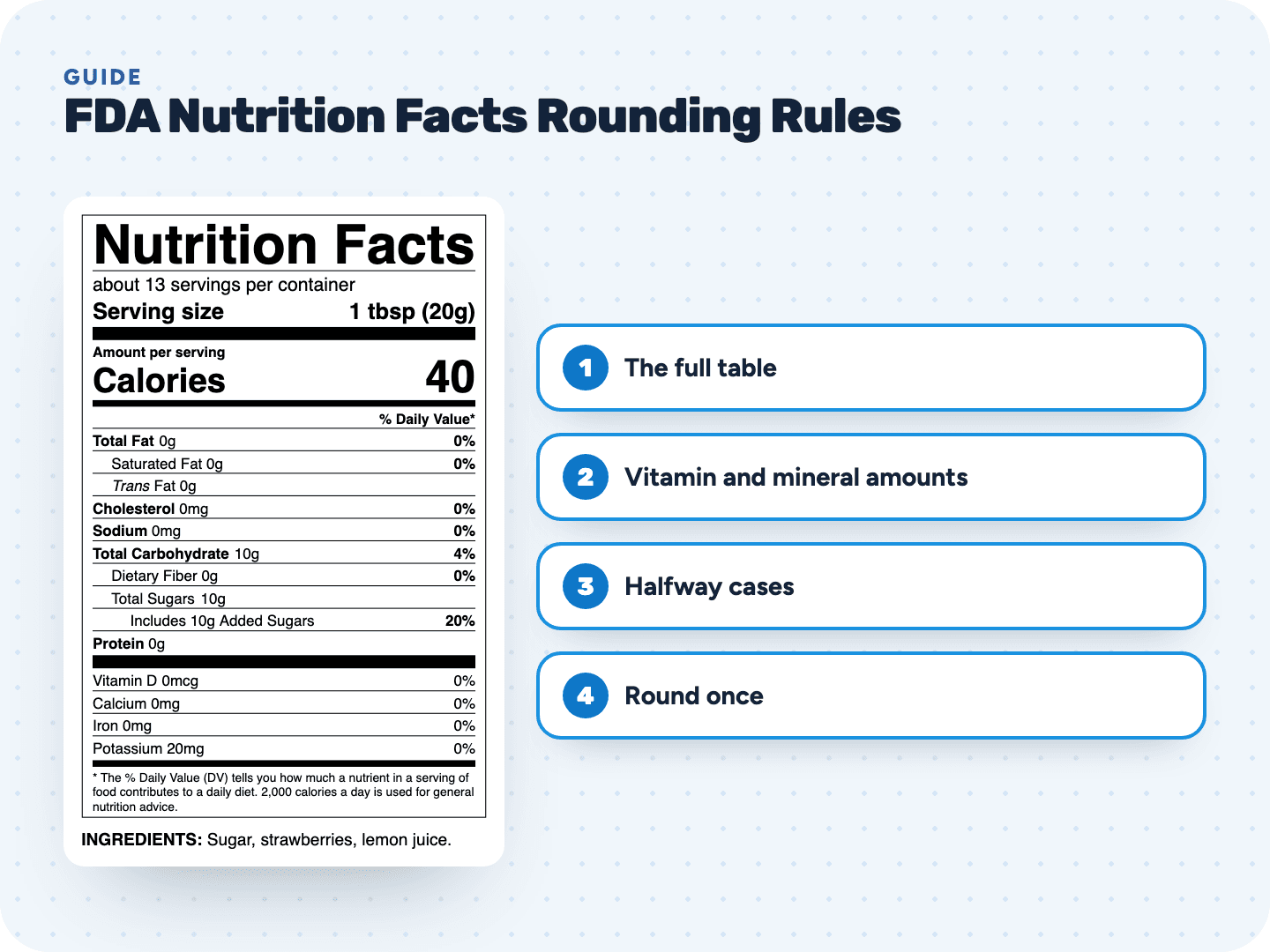
The full rounding table
These are the rounding rules for the nutrition facts label, nutrient by nutrient, as written in 21 CFR 101.9(c) and summed up in FDA's Food Labeling Guide, Appendix H:
| Nutrient | Shown as 0 | Small amounts | Larger amounts |
|---|---|---|---|
| Calories, calories from saturated fat | Under 5 | Up to 50: nearest 5 | Above 50: nearest 10 |
| Total, saturated, trans, polyunsaturated and monounsaturated fat | Under 0.5 g | Under 5 g: nearest 0.5 g | 5 g or more: nearest 1 g |
| Cholesterol | Under 2 mg | 2 to 5 mg: "less than 5mg" | Above 5 mg: nearest 5 mg |
| Sodium | Under 5 mg | 5 to 140 mg: nearest 5 mg | Above 140 mg: nearest 10 mg |
| Total carbohydrate, dietary fiber, total sugars, added sugars, sugar alcohol, protein | Under 0.5 g | 0.5 to under 1 g: "less than 1g" (or 1g) | 1 g or more: nearest 1 g |
| Fluoride (optional) | Under 0.1 mg | Up to 0.8 mg: nearest 0.1 mg | Above 0.8 mg: nearest 0.2 mg |
| % Daily Value, fat to protein | Under 0.5% | Nearest 1% | Nearest 1% |
| % Daily Value, vitamins and minerals | Under 2% (or leave off with a statement) | Up to 10%: nearest 2% | Above 10% to 50%: nearest 5%; above 50%: nearest 10% |
Servings and serving weight round too: servings per container to the nearest whole number (nearest 0.5 between 2 and 5, with "about" when rounded), and the gram weight of a serving to the nearest gram (0.5 g steps from 2 to 5 g, 0.1 g steps under 2 g).
Vitamin and mineral amounts
The regulation doesn't give vitamin and mineral amounts a step like sodium's. It says to use the units and levels of significance of the Daily Value table. FDA's later Q&A guidance spells out the steps it recommends:
| Nutrient | Daily Value | Round to |
|---|---|---|
| Vitamin D | 20 mcg | Nearest 0.1 mcg |
| Calcium | 1,300 mg | Nearest 10 mg |
| Iron | 18 mg | Nearest 0.1 mg |
| Potassium | 4,700 mg | Nearest 10 mg |
| Vitamin A (optional) | 900 mcg | Nearest 10 mcg |
| Vitamin C (optional) | 90 mg | Nearest 1 mg |
Watch out for potassium. Appendix H, written for the old label, still groups it with sodium. FDA's Q&A guidance puts potassium with the other vitamins and minerals: nearest 10 mg at every level. That's what our label maker does. Above 140 mg the two ways agree, but below it they don't: 95 mg is 95mg the sodium way and 100mg the mineral way.
Start a label →Halfway rounds up
FDA's rule for halfway values is simple: exactly halfway or more rounds up, less than halfway rounds down. So 2.5 to 2.99 g becomes 3 g, and 2.01 to 2.49 g becomes 2 g. The same goes for % Daily Values: 7.5% becomes 8%.
Close calls happen all the time. In the brownie below, protein is 2.49 g, so the label says 2g. Saturated fat is 4.98 g: still under 5 g, so it rounds to the nearest 0.5 g, which lands on 5g.
Round once, at the end
- Add up the exact amounts from every ingredient first. Rounding each ingredient and adding the results gives wrong totals
- Calories from protein, carbohydrate and fat use the actual grams, before rounding
- % Daily Value may use either the rounded amount on the label or the exact amount
Our label maker calculates % Daily Value from the rounded amount, so anyone can check it on the label itself: 15g of added sugars ÷ 50 g = 30%. When the label says "less than 1g", it uses the exact amount instead.
Worked example 1: barbecue sauce
Small servings test the low end of the table. Our sauce is tomato sauce, tomato paste, brown sugar, cider vinegar, molasses and spices. The reference amount for barbecue sauce is 2 tbsp; 2 tbsp of our sauce weighs 36 g, and a 12 oz (340 g) bottle holds 9.4 servings: about 9.
| Nutrient | Exact | Rule | Label |
|---|---|---|---|
| Calories | 40.3 | Up to 50: nearest 5 | 40 |
| Total fat | 0.13 g | Under 0.5 g: zero | 0g |
| Sodium | 207.9 mg | Above 140 mg: nearest 10 | 210mg, 9% |
| Total carbohydrate | 9.43 g | Nearest gram | 9g, 3% |
| Dietary fiber | 0.69 g | 0.5 to 1 g | Less than 1g, 2% |
| Total sugars | 8.26 g | Nearest gram | 8g |
| Added sugars | 6.76 g | Nearest gram | 7g, 14% |
| Protein | 0.59 g | 0.5 to 1 g | Less than 1g |
| Calcium | 15.1 mg | Nearest 10 mg | 20mg, 0% |
| Iron | 0.43 mg | Nearest 0.1 mg; 2.4% to nearest 2% | 0.4mg, 2% |
| Potassium | 157.1 mg | Nearest 10 mg; 3.3% to nearest 2% | 160mg, 4% |
Two lines need a second look. Fiber shows "Less than 1g" with 2%, because the percentage comes from the exact 0.69 g. Calcium shows 20mg but 0%: 20 mg is 1.5% of 1,300 mg, and under 2% the percentage may be shown as zero.
Worked example 2: a walnut brownie
A richer food tests the middle of the table. Our brownie is made with unsweetened chocolate, butter, sugar, eggs, flour and walnuts, and sold individually wrapped. The reference amount for brownies is 40 g, so a 40 g brownie is one serving.
| Nutrient | Exact | Rule | Label |
|---|---|---|---|
| Calories | 182.9 | Above 50: nearest 10 | 180 |
| Total fat | 10.70 g | 5 g or more: nearest gram | 11g, 14% |
| Saturated fat | 4.98 g | Under 5 g: nearest 0.5 g | 5g, 25% |
| Cholesterol | 34.3 mg | Above 5 mg: nearest 5 mg | 35mg, 12% |
| Sodium | 31.4 mg | 5 to 140 mg: nearest 5 | 30mg, 1% |
| Dietary fiber | 1.11 g | Nearest gram | 1g, 4% |
| Added sugars | 14.77 g | Nearest gram | 15g, 30% |
| Protein | 2.49 g | Nearest gram, just under halfway | 2g |
| Vitamin D | 0.11 mcg | Nearest 0.1 mcg; 0.5% is under 2% | 0.1mcg, 0% |
| Iron | 0.96 mg | Nearest 0.1 mg; 5.3% to nearest 2% | 1mg, 6% |
FDA's margin of error
Rounding decides what you print. FDA's compliance rules decide how far the real food may be from it when FDA tests a sample. That's the FDA nutrition label variance people ask about:
| Nutrients | The tested amount must be |
|---|---|
| Calories, total sugars, added sugars (when all sugars are added), total fat, saturated fat, trans fat, cholesterol, sodium | No more than 20% above the label |
| Naturally present vitamins, minerals, protein, total carbohydrate, fiber, polyunsaturated and monounsaturated fat | At least 80% of the label |
| Vitamins, minerals, protein and fiber added to fortify the food | At least 100% of the label |
FDA tests a composite of 12 units from 12 different shipping cases of one lot, and allows for the normal variability of the lab method.
Rounding mistakes we see most
- Using 0.5 g steps for fat above 5 g. From 5 g up, it's whole grams
- Using 5 mg steps for sodium above 140 mg. Above 140 mg, it's 10 mg steps
- Rounding potassium like sodium, as the old appendix did
- Working out calories from the rounded grams instead of the exact ones
- Putting a % Daily Value next to total sugars, which has no Daily Value
- Rounding vitamin percentages to the nearest 1% instead of 2%, 5% or 10% steps
Let the tool do the rounding
Our label maker applies every rule on this page automatically, from your recipe. Then it shows its work: the calculation report lists each ingredient's USDA source and how every number on the label was rounded, ready for a store, co-packer or inspector.
Nutrition Label Documentation: The Calculation Report →