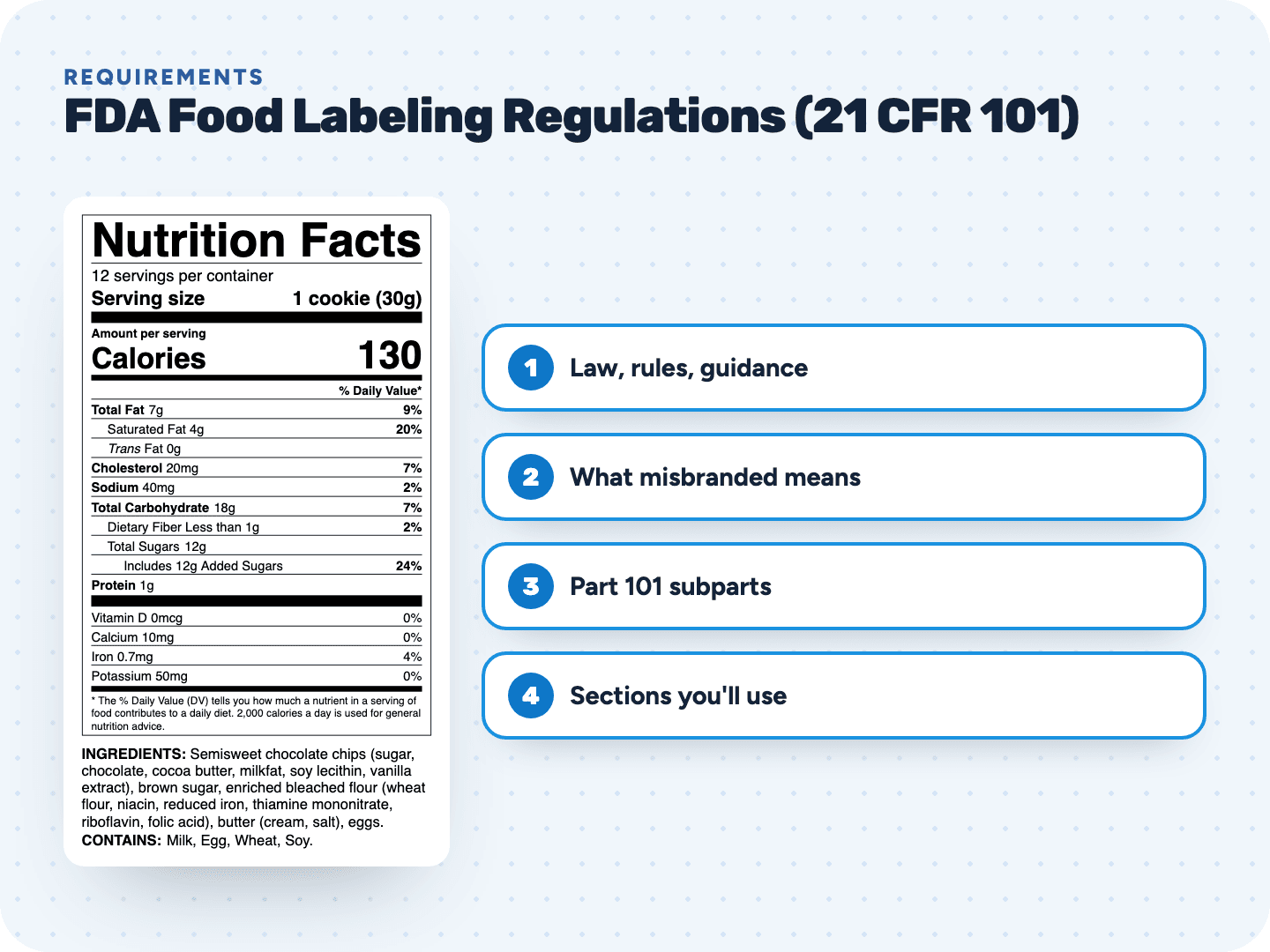
Three layers: the law, the regulations, the guidance
Food labels are required by law. Congress wrote the law, the FDA wrote regulations to carry it out, and the FDA publishes guidance to explain both. Only the first two are binding.
| Layer | Where | Binding? |
|---|---|---|
| The law | FD&C Act section 403 (21 U.S.C. 343) | Yes |
| The regulations | 21 CFR Parts 101 and 102, among others | Yes |
| Guidance | FDA guidance documents, like the Food Labeling Guide | No, it shows FDA's current thinking |
What makes a food misbranded
Section 403 of the FD&C Act is a list of ways a label can break the law. A few of the paragraphs every food maker runs into:
| Paragraph | A food is misbranded if |
|---|---|
| 403(a)(1) | Its labeling is false or misleading in any particular |
| 403(i) | The label lacks the common name of the food or of each ingredient |
| 403(q) | It lacks the required nutrition information |
| 403(w) | It contains a major food allergen that the label doesn't declare |
Are nutrition labels required by law? Yes. Section 403(q) requires nutrition information on most food, and the regulations spell out the exemptions.
Check if your food is exempt →21 CFR Part 101, subpart by subpart
Part 101 is titled Food Labeling. Its seven subparts group the rules by topic, so you can jump straight to the one you need.
| Subpart | Sections | What it covers |
|---|---|---|
| A: General provisions | 101.1 to 101.18 | Panels, name, ingredients, address, net quantity, Nutrition Facts, serving sizes |
| B: Specific food labeling | 101.22, 101.30 | Flavors, colors, preservatives; percent juice |
| C: Specific nutrition labeling | 101.36 to 101.45 | Supplement Facts; raw fruit, vegetables and fish |
| D: Nutrient content claims | 101.54 to 101.69 | "Good source", "high", "light", calorie, sodium and fat claims |
| E: Health claims | 101.70 to 101.83 | Authorized claims about a food and a disease |
| F: Other descriptive claims | 101.91 to 101.95 | Gluten-free, supplement statements, "fresh" |
| G: Exemptions | 101.100, 101.108 | Foods exempt from some or all label rules |
The sections you'll use most
| Section | Topic |
|---|---|
| 101.1 | Principal display panel (the front) |
| 101.2 | Information panel and minimum type size |
| 101.3 | Name of the food (statement of identity) |
| 101.4 | Ingredient list |
| 101.5 | Name and place of business |
| 101.7 | Net quantity of contents |
| 101.9 | Nutrition Facts: nutrients, rounding, format, exemptions |
| 101.12 | Reference amounts for serving sizes |
| 101.13 | Nutrient content claims, general rules |
| 101.15 | Prominence of required statements |
| 101.17 | Warning and safe handling statements |
Rules outside Part 101
- Part 102: common or usual names. The name must describe the basic nature of the food in simple, direct terms
- Standards of identity: some foods, like fruit preserves and jams, have a set recipe and name (for example 21 CFR 150.160)
- Part 117: good manufacturing practice and preventive controls, including keeping allergens out by accident
- 21 U.S.C. 343(w) and 321(qq): the allergen labeling law and the list of major food allergens
Who enforces which labels
| Product or claim | Agency | Main rules |
|---|---|---|
| Most packaged food | FDA | 21 CFR Part 101 |
| Dietary supplements | FDA | 21 CFR 101.36 |
| Meat, poultry, processed egg products | USDA FSIS | Its own label rules |
| "Organic" claims | USDA National Organic Program | 7 CFR Part 205 |
| Home-kitchen (cottage) food | Your state | Your state's cottage food law |
How to read a CFR citation
Take "21 CFR 101.9(c)(8)(iii)", the rule for rounding % Daily Values of vitamins and minerals. Read it left to right, from big to small:
| Piece | Means |
|---|---|
| 21 | Title 21: Food and Drugs |
| CFR | Code of Federal Regulations |
| 101 | Part 101: Food Labeling |
| .9 | Section 101.9: Nutrition labeling of food |
| (c)(8)(iii) | Paragraph (c), item (8), sub-item (iii) |
Our calculation report uses the same citations, so you can show a store or an inspector which rule produced each number.