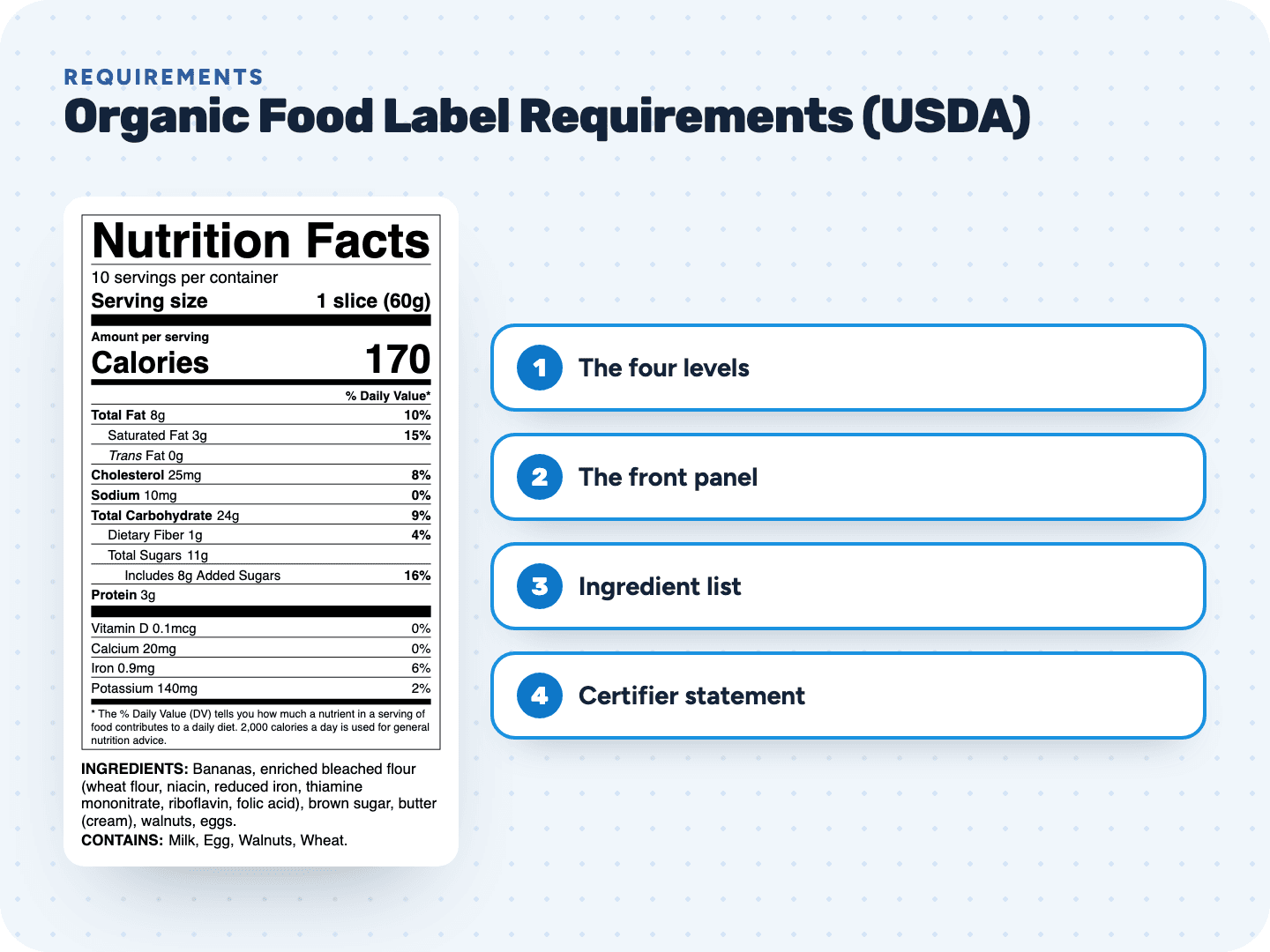
The four organic label levels
The percentage is by weight or fluid volume, not counting added water and salt.
| Label term | Organic content | USDA seal | "Certified organic by" |
|---|---|---|---|
| "100 percent organic" | 100% | Allowed | Required |
| "Organic" | At least 95% | Allowed | Required |
| "Made with organic ..." | At least 70% | Not allowed | Required |
| Ingredient list only | Under 70% | Not allowed | Not required; no certifier seal |
What can go on the front
- "100 percent organic" or "organic" may modify the product name, like "Organic granola"
- A percentage statement, like "96% organic", may be shown, but no bigger than half the largest type on that panel
- "Made with organic" may name up to three organic ingredients or food groups, in letters no bigger than half the largest type
- Percentage and made-with statements appear in one type size, style and color, without highlighting
- Never use "organic" in the product name to describe an ingredient that isn't organic
The allowed food groups for a made-with claim: beans, fish, fruits, grains, herbs, meats, nuts, oils, poultry, seeds, spices, sweeteners, and vegetables or processed milk products. Every ingredient in a named group must be organic.
Marking organic ingredients
Mark each organic ingredient with the word "organic", or with an asterisk explained below the list. This applies at every level that has an ingredient list, including products under 70%.
Ingredients: Rolled oats*, honey*, sunflower oil*, almonds, sea salt. *Organic
- Water and salt can never be marked organic
- Under 70%, you may show the organic percentage, but only on the information panel
The "Certified organic by" line
Products labeled "100 percent organic", "organic" or "made with organic" must name the certifying agent that certified the maker of the finished product.
- On the information panel
- Below the name of the handler or distributor
- Starting with "Certified organic by" or a similar phrase
- The certifier's address, website or phone number may be added
The USDA Organic seal
The seal is optional, but only "100 percent organic" and "organic" products may use it. It must match the official design and be printed clearly in one of two color schemes:
- White background, brown outer circle, "USDA" in green on white, "organic" in white on green
- White or transparent background, black outer circle, black "USDA" and contrasting "organic" on black
A certifier's own seal may appear too, but no more prominently than the USDA seal.
Small producers: the $5,000 exemption
If your organic sales are $5,000 a year or less, you don't need certification to sell your products as organic. The trade-off:
- No USDA seal and no certifier seal
- You can't present the product as certified organic to any buyer
- Your organic product can't be sold as an organic ingredient in someone else's product
- The organic production and handling rules still apply in full
The rest of the label still follows FDA
Organic covers one claim. Everything else on the package follows the usual FDA rules: the name of the food, net quantity, ingredient list, allergens, Nutrition Facts and your address.
FDA food labeling requirements checklist →