What is a co-packer, and what does co packing mean?
Co packing (short for contract packing) means paying another food business to produce your product. The co-packer buys or receives the ingredients, cooks or mixes them by your formula, fills the jars, bags or bottles, applies your labels and ships the finished goods. You own the brand and sell the product. Some co-packers only fill and pack what you supply, others handle everything from sourcing to palletizing.
| Option | Whose recipe | Who makes it | Whose name on the label |
|---|---|---|---|
| Co-packer | Yours | The co-packer, in its plant | Yours, with "Manufactured for" or "Distributed by" |
| Private label | The manufacturer's | The manufacturer | Yours, qualified the same way |
| Rented commercial kitchen | Yours | You, in licensed space | Yours, as the manufacturer |
The rented kitchen route looks cheaper but brings its own paperwork. Several states say production in a rented commercial kitchen needs your own food license: Connecticut's Department of Consumer Protection and Michigan's MDARD both say so. With a co-packer, the plant already holds those approvals.
When a co-packer makes sense
- You are outgrowing your state's cottage food law: a store wants your product, you passed the sales cap, or you want to ship to other states
- You don't want to license, equip and staff your own plant before you know the product sells
- Your product needs equipment or controls a home kitchen can't offer, like a shelf-stable sauce made safe with vinegar
- You want to spend your time on sales and stores, not on production days
Washington shows how a state can treat this. The state agriculture department lists who needs a Food Processor License, including anyone who processes or packages food for someone else, and then lists a co-packer arrangement among the exceptions for the brand owner:
Other states have their own rules, so check with your state's agriculture or health department before you sign. Our state pages name the agency for each state.
Food Label Requirements by State →Who registers and licenses what with a co-packer
FDA facility registration belongs to the building where food is made, packed or held, not to the brand. FDA's definition of manufacturing/processing even lists labeling and packaging as examples, so the co-packer's plant is clearly a facility. What about you?
| Requirement | Who handles it | Source |
|---|---|---|
| FDA food facility registration | The co-packer's plant | 21 CFR 1.225, 1.227 |
| Registration for your own office | Not needed if your business never makes, packs or holds the food, the same test FDA applies to brokers | FDA registration Q&A, C.1.13 |
| Registration for your own warehouse | Holding food counts, so a warehouse you run for finished goods may need its own | 21 CFR 1.227 |
| Acidified food registration and process filing | The commercial processor that acidifies and packs: Form FDA 2541 and Form FDA 2541e | 21 CFR 108.25(c) |
| State food license | The co-packer; your own only if your state says so | Your state agency |
| The label | You: your name, address and every required element | 21 CFR 101.5 |
Whose name goes on a co-packed label
Every packaged food names the manufacturer, packer or distributor, with the place of business. One name is enough, and it can be yours. When your business didn't make the food, FDA wants a short phrase in front of your name that tells the truth about your role:
- Manufactured for [your business name], [street], [city, state ZIP]
- Distributed by [your business name], [city, state ZIP], if a current city or phone directory already shows your street address
- Packed for [your business name], or other wording that states the facts
Use the real business name. A corporation uses its actual corporate name. An individual, partnership or association uses the name the business operates under. You may print your principal place of business instead of the co-packer's address, as long as that isn't misleading.
What a co-packer will ask you for
A co-packer quotes and schedules from paperwork. The better your file, the faster your first run. Expect to be asked for:
- The formula by weight, so a 10-gallon test batch scales to a 500-gallon kettle
- Ingredient specifications and suppliers, or approval for the co-packer to source equivalents
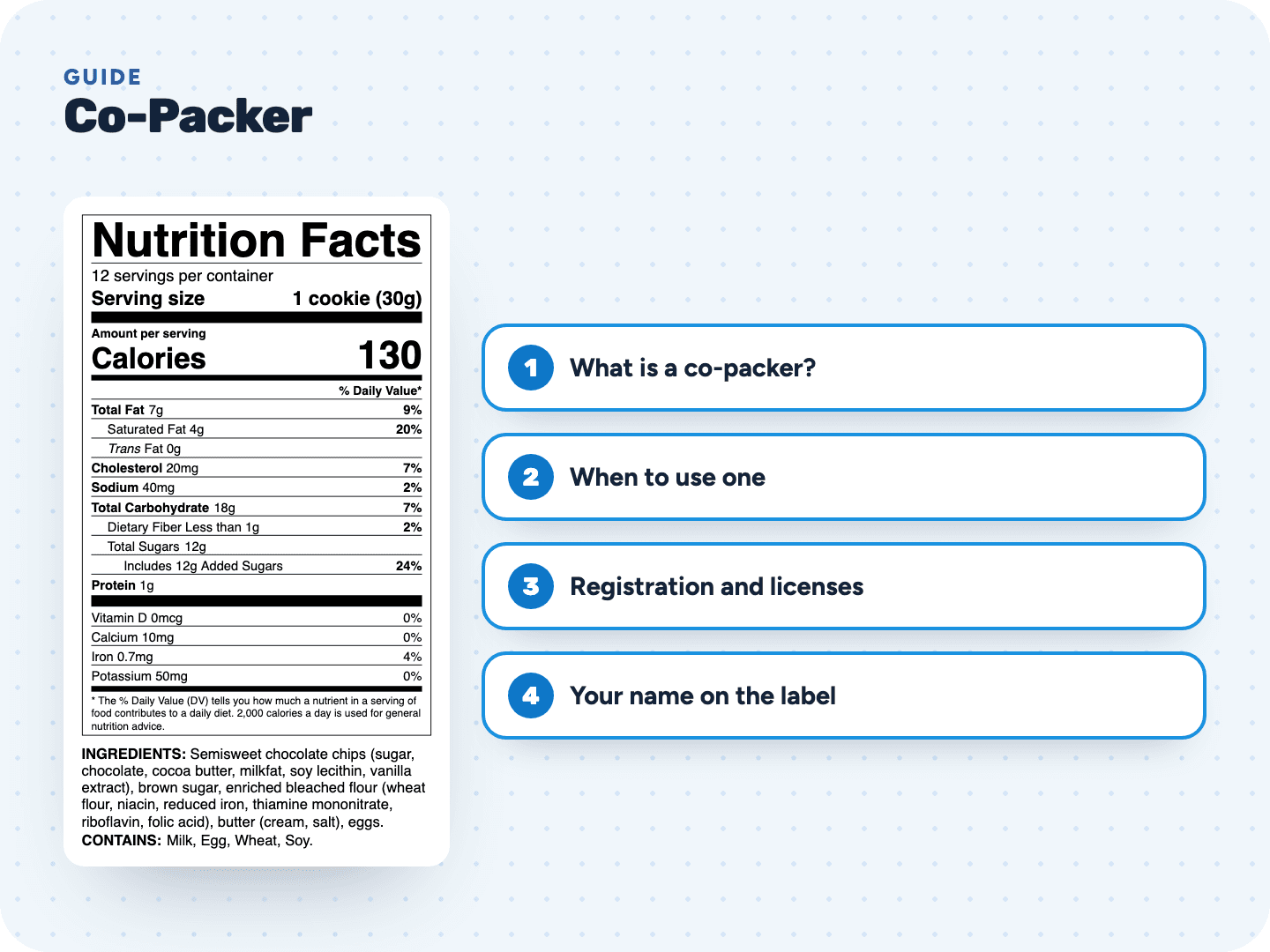
- Your finished label files: Nutrition Facts, ingredient statement, allergen statement, net quantity and your "Manufactured for" line
- Package details: jar, bottle or bag size, fill weight, closures and case pack
- For shelf-stable acidified foods like salsa or hot sauce: the scheduled process from a process authority
- Proof of product liability insurance, if the co-packer requires it
Under FDA's preventive controls rule, a plant's food allergen controls include the label on the finished food. So a careful co-packer will compare your Contains line with the specs of every ingredient they put in the kettle.
Allergens on a shared production line
Your recipe may be peanut free, but the line that fills your jars may run peanut sauce on Tuesdays. Ask early what else the plant produces, how they clean between runs and how they schedule allergen products. The answer decides whether your label stays clean or whether you need to talk about a precautionary statement.
The required allergen labeling follows your ingredients: the nine major allergens named in the ingredient list or a Contains line. A "may contain" line is something else, voluntary and not a substitute for good manufacturing practices.
"May Contain" Allergen Labeling →Allergen Labeling Requirements (FALCPA) →Keep your label in step with production
Scaling up rarely leaves a recipe untouched. The co-packer may use a different oil, a bulk vinegar at another strength, or a spice blend from their own supplier. Every change can move the calories, the sodium or the order of the ingredient list, and a new blend can bring a new allergen. Before the first production run, get the final formula in writing and rebuild the label from it.
- Swap the ingredient in your recipe and download the label again
- For a supplier blend that isn't in our USDA library, type the values from its Nutrition Facts, or upload a photo of that label and check the numbers we read
- Check that the Contains line still names every major allergen in the new ingredients
- Send the co-packer the new files and ask them to retire the old ones
A label you buy stays editable for 2 years, so a supplier change doesn't cost you a new label.
The label files you hand to a co-packer
Our tool makes the regulated parts of your label from your recipe: the Nutrition Facts panel, the ingredient statement in descending order by weight and the allergen Contains line. Each ingredient is matched to USDA FoodData Central, and FDA rounding and % Daily Values are applied for you. Then you export what the co-packer and your designer need:
| Export | Who uses it |
|---|---|
| PDF, vector, at actual size | The co-packer or label printer, for proofs and print runs |
| SVG | Your designer, to place the panel in the package artwork |
| PNG at 600 dpi | Sell sheets, store portals and quick checks |
| Calculation report (PDF) | The co-packer, a store buyer or an inspector who asks how you got the numbers |
The calculation report saves the most back and forth. It shows the recipe, where each ingredient's USDA data comes from and the rounding behind each value on the panel, so their quality team can check your label against their batch sheet without guessing.
Package size matters too. A single bottle or bag that holds 2 to 3 times the reference amount needs a dual column panel, per serving and per package, and our tool has that format built in.
Nutrition Label Documentation: The Calculation Report →Start your label free →How to find and vet a co-packer
Start with your state's agriculture department. Some point to co-packer directories: Washington's food processor page links to a PNW Co-packer Locator hosted on oregon.gov. Trade shows, other makers and your local small business development center are good leads too. Then ask each candidate the same questions:
- Is your plant registered with FDA, and which state license do you hold?
- Have you made products like mine, in the package I want?
- For acidified foods: what is your FCE number, and will you file the process for my product in each container size?
- Which major allergens run on the same line, and how do you clean between runs?
- What is the minimum run, and who buys the ingredients and packaging?
- How do you code each lot, and how would a recall work?
- Will you check my label against your ingredient specs before the run?
Don't ask for an FDA certificate. FDA doesn't issue one, and it doesn't recognize certificates sold by private companies either.