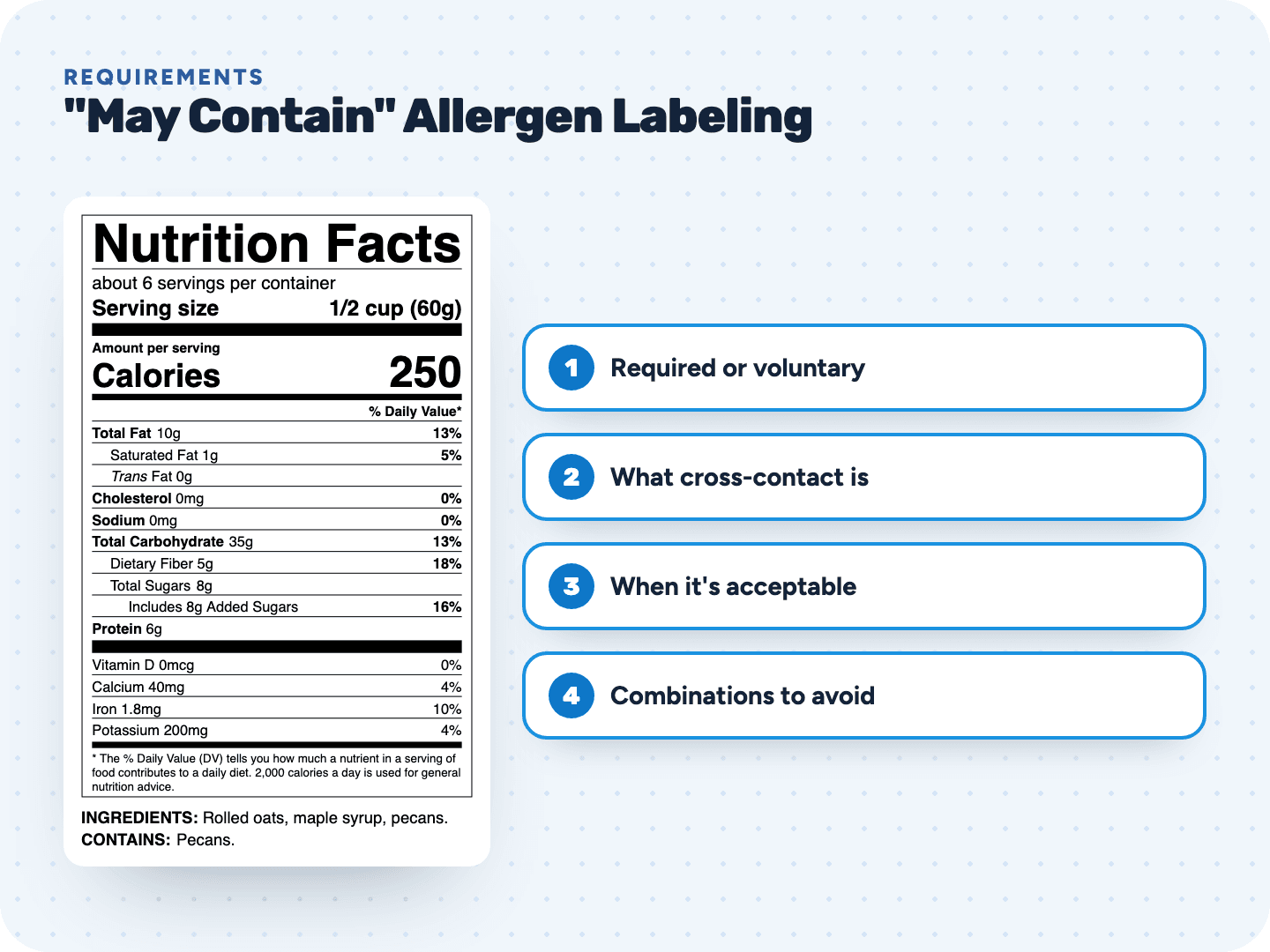
"Contains" versus "may contain"
The two lines look alike but play by different rules. One is the law. The other is your call.
| "Contains" statement | "May contain" statement | |
|---|---|---|
| Required? | Yes, or name allergens in the ingredient list | No, voluntary |
| Covers | Allergens in the recipe | Possible traces from cross-contact |
| Set by | 21 U.S.C. 343(w) | No specific rule; must be truthful |
| Example | Contains: wheat, milk. | May contain peanuts. |
What cross-contact means
Cross-contact is when an allergen gets into a food that was never meant to have it. FDA names typical causes:
- Shared equipment and the order products run on it
- Rework added back into the wrong product
- Allergenic product passing above an open product line
The allergen labeling law does not apply to these unintended traces. The manufacturing rules do: good manufacturing practice, and for facilities covered by them, preventive controls that include allergen controls.
When an advisory line is acceptable
FDA has said a "may contain" line could be considered truthful and not misleading when low levels of an allergen end up in a food through cross-contact, despite strong manufacturing practices.
The order matters. First you control cross-contact. Then, if a real risk remains, an advisory line tells allergic shoppers about it. FDA was asked whether a "may contain" label alone is enough. Its answer: no.
Four combinations to avoid
| Don't print | Why |
|---|---|
| "Contains milk" and "may contain milk" | The advisory line implies milk isn't an ingredient, which misleads |
| "Milk-free" and "may contain milk" | A free-from claim means none at all, including from cross-contact |
| "Contains peanuts" when there are none | Listing an allergen that isn't present does not comply with FDA rules |
| Possible traces inside the Contains line | The Contains statement is reserved for allergens in the food |
How to word it
There is no required wording. Pick a line that describes your real situation, and keep it apart from the Contains statement. Common versions:
- May contain peanuts.
- Made on shared equipment that also processes tree nuts.
- Produced in a facility that also handles sesame.
Our tool writes the Contains line from your recipe, with the specific nut, fish or shellfish named. The advisory line depends on your kitchen, so that one is yours to decide.
Start a label →