What is a cottage food law?
A cottage food law carves out an exception to the usual food business rules. Normally, food for sale has to come from a licensed and inspected kitchen. A cottage food law says a home cook may skip that step for low-risk foods, as long as they follow a set of simpler rules. The person selling is often called a "cottage food operation", though some states use other names, like "home processor" in New York.
These laws are written by states, not by Congress or FDA. That is why the rules in Texas look nothing like the rules in Washington, and why a recipe that is fine to sell in one state can be off limits in the next.
What cottage food laws usually cover
Every state answers the same handful of questions. Read your own law with this list next to it and you won't miss anything:
- Who qualifies: usually a person cooking in the home where they live
- Which foods you may make, and which are banned
- Where and how you may sell: markets, events, your home, online, shipping, stores
- A yearly sales cap, if there is one
- Whether you need a permit, a registration or nothing at all, and any fee
- Food safety training, and whether anyone inspects your kitchen
- What the label must say, often including a required statement about the home kitchen
Which foods cottage food laws allow
States take one of two approaches. Some publish a list of approved foods, and anything not on it is out. Others allow almost everything and list the exceptions instead. Ohio, for example, limits cottage food to the foods on its state list. California keeps an Approved Cottage Food List. Texas works the other way around: every food is allowed except a short list.
Either way, the foods that qualify tend to be shelf stable, meaning they stay safe at room temperature. Think cookies, breads, cakes without cream fillings, candy, jams and jellies, granola, dry mixes and roasted coffee. Foods that are often left out:
- Meat, poultry, fish and seafood
- Dairy products like cheese, yogurt and butter
- Foods that need refrigeration, such as cheesecake or cream pies
- Low-acid canned foods
There are exceptions, which is why you check your own state. Texas allows refrigerated foods if you register with the state and keep them cold, while New York bans any finished product that needs refrigeration.
Where you can sell under a cottage food law
Selling face to face is allowed almost everywhere. The differences start with online orders, shipping and stores. Here is how four states with very different laws handle it:
| Way of selling | Texas | Florida | New York | Washington |
|---|---|---|---|---|
| Markets, events, your home | Yes | Yes | Yes | Yes |
| Online orders | Yes, hand delivered | Yes | In state only | Yes, paid and handed over in person |
| Shipping by mail or courier | No | Yes, by mail or carrier | Not out of state | No |
| Stores and restaurants | Through a registered vendor | No | Yes, in New York | No |
Crossing state lines is where most cottage food laws stop. New York and Washington don't allow shipping out of state, and California defines the sales it allows as transactions within the state. Food sold across state lines falls under FDA, and the federal label rules come with it.
Sales caps: how much you can earn
Many cottage food laws limit your gross sales per year. The caps differ a lot, so a business that is small in one state is too big in another:
| State | Yearly sales cap |
|---|---|
| Washington | $35,000 |
| Michigan | $50,000, or $75,000 when you sell items priced at $250 or more |
| Texas | $150,000, adjusted for inflation |
| Florida | $250,000 |
California sets a separate cap for each of its two classes of cottage food operation and adjusts both every year. Count gross sales, not profit, and keep records: a cap is the easiest rule to break by accident in a good year.
What the law says about your label
The label is where the cottage food law meets your customer. Most cottage food laws make you warn buyers that the food comes from an uninspected home kitchen, and many prescribe the exact words. The wording is different in every state. Compare two:
Besides that statement, expect to show the name of the food, who made it and where (some states let a registration number stand in for the address), the ingredients, any of the 9 major allergens and often the net weight. Our tool sorts your ingredients by weight and drafts the allergen line straight from the recipe, so the slowest part of the label is done in a minute.
Cottage food label requirements, item by item →Download the free cottage food label template →Make your cottage food label from your recipe →Does cottage food need a Nutrition Facts panel?
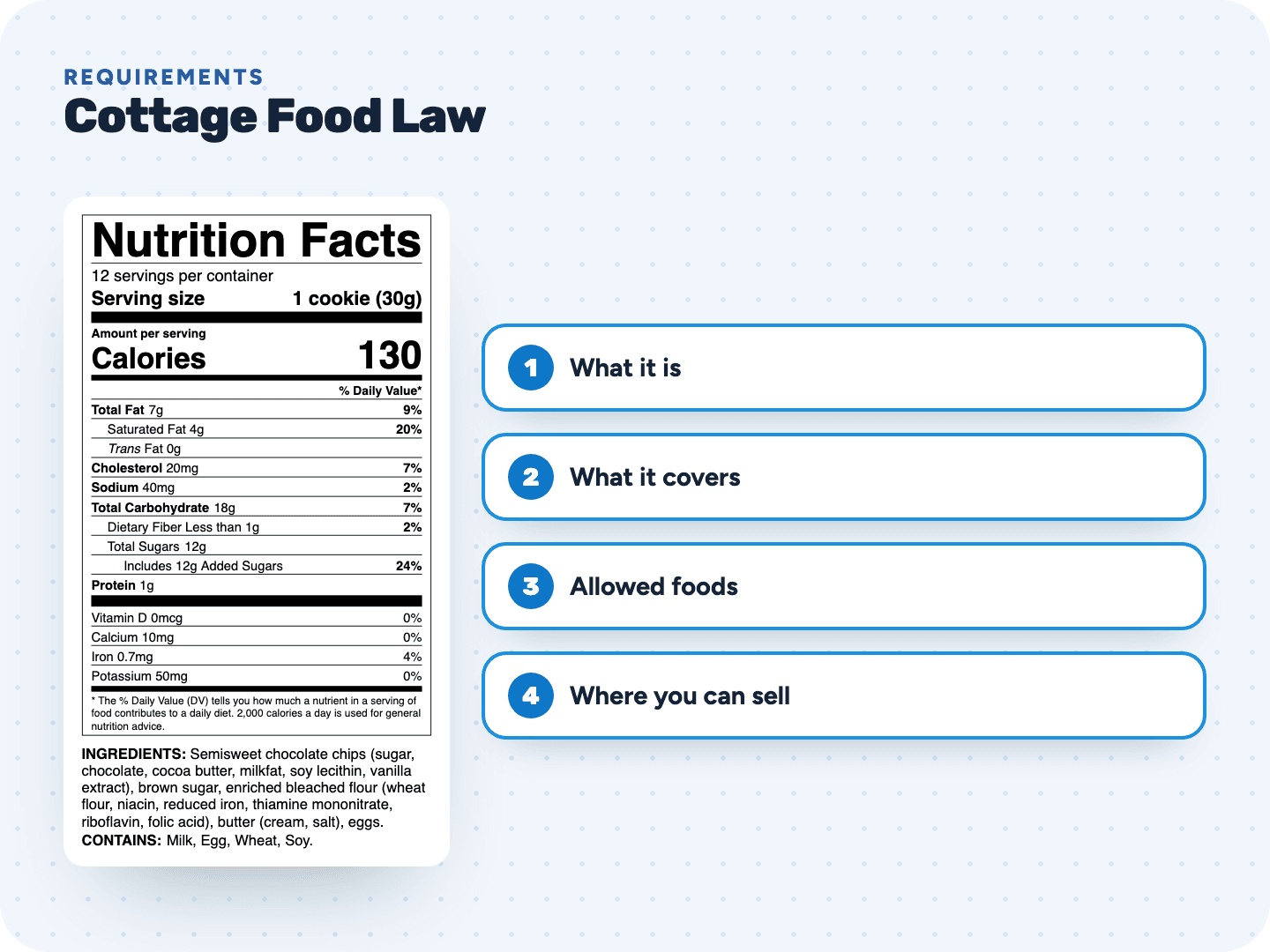
Usually not. Cottage food laws rarely ask for one, and the federal rules exempt small sellers who sell directly to consumers. The catch: the exemption only holds while your label and ads carry no nutrition claims or other nutrition information. Write "only 120 calories" or "high protein" on the bag and you need a full Nutrition Facts panel in the FDA format.
Want one anyway, because customers ask or a shop wants it? Enter your recipe in our tool and see the finished Nutrition Facts label free, before you pay anything.
Try the label maker free →Cottage food laws by state
- Alabama
- Alaska
- Arizona
- Arkansas
- California
- Colorado
- Connecticut
- Delaware
- Florida
- Georgia
- Hawaii
- Idaho
- Illinois
- Indiana
- Iowa
- Kentucky
- Louisiana
- Maine
- Maryland
- Massachusetts
- Michigan
- Minnesota
- Mississippi
- Missouri
- Nebraska
- Nevada
- New Jersey
- New Mexico
- New York
- North Carolina
- Ohio
- Oklahoma
- Oregon
- Pennsylvania
- South Carolina
- South Dakota
- Tennessee
- Texas
- Utah
- Virginia
- Washington
- West Virginia
- Wisconsin
How to find and read your state's cottage food law
- Find the agency: cottage food is run by the health department in some states and the agriculture department in others
- Read the law or the rule itself, not just a summary or a blog post
- Check your food against the allowed list or the banned list
- Note the sales cap, and whether you must register, get a permit or take a course
- Check every way you want to sell: online, shipping, stores, other states
- Copy the label statement word for word, including any capital letters or minimum type size
- Ask your city or county about zoning and home business rules, which sit on top of the state law
When you outgrow the cottage food law
Success has a way of pushing you out of the cottage food law. You pass the sales cap, a grocery store wants your granola, or customers in other states want you to ship. Each of those usually means a state food license and a licensed kitchen, which can be a commercial kitchen you rent or a co-packer who makes the product for you.
Co-Packer →The label changes too. The home-kitchen statement goes away, and the full federal label rules apply: ingredients, net quantity, the manufacturer's name and address, allergens, and in most cases a Nutrition Facts panel. A facility that manufactures, processes, packs or holds food generally has to register with FDA before it starts, unless it is exempt, such as a retail food establishment or restaurant.
Your recipe doesn't change, so neither does the work. Keep the recipe in our tool and the same file gives you the Nutrition Facts panel when you need it.
FDA Food Labeling Requirements →