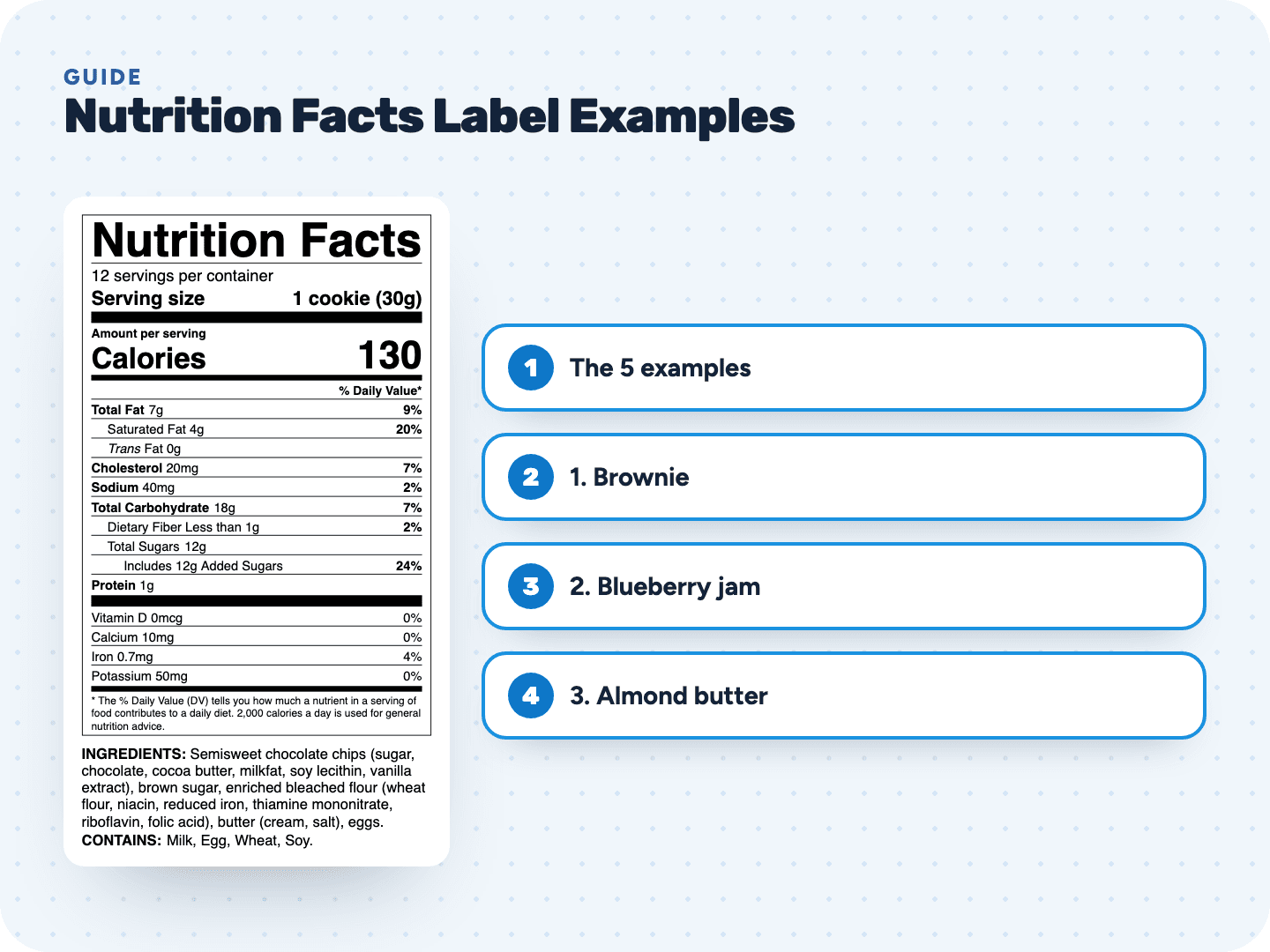
The five examples at a glance
Every example uses the FDA reference amount for its food category as the serving size, so the numbers are what you would really print. Here is the lineup:
| Food | Serving size | FDA reference amount | Calories | What it teaches |
|---|---|---|---|---|
| Fudgy brownie | 1 brownie (40g) | Brownies: 40 g | 190 | High %DV, allergens hidden in sub-ingredients |
| Blueberry jam | 1 tbsp (20g) | Jams: 1 tbsp | 50 | Zeros stay on the label; simplified format |
| Honey almond butter | 2 tbsp (32g) | Nut butters: 2 tbsp | 180 | "About" servings, a named tree nut |
| Cucumber yogurt dip | 2 tbsp (30g) | Dips: 2 tbsp | 35 | "Less than" amounts, 5-calorie steps |
| Peanut oat bar | 1 bar (40g) | Grain-based bars: 40 g | 170 | Total sugars vs. added sugars |
Example 1: a fudgy brownie, 12 to a box
Recipe: 1 cup unsalted butter, 2 cups sugar, 4 eggs, 2 tsp vanilla extract, 1 cup all-purpose flour, 3/4 cup cocoa powder, 1/2 tsp salt and 1 cup semisweet chocolate chips. The batch weighs 38.1 oz after baking. Each brownie is cut at 40 g and sold in a box of 12.
- 12 servings per container with no "about": the box holds exactly 12 brownies
- Saturated fat at 30% DV is high. FDA's rule of thumb: 5% DV or less is low, 20% or more is high
- Total sugars and added sugars are both 18g: nearly all the sugar comes from the sugar itself and the chocolate chips
- Potassium shows 80mg but 0% DV. Under 2% of the Daily Value, a vitamin or mineral may be declared as zero
Ingredients: Sugar, butter (cream), eggs, semisweet chocolate chips (sugar, chocolate, cocoa butter, milkfat, soy lecithin, vanilla extract), enriched bleached flour (wheat flour, niacin, reduced iron, thiamine mononitrate, riboflavin, folic acid), cocoa, vanilla extract (vanilla bean extractives in water, alcohol), salt. Contains: Milk, Egg, Wheat, Soy.
Look at where soy comes from: the lecithin inside the chocolate chips. Nobody adds soy to brownies on purpose, but the label still has to name it.
Example 2: blueberry jam in a 12 oz jar
Recipe: 4 cups blueberries, 2 1/2 cups sugar and 2 tbsp lemon juice, cooked down to 30 oz (850 g). The jar holds 340 g, and the reference amount for jams is 1 tbsp, which weighs 20 g here. That gives exactly 17 servings.
- Fat, cholesterol, sodium, fiber and protein are all zero, and our standard label still lists each one. A line may only be dropped where the rules allow it, with a "Not a significant source of" line in its place
- Calories round to the nearest 5 up to 50, so this jam shows 50
- Total sugars 13g includes 12g added sugars. The rest is the blueberries' own sugar, which doesn't count as added
- No allergens in the recipe, so there is no Contains line
This jam has insignificant amounts of eight or more nutrients, so it may also use the simplified format. Saturated fat, trans fat, cholesterol, fiber, vitamin D, calcium, iron and potassium drop off, and one line at the bottom reads: Not a significant source of saturated fat, trans fat, cholesterol, dietary fiber, vitamin D, calcium, iron and potassium.
Example 3: honey almond butter
Recipe: 16 oz almond butter, 1/4 cup honey and 1/2 tsp salt. The jar holds 340 g. Nut butters have a reference amount of 2 tbsp, which weighs 32 g for this spread.
- 340 g divided by 32 g is 10.6, so the label says "about 11" servings. Above 5 servings, round to the nearest whole number and add "about"
- Total fat 15g is 19% DV, but saturated fat is only 1g: most of the fat in almonds is unsaturated
- The honey brings 4g of added sugars. Honey is always added sugar, even though it's natural
- Calcium 70mg (6%) and potassium 130mg (2%) come from the almonds
Ingredients: Almond butter (almonds), honey, salt. Contains: Almonds. The Contains line names the nut itself. "Contains: tree nuts" would not meet the rule.
Example 4: cucumber yogurt dip
Recipe: 2 cups Greek yogurt, 1 cup chopped cucumber, 2 tbsp olive oil, 1 tbsp lemon juice, 2 cloves garlic and 3/4 tsp salt. It's packed in 8 oz (227 g) tubs. All dips share one reference amount: 2 tbsp, here 30 g.
- 35 calories: under 50, calories go in steps of 5
- Cholesterol reads "Less than 5mg". Between 2 and 5 mg per serving, FDA allows that wording instead of a number
- Total sugars reads "Less than 1g", another allowed wording for small amounts
- Total fat 2.5g: below 5 g, fat rounds to the nearest half gram
- Added sugars 0g: nothing sweet went in, and the line stays anyway
Ingredients: Greek yogurt (cultured milk), cucumbers, olive oil, lemon juice, garlic, salt. Contains: Milk.
Example 5: no-bake peanut oat bar
Recipe: 3 cups rolled oats, 1 cup peanut butter, 2/3 cup honey, 1/2 cup raisins and 1/4 tsp salt, pressed and cut into 40 g bars. A box holds 6 bars (240 g). Grain-based bars, like granola bars and breakfast bars, have a reference amount of 40 g.
- Total sugars 13g, added sugars 9g. The honey counts as added; the sugar in the raisins does not
- Fiber 2g (7%) and protein 5g come from the oats and peanut butter
- Peanut butter outweighs the oats here (1 cup is heavier than 3 cups of oats), so it leads the ingredient list
- Peanuts are a major allergen on their own, separate from tree nuts: "Contains: Peanuts"
Ingredients: Peanut butter (peanuts), rolled oats, honey, raisins, salt. Contains: Peanuts.
What the examples show side by side
| Nutrient | Brownie | Jam | Almond butter | Yogurt dip | Oat bar |
|---|---|---|---|---|---|
| Calories | 190 | 50 | 180 | 35 | 170 |
| Saturated fat | 6g (30%) | 0g (0%) | 1g (5%) | 0.5g (3%) | 1.5g (8%) |
| Sodium | 55mg (2%) | 0mg (0%) | 70mg (3%) | 95mg (4%) | 85mg (4%) |
| Total sugars | 18g | 13g | 5g | Less than 1g | 13g |
| Added sugars | 18g (36%) | 12g (24%) | 4g (8%) | 0g (0%) | 9g (18%) |
| Protein | 2g | 0g | 6g | 2g | 5g |
| Contains | Milk, egg, wheat, soy | None | Almonds | Milk | Peanuts |
The brownie (190 calories) and the almond butter (180) are only 10 calories apart, but the calories come from very different places: sugar and butter in one, almond fat in the other. That's why the label lists every nutrient instead of just calories.
The same food in other label formats
All five examples use the standard vertical format. The same numbers can be laid out differently when the package calls for it:
| Format | When it fits | Example from this page |
|---|---|---|
| Simplified | Eight or more nutrients in insignificant amounts | The blueberry jam |
| Dual column | A package with 200% to 300% of the reference amount | A single 100 g brownie (250% of 40 g) |
| Tabular (wide) | Not enough height for the vertical label | A short, wide box of bars |
| Linear | Small packages where even a tabular label won't fit | A sample-size dip cup |
| Supplement Facts | Dietary supplements, not food | Not used for any of these foods |
Turn your recipe into a label like these
Every label on this page came out of our label maker. You can make yours the same way, and preview it free:
- Type your recipe the way you cook it: cups, spoons, ounces, grams, "2 1/4"
- Confirm each ingredient's USDA FoodData Central match, or type the values from your supplier's label
- Enter the batch weight after cooking and pick a serving size with help from the FDA reference amounts
- Get the rounded values, % Daily Values, ingredient list and Contains line in one go
- Download a vector PDF, SVG or 600 dpi PNG for $29 per label