Alaska Cottage Food Label Requirements
Alaska cottage food label requirements now come from the state's homemade food law, and they are short. A package sold on its own shows your name, current address and phone number, your business license number if you have one, and this sentence word for word: "This food was made in a home kitchen, is not regulated or inspected, except for meat and meat products, and may contain allergens." That's it for state rules. Selling unpackaged? Then you tell the buyer instead.
Required on every packaged Alaska homemade food
Sell a jar, bag or box on its own? Print these five parts on it, clear and easy to spot.
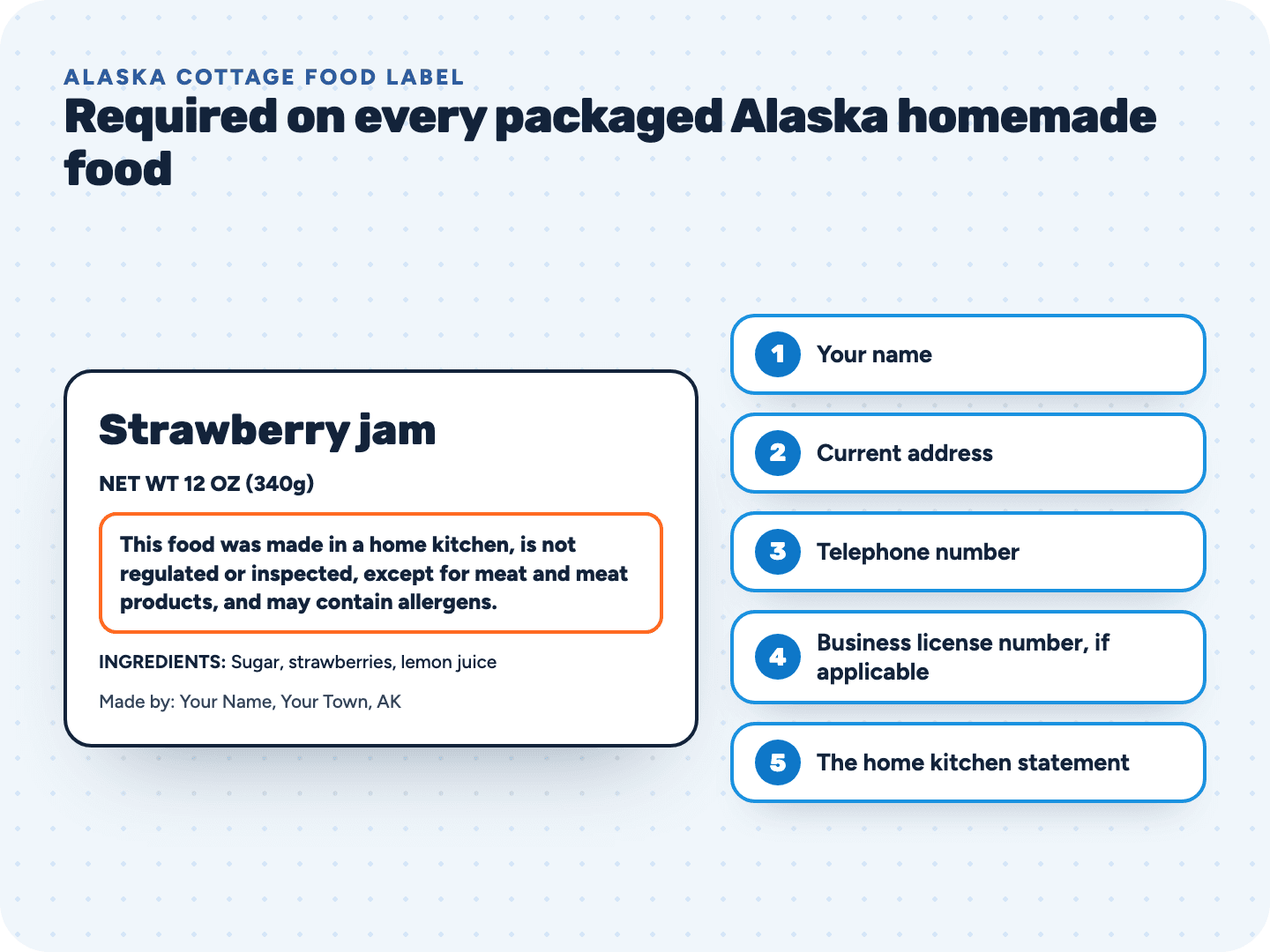
- 1Your nameAS 17.20.332(e)(1)The producer: the person who made and packaged the food.
- 2Current addressAS 17.20.332(e)(1)Where you can be reached now. Moved? Update your labels.
- 3Telephone numberAS 17.20.332(e)(1)So a buyer can call you with a question about ingredients or allergens.
- 4Business license number, if applicableAS 17.20.332(e)(1)If you hold a business license, its number goes on the label too.
- 5The home kitchen statementAS 17.20.332(e)(2)Word for word: "This food was made in a home kitchen, is not regulated or inspected, except for meat and meat products, and may contain allergens."
- No ingredient list requiredGood practiceAlaska's homemade food law doesn't ask for ingredients, allergens, net weight or a product name. Buyers with allergies look for them anyway, so adding the product name and an ingredient list with a Contains line is a smart move.
Permits, sales cap and where you sell
Where this comes from
- Alaska Statutes AS 17.20.332 to 17.20.338The homemade food exemption and its label rule
- Enrolled HB 251 (copy hosted by Penn State's Center for Agricultural and Shellfish Law)Full text of the act, with the label statement in section 7
- Alaska DEC: Homemade Food, Requirements for SellingOfficial state page on the exemption
Alaska label questions
Alaska now uses a homemade food exemption in its food statutes. It covers more foods than a classic cottage food law, including perishable ones, and it has its own label statement. Alaska Cottage Food Law →
The law asks for your current address on every packaged item, next to your name and phone number. Plan on printing an address you're comfortable sharing, and keep it up to date.
Keep it word for word. The law prints the exact sentence, including the part about meat and meat products, even if your food has no meat.
Not under the homemade food law. Federal rules can still require one, for example when you put a claim like "low fat" on the package.
See your label before you pay anything
Free preview, no account. $29 when you're ready to print.