Florida Cottage Food Label Requirements
Florida cottage food label requirements come from one law, Fla. Stat. 500.80. Every product must be prepackaged with a label that shows your name and address, the product name, the ingredients by weight, the net weight or volume, allergens, and one required statement in at least 10-point type. No permit or registration, and you can sell up to $250,000 a year, online and by mail too.
Required on every Florida cottage food label
Florida asks for more than most states: a full ingredient list and the net weight, not just a name and a warning.
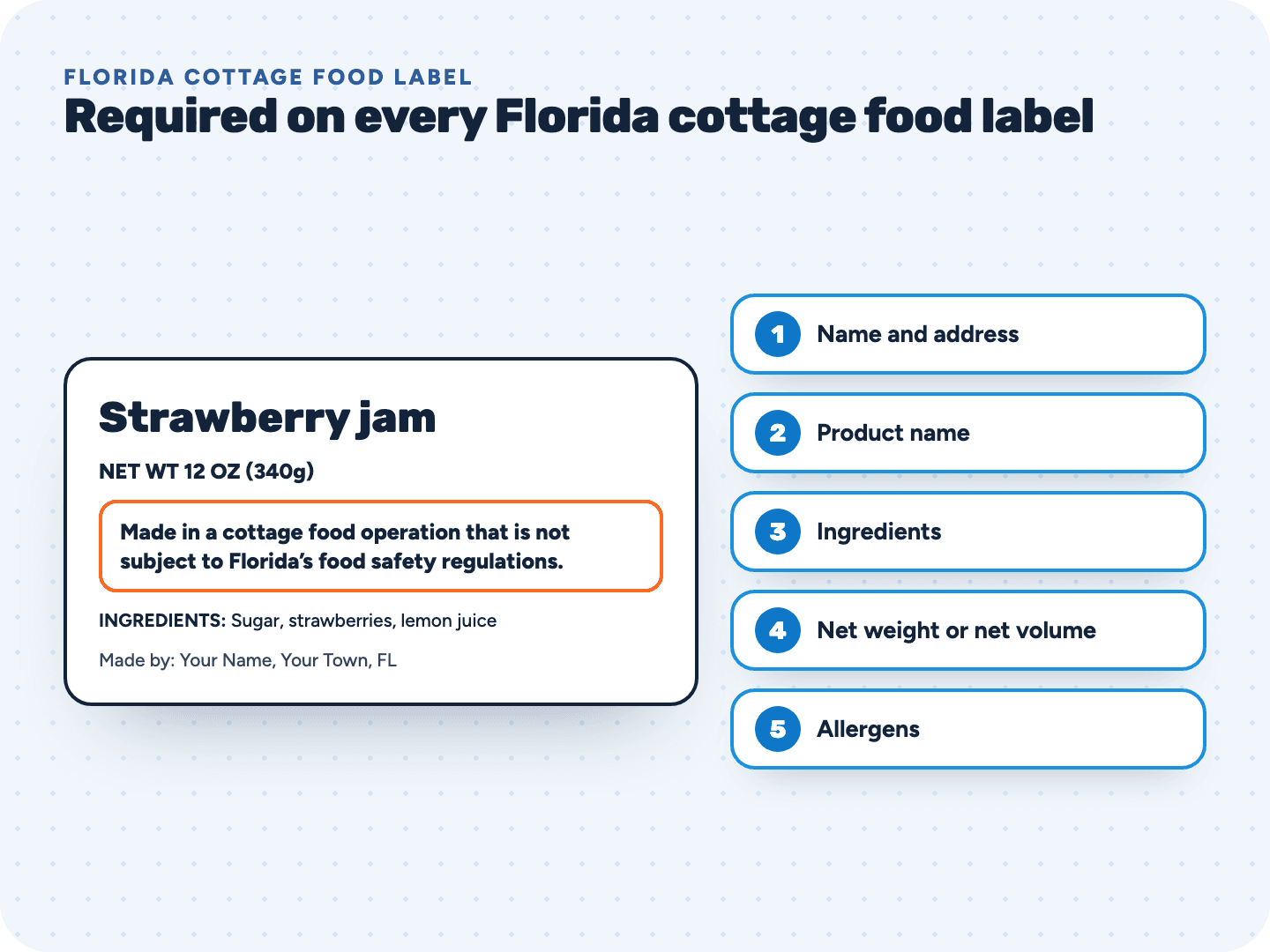
- 1Name and addressFla. Stat. 500.80(3)(a)The name and address of your cottage food operation.
- 2Product nameFla. Stat. 500.80(3)(b)What the food is, like "Key lime cookies" or "Guava jam".
- 3IngredientsFla. Stat. 500.80(3)(c)Every ingredient, in descending order of predominance by weight. The heaviest ingredient goes first.
- 4Net weight or net volumeFla. Stat. 500.80(3)(d)How much is in the package, like "Net Wt. 8 oz (227 g)" for cookies or fluid ounces for a sauce.
- 5AllergensFla. Stat. 500.80(3)(e)Allergen information as federal labeling rules require it: any of the 9 major allergens, named in the ingredients or in a Contains line.
- 6Nutrition info, only with a claimFla. Stat. 500.80(3)(f)Say "low sugar" or "high protein" on the label and you need nutrition information under federal rules. No claim, no panel needed.
- 7The cottage food statementFla. Stat. 500.80(3)(g)Word for word, in at least 10-point type and a color that clearly contrasts with the label background: “Made in a cottage food operation that is not subject to Florida’s food safety regulations.”
- Prepackaged, alwaysFlorida ruleYou may only sell cottage food that is prepackaged with the label already on it. No loose cookies from a tray. You may also only sell products you store at your home.
Sales cap, permits and where you can sell
Where this comes from
Florida label questions
Seven things: your name and address, the product name, ingredients by weight, net weight or volume, allergens, nutrition information if you make a nutrition claim, and the statement “Made in a cottage food operation that is not subject to Florida’s food safety regulations.” Florida Cottage Food Law →
At least 10-point type, in a color that clearly contrasts with the label background. Our PDF exports are actual size, so print at 100% scale and 10-point type stays 10-point on the sticker.
Yes. Florida law lets you sell and take payment online or by mail order, and deliver in person, to an event venue, or by USPS or a commercial delivery service.
No. Florida cottage food operations may not sell at wholesale. To supply a store you need a food permit from the state.
Use our free cottage food label template and add the Florida statement word for word. Or let the label maker build the ingredient list and allergen line from your recipe, so the weights are in the right order. Cottage Food Label Template →
Florida law stops cities and counties from banning cottage food or regulating how you make and sell it. You still have to follow the state's general rules for home-based businesses.
See your label before you pay anything
Free preview, no account. $29 when you're ready to print.