Maine Honey Label Requirements
Maine honey label requirements are short: the common name, the ingredients, the net weight and your name, address and ZIP code. That label is needed once a jar leaves your home for a market, a shop or a store shelf. Maine has no honey-specific label rule, so these general rules and the federal ones apply. What you do need first is an apiary license for your bees, and since state law gives honey no licensing exemption, check with DACF before you sell packaged honey.
Required on every Maine honey label
The Maine Department of Agriculture, Conservation and Forestry (DACF) lists these four items for foods sold outside the home.
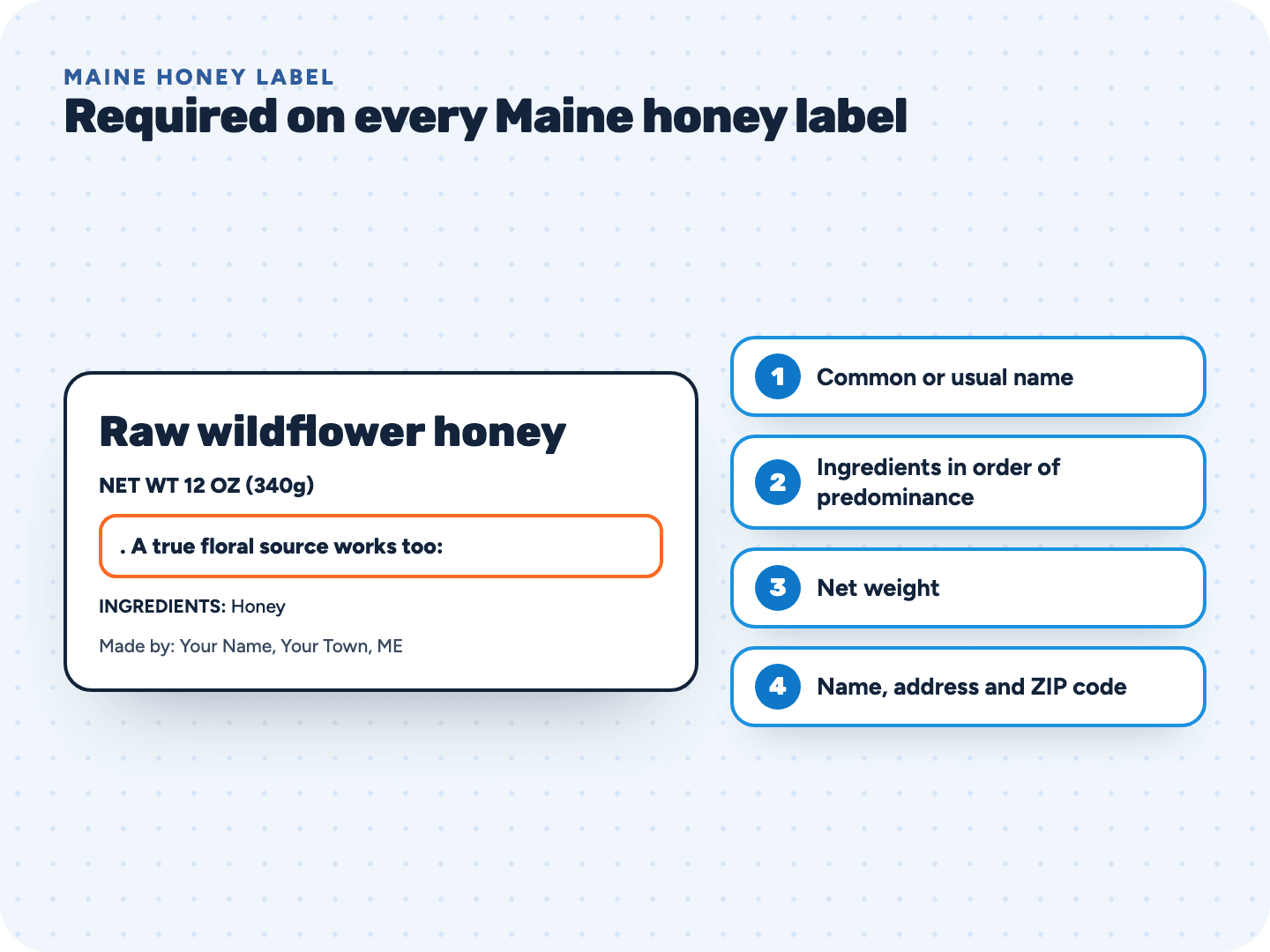
- 1Common or usual nameDACF Home Food License 101For a jar of pure honey that is "Honey". A true floral source works too: "Blueberry Blossom Honey", "Wildflower Honey".
- 2Ingredients in order of predominanceDACF Home Food License 101For pure honey that is one word. Spiced, whipped with cinnamon or infused honey lists every ingredient, heaviest first: "Honey, cinnamon".
- 3Net weightDACF Home Food License 101Honey is sold by weight, like "NET WT 16 oz (454 g)". Federal rules want it in the bottom 30% of the front label.
- 4Name, address and ZIP codeDACF Home Food License 101Of the producer. Your farm or apiary name works with a street address, town and ZIP.
- Selling right from your home?No labelMaine's home food rules say a product sold directly to the consumer from the home does not need a label. At a farmers market, a farm stand or in a store, every jar needs the full label.
Licenses for Maine beekeepers
Where this comes from
- Maine DACF: Home Food License 101The four label items, the no-label rule at home, the $20 fee
- 7 MRSA §2701: Licensing (honeybees)The annual apiary license for everyone who owns honeybees
- 7 MRSA Chapter 8-F: Maine Food Sovereignty ActLocal ordinances for direct producer-to-consumer sales
- 22 MRSA §2152: Definitions (food establishments)Who needs no food establishment license
Maine label questions
For your bees, yes: every Maine beekeeper needs an apiary license. For selling packaged honey, state law has no honey exemption from food licensing, so ask DACF's Quality Assurance and Regulations division how your operation is classed before you offer jars for sale.
Not under state law. Maine's statute lists the businesses that need no food establishment license, and honey is not one of them. The exception is a town with a food sovereignty ordinance, for honey you sell directly to consumers there.
DACF's home food guidance asks for the name, address and ZIP code of the producer. Federal rules let you leave off the street address when your business is listed in a current city or phone directory.
Maine's home food rule doesn't ask for one. Under federal law, many small beekeepers qualify for the small business exemption as long as the label makes no nutrition or health claims. Write something like "good source of antioxidants" and you need the panel. Do I Need a Nutrition Label? →
Same four label items, with every added ingredient in the ingredient line, heaviest first. Call it what it is, like "Cinnamon Creamed Honey". Mixed with any other sweetener, it is no longer just honey.
See your label before you pay anything
Free preview, no account. $29 when you're ready to print.