Michigan Cottage Food Law Label Requirements
Michigan cottage food law label requirements: each product gets its own label with your name and home address, the product name, every ingredient (sub-ingredients too), the net weight with its metric equivalent, allergens, and a required home kitchen statement in at least 11-point type. You don't need a license or registration, and you can sell up to $50,000 a year.
Required on every Michigan cottage food label
MDARD wants every item labeled before it is sold. These six parts make a Michigan cottage food label complete.
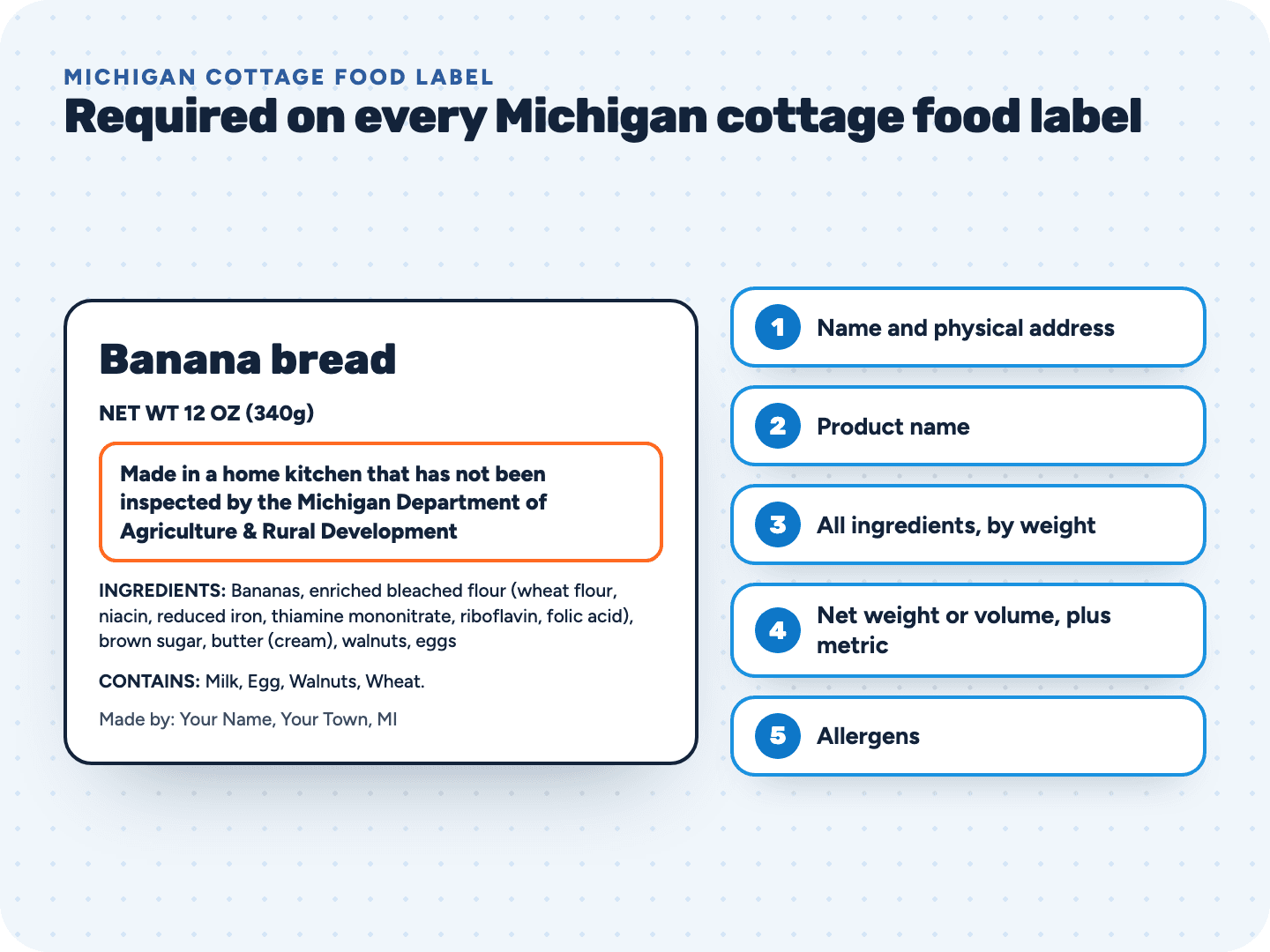
- 1Name and physical addressThe address of your home kitchen. A P.O. box is not allowed. With the MSU Product Center voluntary registration, you can print your assigned registration number in place of your name and address.
- 2Product nameWhat the food is, like "Cherry oatmeal cookies". All capitals or mixed case are both fine.
- 3All ingredients, by weightHeaviest first. If you use a ready-made ingredient, list what is in it too, like "butter (cream, salt)". Trade secrets are no excuse to leave one out.
- 4Net weight or volume, plus metricThe amount in the package with the metric equivalent next to it, like "Net Wt. 8 oz (227 g)".
- 5AllergensAs federal labeling rules require: in the ingredient list or a "Contains" line. Name the exact tree nut. "Walnuts" works, "nuts" does not.
- 6The home kitchen statementMDARD cottage food labeling guidanceWord for word, in at least 11-point type (about 1/8 inch tall) and a color that contrasts with the background: “Made in a home kitchen that has not been inspected by the Michigan Department of Agriculture & Rural Development”
- Cakes you can't stick a label onMDARD tipFor wedding cakes, birthday cakes and other specialty cakes, put all the label information on the invoice and deliver it with the cake. Smaller cakes go in a box with the label on the box.
Sales caps, licensing and where you can sell
Where this comes from
- MDARD: Cottage FoodOfficial state program page
- MDARD: Cottage Food LabelingRequired label items and the exact statement
- MDARD: Getting Started and FAQSales caps, no registration, primary residence
- MDARD: Selling and SamplesWhere and how you can sell
- MDARD: What Can I Make?Allowed and not allowed foods
- MDARD: Maple Syrup and HoneyThe separate honey and maple syrup exemption
Michigan label questions
Yes, if they are clearly legible, written in durable permanent ink, and large enough to match the font size rules. Printed labels are faster once you sell more than a few dozen items. Michigan Cottage Food Law →
Yes, the physical address of your home kitchen. A P.O. box is not accepted. The MSU Product Center voluntary registration lets you print an assigned registration number in place of your name and address.
No. MDARD does not require lab analysis. You list every ingredient yourself, in descending order by weight, with sub-ingredients for anything ready-made.
You can sell online or by mail order if the customer can interact with you directly before the sale. Sales and deliveries must stay within Michigan.
A Nutrition Facts panel is not on MDARD's list of required items. Add one if you make a nutrition claim like "low fat" or "high fiber", because federal rules then ask for it.
No. If two people in one home each run their own cottage food business, each one can sell up to the full limit.
See your label before you pay anything
Free preview, no account. $29 when you're ready to print.