Cheese Label
Cheese label requirements start with the name: cheddar, monterey jack, mozzarella and dozens of other cheeses have an FDA standard of identity, and the label uses that exact name. Add the net weight, the ingredients, a Contains line for milk, your name and address and, in most cases, Nutrition Facts per 1 oz (28 g). Enter your cheese and get a panel that fits a wedge, a block or a pack of slices.
- Free preview
- $29 per label
- Ready to print
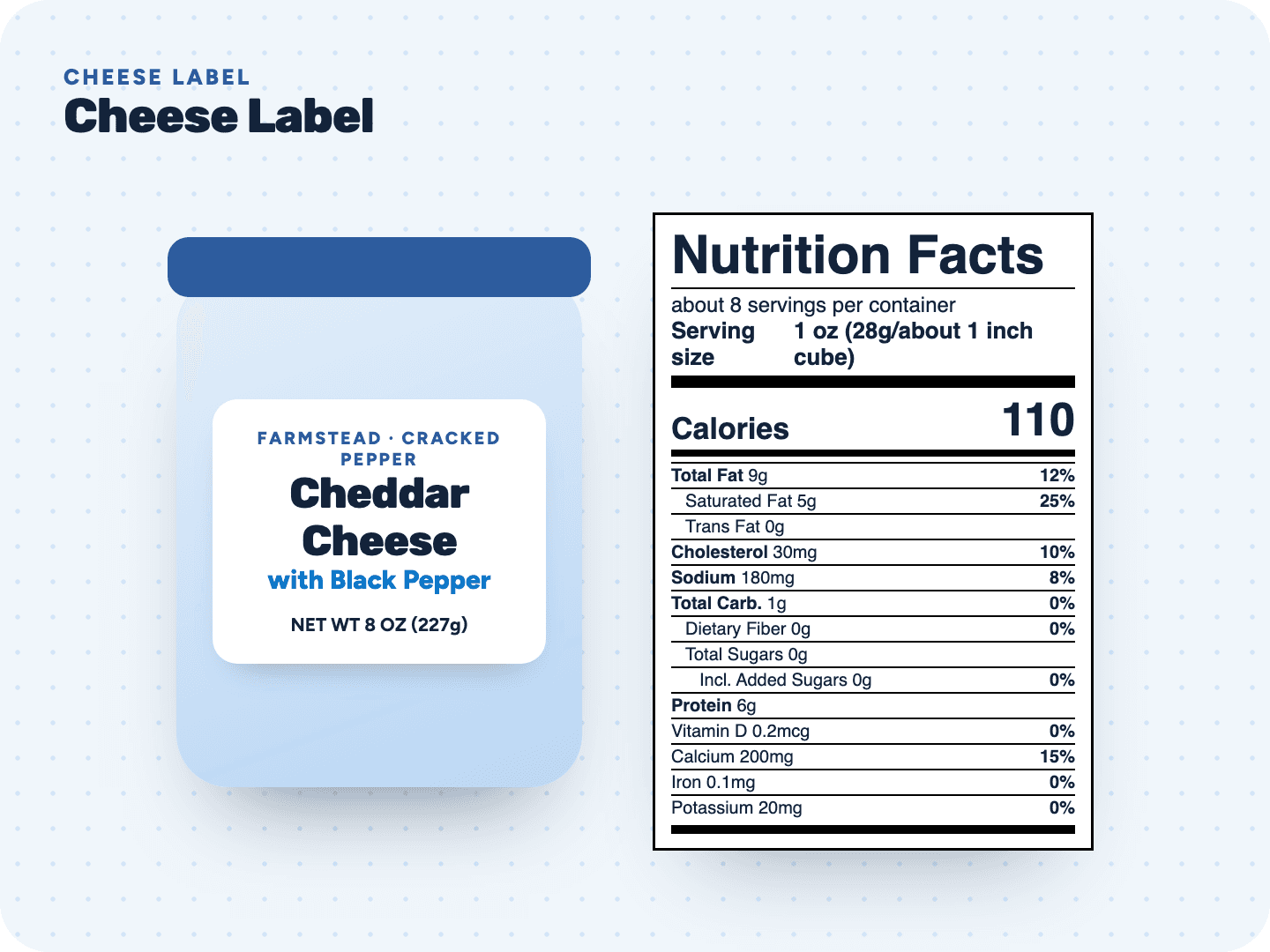
What has to be on your cheese label
The name and weight go on the front of the wrap. The rest fits on the back or a side label, like the block on the left.
- 1Standard name of the cheese21 CFR 133.113, 133.193A cheese that meets a standard carries its name: "cheddar cheese", "monterey jack cheese", "mozzarella cheese". Add a spice and the name keeps the variety plus the spice, like "cheddar cheese with black pepper".
- 2Net weight21 CFR 101.7Ounces and grams on the front: NET WT 8 OZ (227g). Wedges cut to order weigh something different each time, so each one gets its own weight, which may be written in decimal pounds, like 0.75 lb.
- 3Nutrition Facts21 CFR 101.9Per 1 oz (28 g) for a block or wedge, per slice for sliced cheese. Small producers may be exempt while the label makes no nutrition claims, such as "high protein" or "good source of calcium".
- 4Ingredient list21 CFR 101.4, 133.113(d)Milk, culture, salt and enzymes. The cheddar standard lets you write "enzymes" instead of naming each one. Smoked, herbed or peppered cheese adds those extras in order of weight.
- 5Allergen statementFALCPACheese means milk, so name it in a Contains line or in the ingredient list. Coated, rolled or stuffed cheeses can bring more allergens, like nuts in a crust.
- 6Name and address21 CFR 101.5The dairy that made the cheese or the shop that packed it, with city, state and ZIP. Cutting and wrapping someone else's wheel? "Packed by" with your details works.
Things that are different for cheese
Cheese packages and the label that fits
Wrapped wedges leave little flat space. Measure the face you will stick the label on, then try the formats in the tool.
| Package | Typical label area | Style that usually fits |
|---|---|---|
| 4 oz wedge | 2 × 2.5 in | Small package (linear) |
| 8 oz block | 3 × 2.5 in | Tabular (wide)Most common |
| 8 oz pack of slices | 3 × 3 in | Standard (vertical) |
| 1 lb block or wheel | 3.5 × 4 in | Standard (vertical) |
Start from a cheese label that's already filled in
Cracked pepper cheddar, entered as finished cheddar plus the pepper. Cheesemaking drains away the whey, so a recipe that starts from milk would not add up: start from the USDA match for your cheese type, or type in the values from a lab report on your own cheese. Pick monterey jack or swiss instead of cheddar and the numbers follow.
| Ingredient | Amount | Unit |
|---|---|---|
| Cheddar cheese✓ USDA match | 4.4 | lb |
| Black pepper✓ USDA match | 2 | tbsp |
Cheese label questions
Yes. Our free blank Nutrition Facts templates come as fillable PDF, Word, SVG and PNG, and the pepper cheddar on this page is already filled in. Swap in your own cheese in the free preview, then pay $29 when you want the print files. Blank Nutrition Facts Label Template →
For most cheeses, 1 oz (28 g) or one piece, based on a 30 g reference amount. Grated hard cheese, ricotta and cottage cheese have their own reference amounts, so check which group yours belongs to.
Only if it meets the standard: at least 50% milkfat in the solids, no more than 39% moisture, and the cheddar process or one that gives the same result. If it does not, give it a name that truthfully describes what it is.
Not if you qualify as a small business: no more than $50,000 a year in food sales to consumers, or $500,000 in total sales, and no nutrition claims on the label or in your ads. The name, weight, ingredients, milk allergen and your address are still required. How to Sell at a Farmers Market →
We make the files, not the stickers. Download a vector PDF at actual size for your label printer, or print sheets for Avery 5126, 5168, 5164 and 5163 on US Letter, sized to fit wraps and boxes. Avery Food Labels →
Make your cheese label now
Free preview, no account. $29 when you're ready to print.