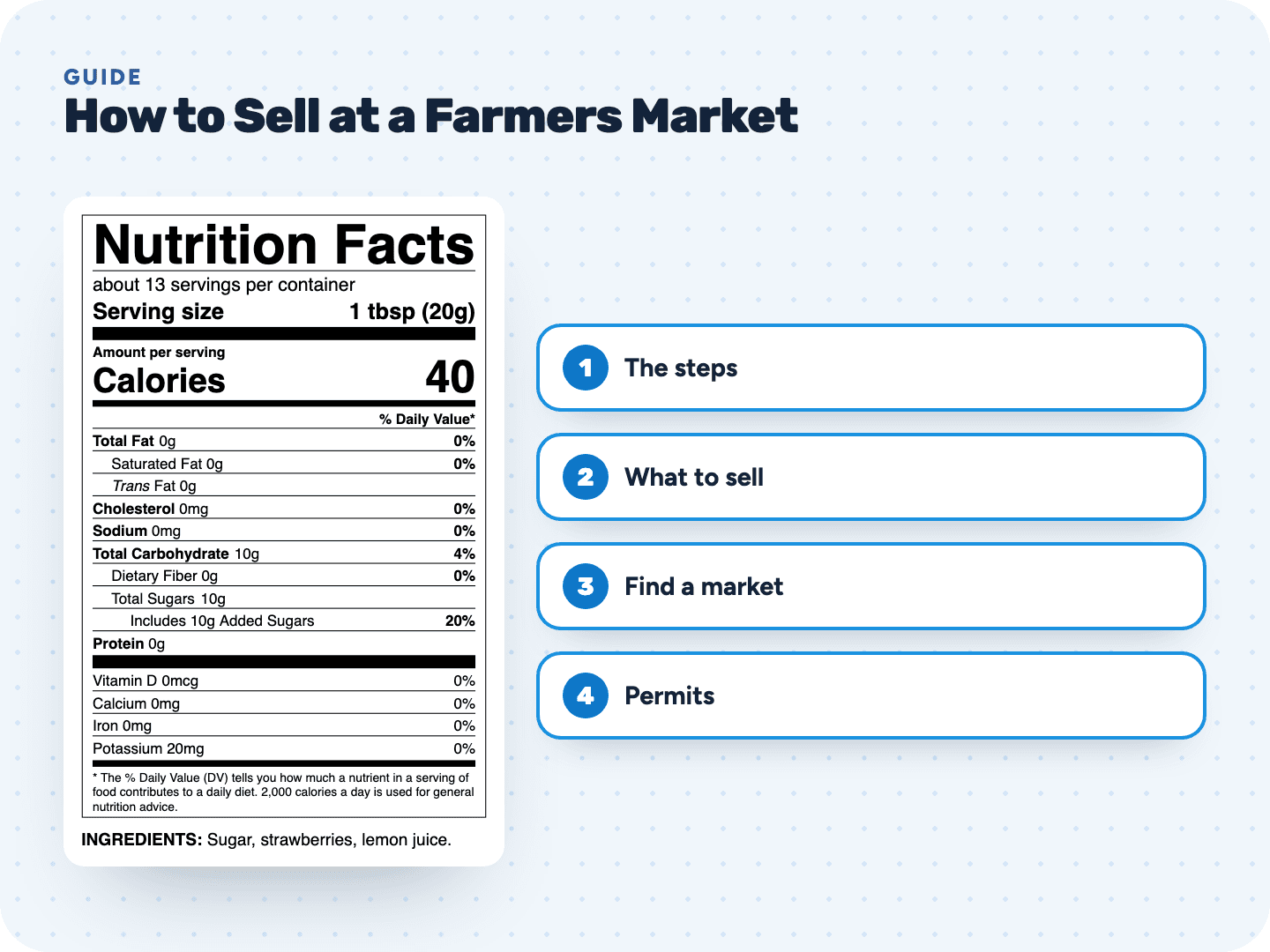
How to become a farmers market vendor
Work through these in order. Each step decides the next one, and the label comes last because it depends on everything before it:
Step 1: choose what to sell
Start with what your state allows from a home kitchen. Cookies, breads, candy and jams make the list in Washington and Ohio, and Texas allows every food except a short list. Jarred and preserved foods are where states split the most:
- Washington: canned fruits and vegetables, salsas, pickles and relishes are off the cottage food list.
- Texas: pickles qualify under the current cottage food law.
- Mississippi: acidified foods are on the approved list if they fit the federal definition and finish at pH 4.6 or lower.
- Kentucky: farmers who grow the main ingredients can make pickles and salsa as home-based microprocessors, after Food Processing School and an approved scheduled process for each recipe.
- Iowa: honey can go to farmers markets without a market license.
If a product isn't on your state's list, it needs a licensed kitchen and the matching food license before it can go on your table.
Step 2: find a market and apply
Markets pick their vendors, and each one has its own rules. Get the vendor application before you buy packaging, and look for:
- Which products the market accepts, and whether it limits how many vendors sell the same thing
- What it asks from food vendors: a license, insurance, a food handler certificate
- Whether you may hand out samples
- Booth fees, the season and what you must bring: tent, table, weights
Some states route market sales through specific bodies. Alabama sends cottage food sellers to the Farmers Market Authority, which runs the state-sanctioned markets. In Nevada, a cottage food operator sells at a licensed farmers market, flea market or swap meet with the market manager's approval.
Step 3: permits for selling at farmers market stands
Up to three layers can apply: your state's cottage food registration or permit, a short-term health department permit for any food handled at the stand, and the market's own vendor rules. Many sellers of packaged, labeled cottage food need only the first layer, and in exempt states not even that. Our permit guide walks through each layer with state examples.
Farmers Market Permit →Step 4: pack and label before market day
Under a cottage food law, food arrives at the market finished: made, packed, sealed and labeled in your home kitchen. Three states spell it out:
- New York: packaging and labeling happen in your home, never at the market table or a craft fair booth.
- Nevada: everything you sell or sample is packaged at home, before it heads to the market.
- Florida: every product is prepackaged with its label on before you sell it.
Packing at home also saves you at the stand. You can't relabel a bag in the wind, and a sealed, labeled package can sit in a cooler or a crate without anyone touching the food.
Step 5: selling at farmers market stands
On market day, a few state rules travel with you:
- Show your paperwork: Washington wants a copy of your cottage food permit displayed where you sell, Arizona your certificate of registration, Delaware your registration.
- Carry your card: in Minnesota, inspectors and market managers may ask to see your registration card.
- Samples: Michigan allows free samples of foods that stay safe at room temperature, Florida allows them if they are prepackaged, and Connecticut allows them if your local health department approves.
- Keep a sales total: caps count every market day. Mississippi's is $35,000 a year, Michigan's $50,000 (or $75,000 when each product is priced at $250 or more), Florida's $250,000.
Write each market day's sales down the same evening. If you ever get close to your cap, you will want the numbers by month, not a shoebox of receipts.
The label every farmers market vendor needs
Your label does the talking when you're busy with the next customer. For cottage food it usually carries the product name, net quantity, your name and address, the ingredients from heaviest to lightest, any of the nine major allergens and the home-kitchen statement your state prescribes.
Build it once in our tool and reuse it all season. Enter the recipe, confirm each USDA match, and the tool writes the ingredient list in the right order, spells out which tree nut, fish or shellfish is in the food on the Contains line and adds a Nutrition Facts panel when you need one. Print on Avery 5163, 5164, 5168 or 5126 sheets, or export a PDF for a print shop.
Cottage Food Label Requirements →Cottage Food Label Template →Start your label free →When your market business outgrows cottage food
Every cottage food law has edges. In Michigan, wholesale, sales over the cap, refrigerated foods or shipping out of state make you a licensed food processor with MDARD. In Texas, passing $150,000 in yearly sales, selling to shops on your own or mailing orders means a food manufacturer license or a food establishment permit. Licensed food carries the complete federal label, which for most products includes a Nutrition Facts panel.
License to Sell Food →Farmers market vendor rules by state
- Alabama
- Alaska
- Arizona
- Arkansas
- California
- Colorado
- Connecticut
- Delaware
- Florida
- Georgia
- Hawaii
- Idaho
- Illinois
- Indiana
- Iowa
- Kentucky
- Louisiana
- Maine
- Maryland
- Massachusetts
- Michigan
- Minnesota
- Mississippi
- Missouri
- Nebraska
- Nevada
- New Jersey
- New Mexico
- New York
- North Carolina
- Ohio
- Oklahoma
- Oregon
- Pennsylvania
- South Carolina
- South Dakota
- Tennessee
- Texas
- Utah
- Virginia
- Washington
- West Virginia
- Wisconsin