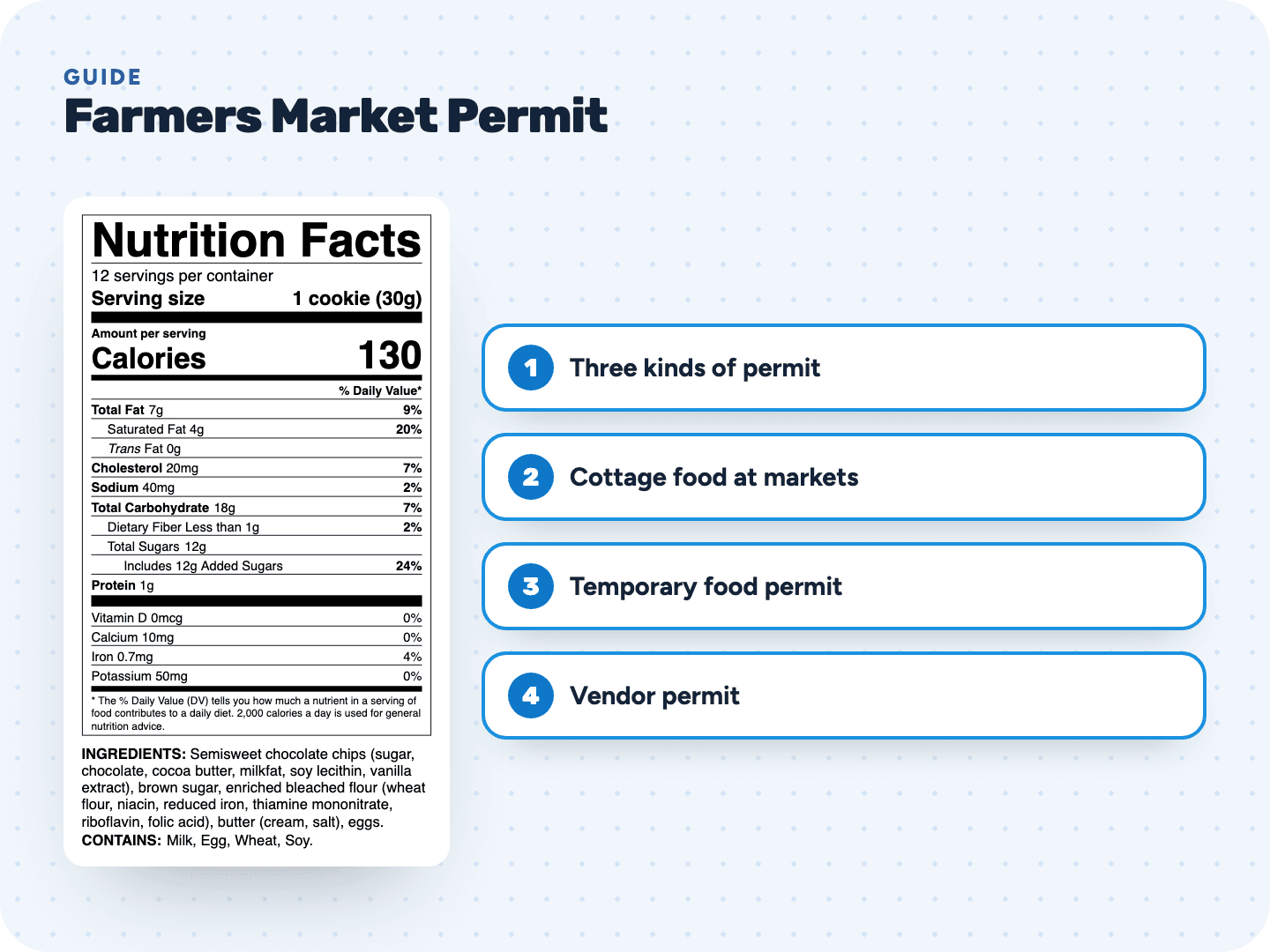
The three kinds of farmers market permit
People say "farmers market permit" for three different things. Most food sellers deal with one or two of them, and they come from different offices:
- Cottage food exemption, registration or permit: the state rule for food made in your home kitchen. In many states it is an exemption, so packaged, labeled homemade food needs no food permit at the market.
- Temporary food establishment permit: issued by a city or county health department for a stand at a market or event. It matters when food is handled at the stand: opened, cooked, portioned or served.
- Farmers market vendor permit: the market's own application, booth agreement and vendor rules. A market can ask for more than the state does.
That sentence in FDA's food facility registration rule keeps your home kitchen out of FDA registration. The paperwork for a market stand comes from your state, your county or city, and the market.
FDA Food Facility Registration →Cottage food at the market: often no food permit
For homemade breads, cookies, candy, jams and other shelf-stable foods, your state's cottage food law sets the rules at the market too. Every state below allows cottage food sales at farmers markets. What each one asks for first is different:
| State | What you need to sell cottage food at a farmers market |
|---|---|
| Mississippi | No food permit, if you stay under the $35,000 yearly cap and sell packaged, labeled food |
| Indiana | No food license, and no local government may demand one. An accredited food handler certificate is required |
| Iowa | No farmers market license for cottage food |
| Ohio | No local health department license, as long as everything is prepackaged and labeled |
| Nebraska | A one-time registration and a food safety course, unless you only sell shelf-stable food at farmers markets |
| New Jersey | A state cottage food permit, plus the local permits your town or market requires |
| Massachusetts | A retail permit from your local board of health |
| Washington | A WSDA cottage food permit before your first sale, with a copy on display where you sell |
In the exempt states, the exemption follows you to the market as long as the food arrives packed and labeled from your home kitchen. In the permit states, get the permit or registration before your first market day.
Cottage Food Permit →When you need a temporary food establishment permit
The cottage food exemption covers food that was made, packed and labeled at home. Handle food at the stand and you are running a food stand, which is the health department's territory. Four states show how that works:
- Ohio: cookies set out unwrapped for customers to choose from need the local health department's temporary or mobile food license.
- Iowa: DIAL allows one kind of food establishment for cottage food sales, a temporary food establishment that the producer runs.
- New Jersey: a craft fair or county fair takes a temporary food permit on top of the cottage food permit.
- Hawaii: the state doesn't require a Special Event permit for homemade food, but a market or fair may. If an organizer asks for one, the Food Safety Branch reviews and signs the application.
Selling something your state's cottage food law doesn't cover, like hot food or a refrigerated item your state leaves out? Then the exemption doesn't apply at the market either, and you start with the food permit rules of your local health department.
The farmers market vendor permit
A market writes its own vendor rules, and state agencies say plainly that those rules can go further than the law:
- Connecticut: a farmers market may still require a food establishment license from vendors who hold a cottage food license.
- Georgia: the Department of Agriculture says markets may ask vendors for a Food Sales Establishment License.
- Michigan: some markets ask every vendor for a food license, whatever the cottage food law says.
- Indiana: a market can't force a home-based vendor to hold a food license, though its manager may want to see your food handler certificate or your insurance.
Read the vendor application before you plan your products. If it asks for a license your state doesn't require, the market's rule decides whether you get a stall there.
Business licenses and zoning
The food permit is one piece. Washington asks cottage food applicants for a master business license and local zoning approval before they apply. In Mississippi, the state health department's exemption doesn't cover a business license your city or county may want. Call your city or county clerk once and ask which business license, if any, covers selling at a market.
Label rules for market sales
Whichever permit you hold, every jar and bag on your table needs a label. For cottage food, that means the product name, your name and address, an ingredient list sorted by weight, the major food allergens and your state's home-kitchen statement in its exact wording. Florida's reads:
Sell under a commercial license instead and the federal label rules apply to your packaged food, with a Nutrition Facts panel unless an exemption fits. Our tool makes both from the same recipe: it matches each ingredient to USDA data, sorts the ingredient list by weight, flags the nine major allergens, writes the Contains line and exports a print-ready PDF.
Cottage Food Label Requirements →Start your label free →Farmers market rules by state
Pick your state for its market rules, permit or registration, yearly cap and home-kitchen statement:
- Alabama
- Alaska
- Arizona
- Arkansas
- California
- Colorado
- Connecticut
- Delaware
- Florida
- Georgia
- Hawaii
- Idaho
- Illinois
- Indiana
- Iowa
- Kentucky
- Louisiana
- Maine
- Maryland
- Massachusetts
- Michigan
- Minnesota
- Mississippi
- Missouri
- Nebraska
- Nevada
- New Jersey
- New Mexico
- New York
- North Carolina
- Ohio
- Oklahoma
- Oregon
- Pennsylvania
- South Carolina
- South Dakota
- Tennessee
- Texas
- Utah
- Virginia
- Washington
- West Virginia
- Wisconsin