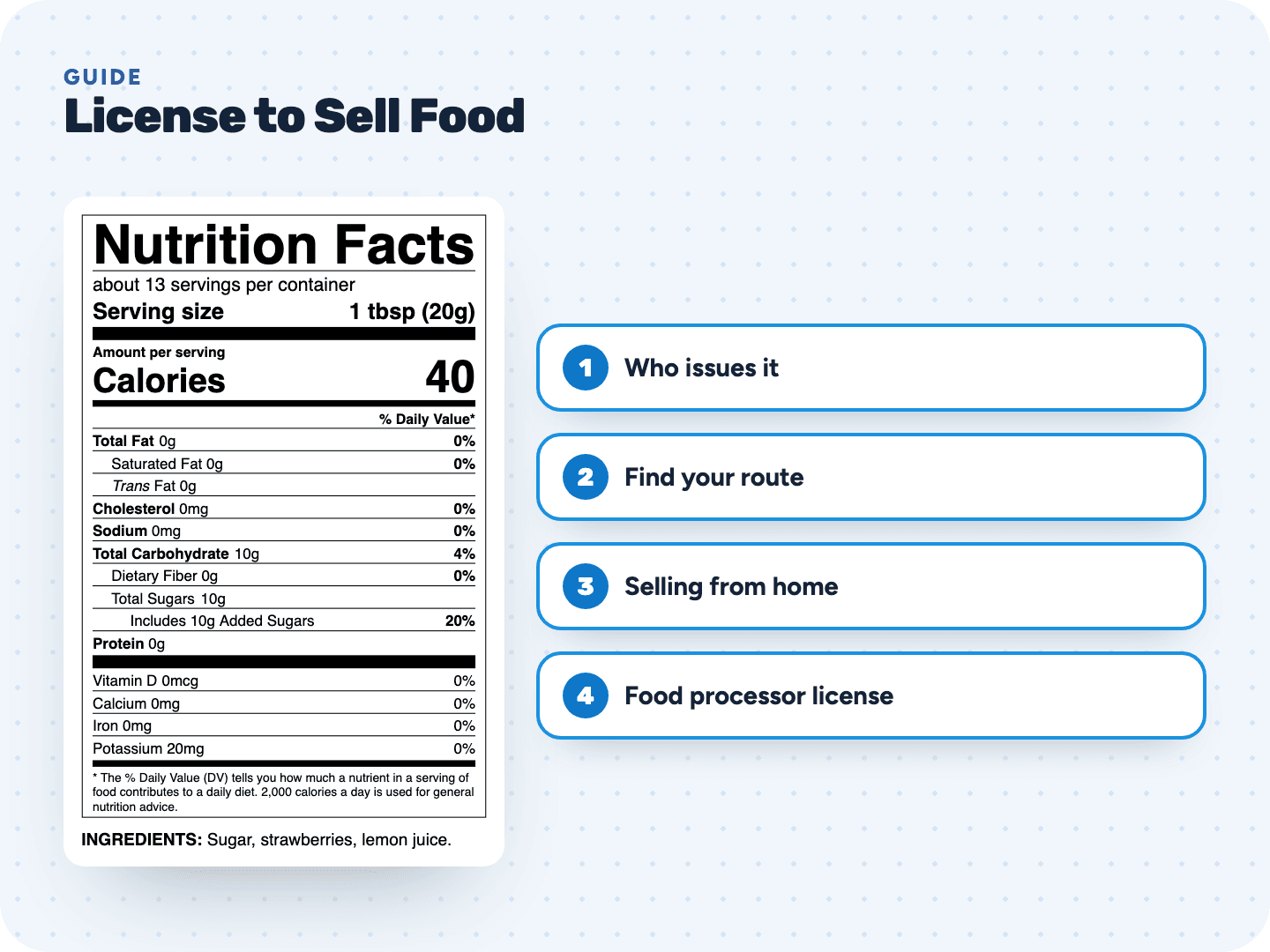
Who issues a food business license
There is no single "food license" that covers the whole country. A food business usually deals with three levels of government, each with its own job:
| Level | What it handles | Typical paperwork |
|---|---|---|
| City or county | Food sold and served to consumers: restaurants, food trucks, market stands. Also the general business license | Retail food permit from the local health department, business license from the city or county |
| State | The cottage food law for home kitchens (in some states run by counties, like California), and commercial plants that make packaged food | Cottage food registration or permit, or a food processor license |
| FDA | Facilities that manufacture, process, pack or hold food, and the federal rules for safety and labels | Food facility registration, unless the facility is exempt |
Find your route in three questions
- Where is the food made: your own home kitchen, a rented commercial kitchen, or your own plant?
- Who buys it: the person who eats it, or a store, cafe or distributor that resells it?
- Where does it go: only inside your state, or across state lines and online to other states?
| Your situation | Usual route | FDA registration? |
|---|---|---|
| Home kitchen, selling directly to customers | Your state's cottage food law: nothing to file, a registration or a permit | No: a private home is not a facility |
| Home kitchen, selling through local shops | Only where your state's law allows it, sometimes with a higher permit level | No: a private home is not a facility |
| Commercial or shared kitchen, selling wholesale | A state food processor or manufacturer license | Yes, unless an exemption fits |
| Food truck, stand or shop selling to the public | A retail food permit from the local health department | No: retail food establishments are exempt |
Selling from home: the cottage food route
Every state sets its own cottage food rules, and the paperwork runs from none at all to a permit with an inspection. Four states from our state pages show the range:
| State | What you file | Worth knowing |
|---|---|---|
| Alaska | No state permit or inspection under the homemade food exemption | Cities and boroughs can have their own rules |
| Arkansas | No health permit under the Food Freedom Act | A shop can sell your food, and a carrier can deliver it |
| Arizona | Online registration with ADHS, renewed every three years | No annual program fees |
| Alabama | No food service permit | A food safety course and a county review of your certificate and label |
The catch in every state is the food list and the sales channel. Cottage food laws are written for food made and sold in a particular way, so check that your product and your way of selling are both covered before you buy jars. Pick your state below:
- Alabama
- Alaska
- Arizona
- Arkansas
- California
- Colorado
- Connecticut
- Delaware
- Florida
- Georgia
- Hawaii
- Idaho
- Illinois
- Indiana
- Iowa
- Kentucky
- Louisiana
- Maine
- Maryland
- Massachusetts
- Michigan
- Minnesota
- Mississippi
- Missouri
- Nebraska
- Nevada
- New Jersey
- New Mexico
- New York
- North Carolina
- Ohio
- Oklahoma
- Oregon
- Pennsylvania
- South Carolina
- South Dakota
- Tennessee
- Texas
- Utah
- Virginia
- Washington
- West Virginia
- Wisconsin
Growing past the home kitchen: the processor license
Selling to grocery stores, shipping to other states, or making a food your cottage law excludes usually means moving to a licensed kitchen. Our state pages show the pattern in different words: in Arizona, selling across state lines or moving production out of your home means a licensed food establishment; in California, going past the Class B cap or selling out of state means a licensed food facility.
- A state license for the kitchen or plant, from the state health or agriculture department
- FDA food facility registration before you start making food there, renewed every other year
- A DUNS number from Dun & Bradstreet, which FDA asks for before you register
- Current good manufacturing practice (21 CFR 117): food made under safe and sanitary conditions
- Records that show where each ingredient came from and where each shipment went
Some foods bring extra federal rules on top: juice (a HACCP plan under 21 CFR 120), acidified foods like pickles and hot sauce, low-acid canned foods, and seafood. Plan for those before you sign a lease.
Food trucks, market stands and shops
If you serve or sell food straight to the public from a place of business, the local health department is your licensing office. FDA's own examples of food businesses it does not regulate are retail food establishments, such as grocery stores, restaurants and food trucks, and farmers markets.
The same idea runs through FDA's registration rule. A retail food establishment, one that sells more food directly to consumers than to all other buyers combined, does not register with FDA, even when it makes the food it sells there.
A food permit is not a business license
Food permits are about safety. A business license is about running a business in your city or county, and you can need one even when your state asks nothing for the food itself. Our Alaska and Arkansas pages both point this out. Ask your city or county clerk what applies to your address, and if you rent or belong to an HOA, check those rules too.
Every license ends with a label
Whichever route you take, the inspector, the market manager and the store buyer will all look at the package. What goes on it depends on the route:
| Route | Label |
|---|---|
| Cottage food | Whatever your state lists, often the food's name, who made it and where, the ingredients and allergens, plus a home-kitchen statement copied exactly |
| Licensed kitchen | The full FDA label: name, net quantity, ingredients, allergens, name and place of business, and Nutrition Facts unless an exemption applies |
Our label maker does both. Type your recipe, confirm each USDA match, and get the ingredient list, the allergen statement and an FDA-rounded Nutrition Facts panel, with print sheets for common Avery labels. The preview is free.
Make your food label →