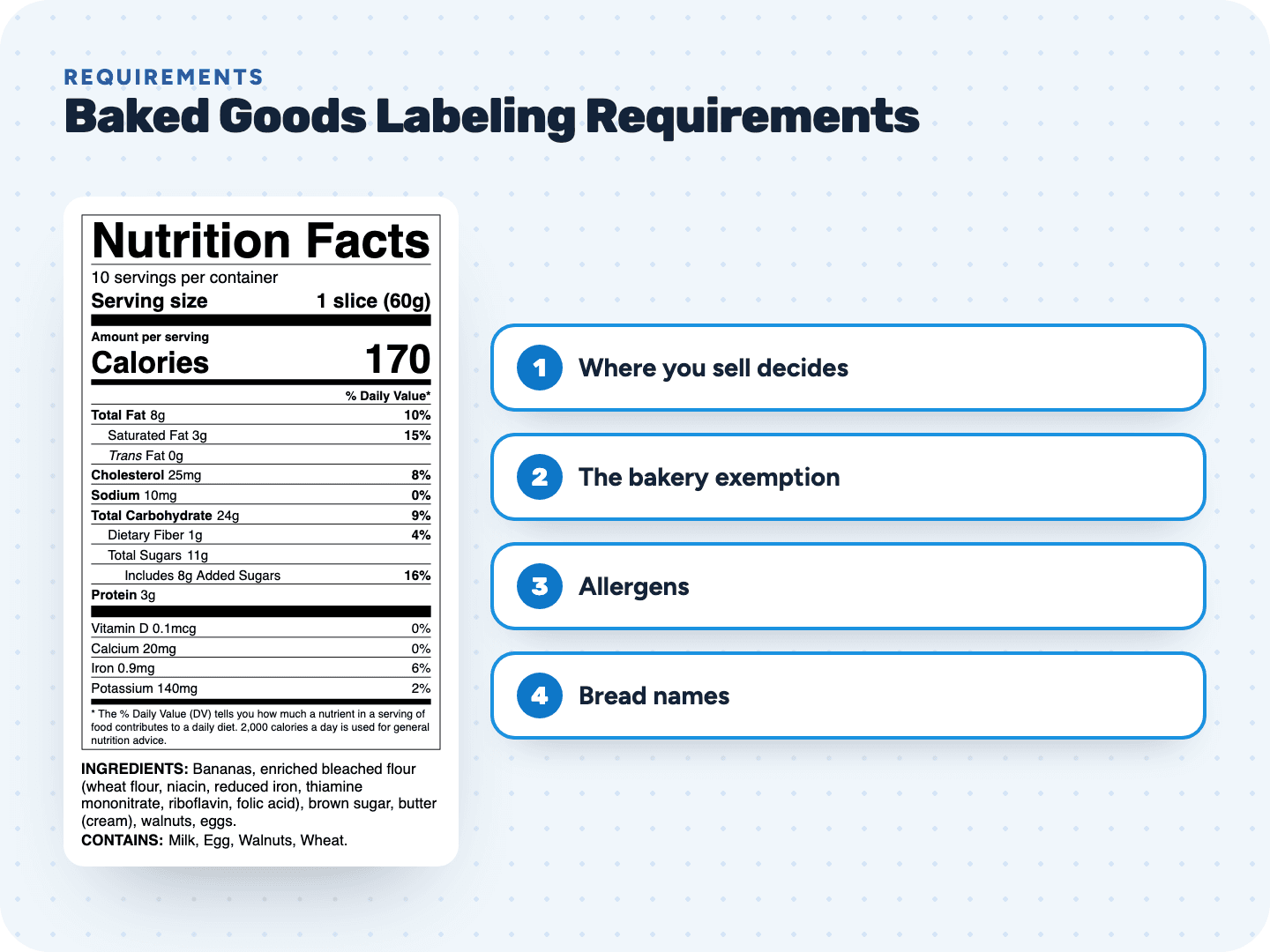
What the label needs, by where you sell
| How the item is sold | Allergen labeling | Nutrition Facts |
|---|---|---|
| Packed ahead and sold only in your own bakery or in-store bakery department | Yes: FALCPA covers retail shops that package and label food | Exempt, if there are no nutrition claims or nutrition information |
| Put in a bag or box after the customer orders | Not covered by FALCPA's labeling rules | Exempt, if there are no nutrition claims |
| Sold online or at markets straight to consumers | Yes | Exempt for a business with $500,000 or less in sales to consumers, or $50,000 or less in food sales to consumers, and no nutrition claims |
| Sold wholesale through grocery stores or other shops | Yes | Usually required. Check the low-volume exemption: fewer than 100 full-time equivalent employees and fewer than 100,000 units of that product a year |
Exempt from Nutrition Facts does not mean exempt from labeling. A packaged item still needs its name, net weight, ingredients, allergens and your name and address.
The bakery exemption, condition by condition
- The item is ready to eat
- It is sold to consumers, but not for eating right there
- It is made mainly in your retail establishment
- It is not offered for sale anywhere outside that establishment
- Nothing about it makes a nutrition claim or gives nutrition information, on the label, in labeling or in advertising
FDA's own examples are independent bakeries with no seating and in-store bakery departments. Add tables where customers eat on the spot and you fall under the food service exemption instead, with the same no-claims condition.
The two ways bakeries lose it: selling the same muffins through a café or grocery store, which puts them outside your shop, or posting "only 120 calories" or "low sugar" on a sign, a menu or social media. From then on, check the small business and low-volume exemptions, or label.
Allergens: wheat, milk, egg, nuts and sesame
- Name the source once: in parentheses in the list, like "flour (wheat)" or "whey (milk)", or in a Contains line right after the ingredients
- Name the tree nut itself: pecans, almonds, walnuts. "Tree nuts" alone is not enough
- Sesame counts like the other eight: seeds on top, tahini in a filling, or any ingredient made from sesame
- Read your supplier labels again. FDA warns that some manufacturers changed their recipes after sesame became a major allergen, and some products now hold small amounts of sesame they did not have before
- "May contain" lines are voluntary. They must be truthful and are no substitute for good manufacturing practices
Bread names with a federal recipe
Bread, rolls and buns have a federal standard of identity, and so do the names that build on it. Two that trip up small bakeries:
- "Whole wheat bread" (or "graham bread" or "entire wheat bread"), and the same names for rolls and buns, must be made from whole wheat flour only. One cup of white flour in the dough and the name is off limits
- "Egg bread" needs at least 2.56% whole egg solids by weight, plus the line "Contains __ medium-sized egg(s) per pound". Any egg word or egg picture on the label triggers the same minimum
Ingredients: Whole wheat flour, water, honey, olive oil, salt, yeast. Contains: Wheat.
- Only whole wheat flour, so this loaf can be called honey whole wheat bread
- Serving: 1 slice (44g). The reference amount for bread is 50 g; a 44 g slice is 88% of that, and any piece from 67% up to just under 200% is labeled as one piece
- Weighed after baking and cooling: about 31.8 oz of dough bakes down to a 28 oz loaf. Net weight on the front: NET WT 28 OZ (1 LB 12 OZ) 794g
- Honey is an added sugar: 4g per slice
Home bakers and cottage food
Baking at home for sale is governed by your state's cottage food law, and each state writes its own label wording, sales limits and registration rules. The federal parts above still shape a good label: the name, net weight, ingredients in order and the allergen line.
On the federal side, your business name, city, state and ZIP are required. FDA lets you leave out the street address if it is listed in a current city or telephone directory. Your state may ask for more, so check its rules first.