Massachusetts Food Labeling Requirements
Massachusetts food labeling requirements for home kitchens come from the Department of Public Health (DPH). A cottage food operation sells only prepackaged products with a label in English that shows: your name and address, the product name, the ingredients by weight with sub-ingredients, the net weight or volume, and the allergens. You need a permit from the board of health in your own city or town first. Selling to stores and restaurants is a separate wholesale license from DPH.
Required on every Massachusetts cottage food label
DPH calls a permitted home kitchen that sells direct to consumers a Retail Residential Kitchen, permitted as a Cottage Food Operation. Its label shows these items, printed in English.
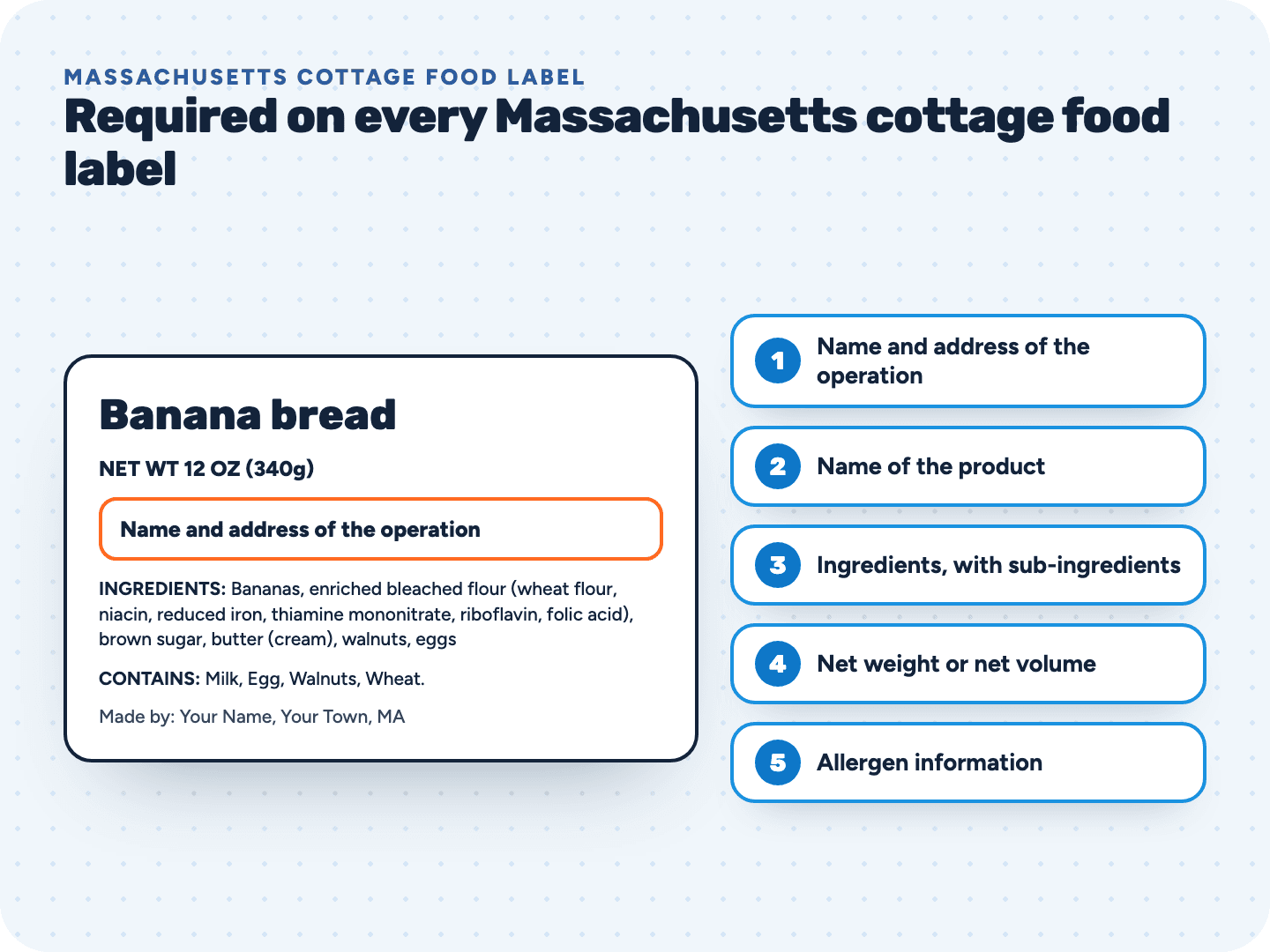
- 1Name and address of the operationDPH residential kitchen standardsThe name of your cottage food operation and its address.
- 2Name of the productDPH residential kitchen standardsWhat the food is, like "Cranberry Walnut Bread" or "Concord Grape Jelly".
- 3Ingredients, with sub-ingredients105 CMR 590.003; FC 3-602In descending order of predominance by weight. A bought ingredient lists its own ingredients: not just "soy sauce" but "soy sauce (wheat, soybeans, salt)". No lab analysis is needed for the list.
- 4Net weight or net volumeDPH residential kitchen standardsHow much is in the package, like "Net Wt 1 lb".
- 5Allergen informationDPH residential kitchen standardsAs federal labeling requirements specify. Federal law names nine major allergens: milk, eggs, fish, crustacean shellfish, tree nuts, peanuts, wheat, soybeans and sesame.
- 6Nutrition Facts, only with a claimDPH residential kitchen standardsRequired when the label gives a nutrient content claim, a health claim or other nutrition information.Nutrient Content Claims →
- Permit before your first saleLocal permitAnyone making food at home to sell direct to the consumer, at farmers markets, craft fairs, online or by mail, needs a permit from the local board of health. The board inspects and permits your kitchen, so fees and forms vary by town.
Retail permit, wholesale license and allowed foods
Where this comes from
- Mass DPH: Retail Food Code Standards for Permitted Residential KitchensOfficial guidance: the cottage food label items and kitchen rules
- Mass DPH: Residential Kitchen Questions and AnswersRetail versus wholesale, allowed foods, bake sales
- 105 CMR 590.010: Cottage Food OperationsPermit rule and the exemption for unprocessed honey and pure maple
- M.G.L. c. 128, § 36B: Labeling and sale of honeyThe Massachusetts honey labeling law
- MDAR: Honey Bee FAQSelling local honey and voluntary apiary registration
Massachusetts label questions
DPH's label list for cottage food has no such statement. The required items are your name and address, the product name, ingredients by weight, net weight or volume and allergen information. A warning sign only comes up for charitable bake sales. Massachusetts Cottage Food Law →
Not from the board of health, if your operation sells only unprocessed honey (or other exempt items like pure maple products). MDAR says you must still follow the honey labeling law and any local ordinances. Processed or flavored honey is not on that exempt list.
Yes, with a Retail Residential Kitchen permit from your local board of health. DPH counts internet and mail sales as direct to the consumer. Shipping to another state means checking federal law and that state's rules too.
Only with a Wholesale Residential Kitchen license from the DPH Food Protection Program. Wholesale kitchens are limited to foods that are safe at room temperature.
No. DPH lists pickled products, relishes and tomato sauces among the foods a residential kitchen may not make. Acidification, hot fill and vacuum packaging are not allowed either. Jams and jellies processed in sealed jars are the one exception.
Yes. If it is unclear whether a product is safe at room temperature, the board may ask for lab evidence such as pH or water activity. Using one standard recipe per product keeps that simple.
See your label before you pay anything
Free preview, no account. $29 when you're ready to print.