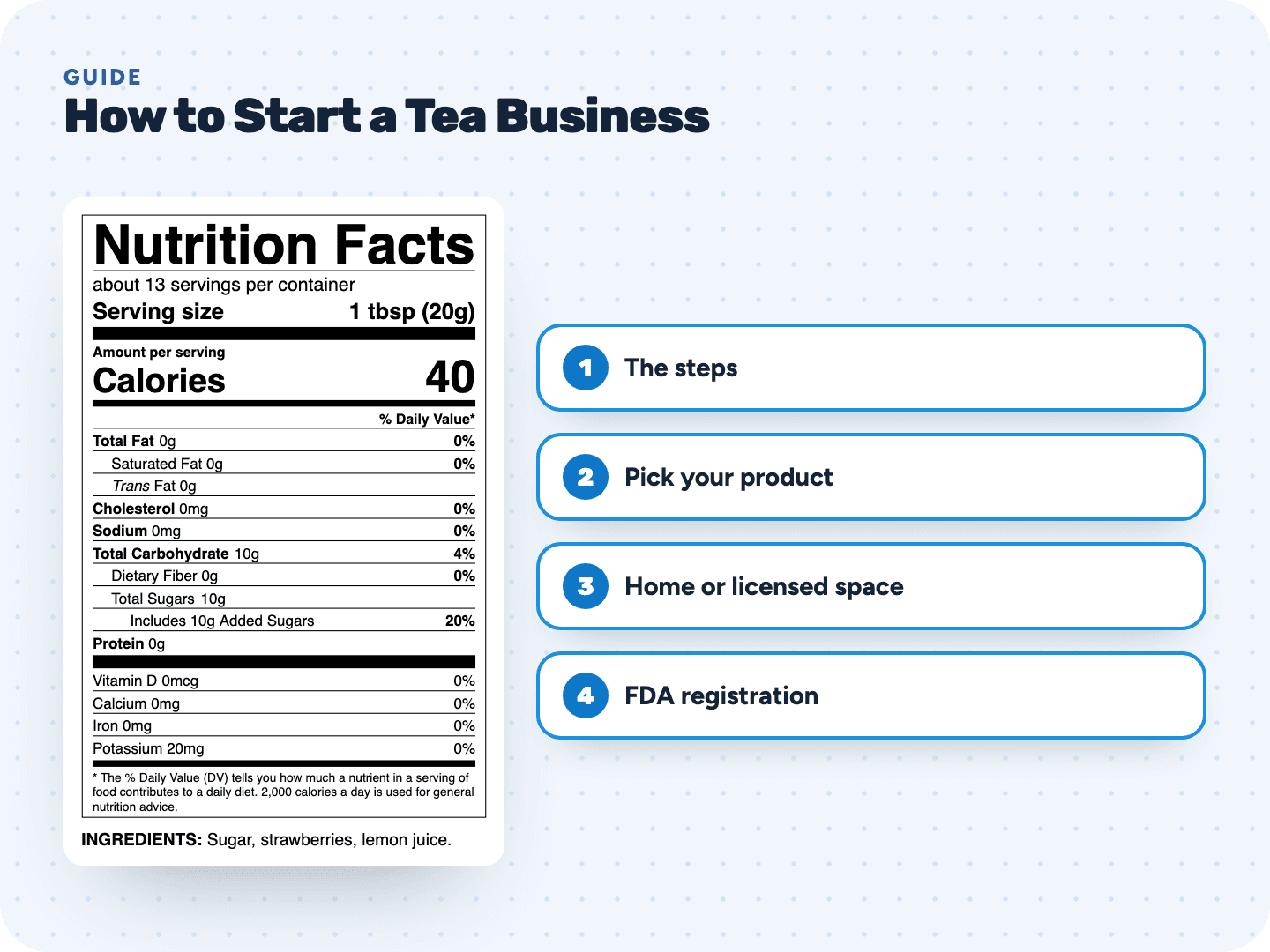
Starting a tea business in seven steps
- Choose your product: straight teas, your own blends, tea bags, a sweetened mix or a bottled tea drink
- Find your suppliers, and plan how leaves from other countries reach you
- Decide where you blend and pack: your home under your state's cottage food law, or a licensed space
- Register that space with FDA if the rules require it, and get your state or local license
- Pick packaging that fits your price and your label
- Make the label for every tea and every size
- Choose where you sell: markets, your own website, cafes or shops
Loose leaf, tea bags or bottled tea: the form sets the rules
A dry tea and a bottled tea drink look like the same business, but they are two different products in the eyes of a regulator. Dry leaves keep on a shelf. A brewed drink is a beverage, and many cottage food laws leave beverages out.
| What you sell | Usual starting point | Label note |
|---|---|---|
| Straight loose leaf tea | Often possible at home where your state lists tea | One ingredient, so no ingredient list; plain tea is exempt from Nutrition Facts without claims |
| Herbal, fruit or spiced blends | Home or licensed space, depending on your state | Every leaf, herb, spice and flavor listed by weight |
| Sweetened instant mix | Check your state's dry mix rules | Nutrition Facts; the serving is the amount of mix that makes 12 fl oz (360 mL) |
| Bottled iced tea or sweet tea | Usually a licensed kitchen, since many cottage laws exclude drinks | Nutrition Facts with the serving in mL |
Planning a tea sold for a health purpose, like sleep or digestion? Then you may be making a dietary supplement instead of a food, with a Supplement Facts panel and its own rules. Decide this before you design anything, because it changes the whole label.
FDA Tea Labeling Requirements →Can you start a tea business from home?
Often, yes, for dry tea. Cottage food laws are state laws, and several of them name tea directly. Bottled tea is where most home routes end. Some examples from our state pages:
| State | What the cottage food rules say about tea |
|---|---|
| Connecticut | Dry herbs, seasonings, tea and coffee are allowed; beverages are not |
| Indiana | Dried herbs, spices and teas are allowed; kombucha and cold brew coffee are not |
| Arkansas | Packaged teas are on the allowed list |
| Oregon | Dried tea blends made from commercial food are allowed; bottled brewed tea is out |
Check two more things in your own state: whether you may sell online or ship, and whether there is a yearly sales cap. Both decide how far a home tea business can grow.
Cottage Food Law →Food Label Requirements by State →When a tea business must register with FDA
FDA's registration rule covers any facility that manufactures, processes, packs or holds food. For tea, that net is wide: FDA counts mixing, packaging and labeling as manufacturing, so filling pouches with a blend you mixed is enough. A private home is not a facility, so a cottage food tea maker blending in their own kitchen does not register.
The exemption that matters most for a small tea shop is the one for retail food establishments. You qualify when selling straight to consumers is your main business, measured in dollars:
Cafes and shops are businesses, not consumers. So once your wholesale tea sales outgrow your direct sales from a commercial space, plan on registering. Registration itself costs nothing, and you renew it every other year.
Buying tea from abroad: prior notice and English labels
Most tea is grown outside the US, so many tea businesses import, either directly from a garden or through an importer. FDA treats every imported food as interstate commerce, which means the federal rules apply from day one.
- Prior notice: FDA must receive a prior notice before food shipments arrive in the US, unless an exemption applies
- Samples count too: for food sent by international mail, the prior notice is due before the package is sent to the United States
- The PN Confirmation Number goes on the customs declaration that travels with a mailed package
- Retail packs labeled abroad still need an English label; another language may appear next to the English translation
Ask your supplier or customs broker who files the prior notice before you place the first order. Agreeing on it up front saves a shipment from sitting at the port.
Choose your packaging before you print labels
Your pouch, tin or box sets how much room the label gets, and that decides which label layout fits. Settle the package first, then the label:
| Package | What to plan for |
|---|---|
| Stand-up pouch | A flat back panel holds a standard label; weigh the tea, not the pouch, for the net weight |
| Round tin | A curved surface with little flat room: a wide or linear label often fits better than a tall one |
| Box of tea bags | Label the box; state the tea's weight, and add the bag count if you like |
| Bottle of iced tea | Fluid ounces and mL on the front; a tall, narrow label wraps well |
From our tool you download the label as a print-ready PDF in its real size, an SVG your designer can place on the artwork, a 600 dpi PNG, or a sheet that prints on Avery 5126, 5168, 5164 or 5163. When the package changes, you change the layout, not the recipe.
Nutrition Facts Label Formats →The label your tea needs
Every packaged tea shows its name, the net weight, your business name and address, and an ingredient list for blends. Whether you also need Nutrition Facts depends on what is in the package and what you claim. Our tea labeling page covers flavor wording, the iced tea serving size and the juice rule.
For blends and drinks, type the recipe into our tool. Each ingredient gets its USDA match, the list comes out heaviest first, and allergens are picked up: sliced almonds in a chai blend put "Contains: Almonds." on the label. For a bottled tea, the Liquid box declares the serving in mL. You see the finished label free before you pay anything.
Tea Bag Label Template →Start your tea label free →Where to sell your tea
| Channel | What changes |
|---|---|
| Farmers markets and fairs | The classic cottage food route; the market may have its own vendor rules |
| Your own website | Allowed in many cottage food states, often only within the state; out-of-state orders bring in the federal rules |
| Cafes and restaurants | Wholesale: some cottage food laws don't allow it, and it counts against the retail exemption from FDA registration |
| Shops and grocery stores | Usually a licensed space, plus whatever the store asks of its suppliers |