Lemon Curd Label
Lemon curd labels cover the same ground as any jarred food: the name, how much curd is inside, every ingredient, a Contains line for egg and milk, who made it, and Nutrition Facts if you are not exempt. Two details trip up most makers. Curd is thick, so the jar is labeled by weight in ounces and grams, not fluid ounces. And FDA's serving table has no line for lemon curd, so you pick the closest one: 1 tbsp, like jams and fruit butters, when you sell it as a spread. Enter your recipe and print labels for every jar size.
- Free preview
- $29 per label
- Ready to print
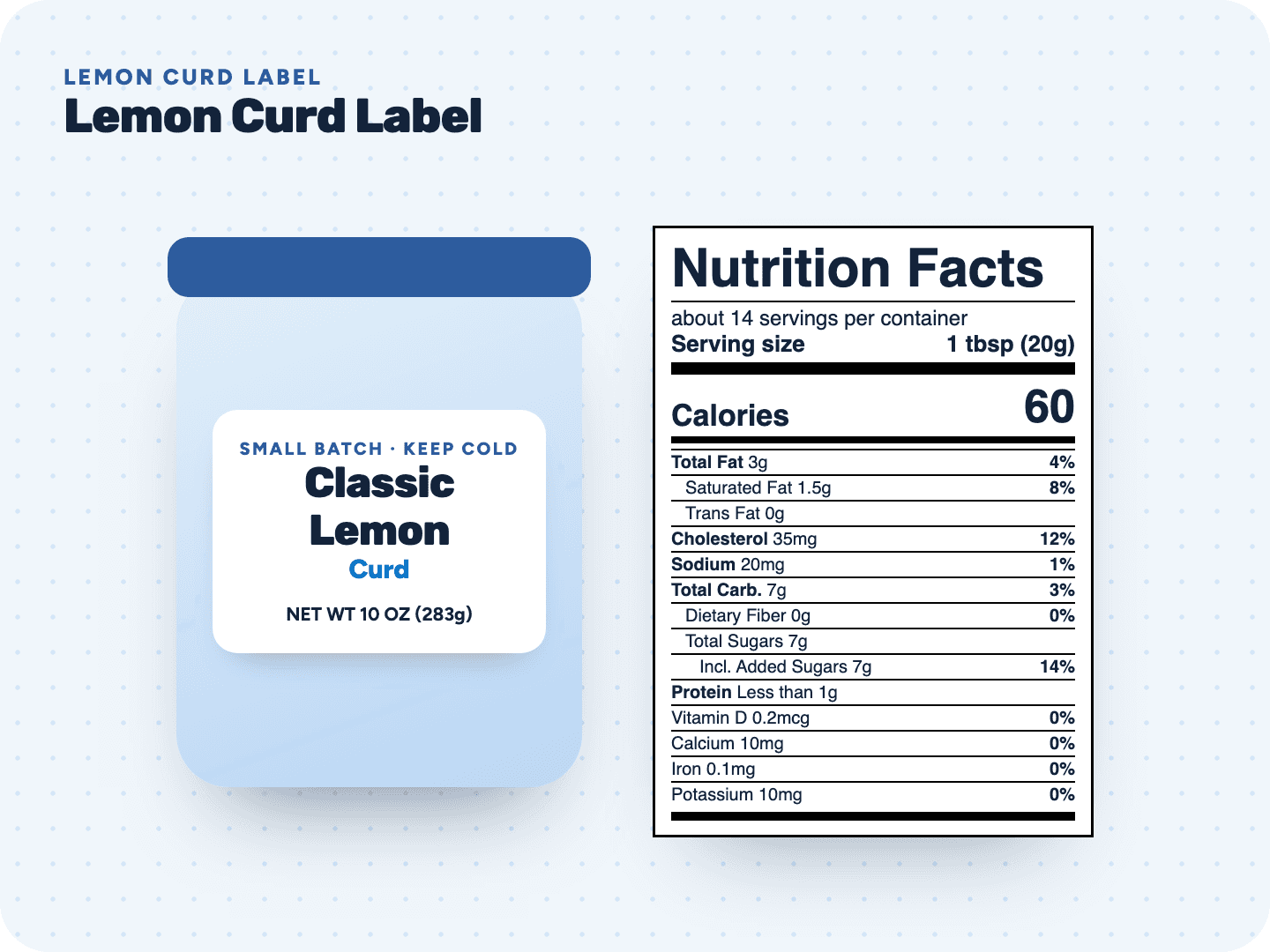
What has to be on your lemon curd label
Name and net weight face the shopper on the front. Everything else goes on a side label or the lid; the jar pictured here shows the same values.
- 1Name of the curd21 CFR 101.3(b)"Lemon curd" is the name buyers know, so use it. Lime, passion fruit or Meyer lemon versions say so: "Lime curd".
- 2Net weight, not fluid ounces21 CFR 101.7(a)Weight in ounces and grams, placed in the lower 30% of the front panel, even on a half pint jar: NET WT 10 OZ (283g). Weigh what you fill, not what the jar holds.
- 3Nutrition Facts21 CFR 101.9Per tablespoon, followed by what one level tablespoon of your curd weighs. Low-volume sellers with no nutrition claims may qualify for an exemption.
- 4Ingredient list21 CFR 101.4Heaviest first. Sugar usually leads, then whole eggs. Extra yolks are their own ingredient and land further down.
- 5Allergen statementFALCPAEgg from the eggs and yolks, milk from the butter. A curd made with coconut oil instead of butter drops milk, but egg stays.
- 6Name and address21 CFR 101.5Your business name with city, state and ZIP. Made in a shared kitchen for your brand? "Made for" or "Distributed by" works.
Things that are different for lemon curd
Lemon curd jars and the label that fits
Jars have a curved side and a small lid. Measure the flat band between the shoulders, then try the formats in the tool.
| Jar | Typical label area | Style that usually fits |
|---|---|---|
| 2 oz sample jar | 2 × 1¼ in | Small package (linear) |
| 4 oz jelly jar | 2 × 4 in wrap | Tabular (wide)Avery 5163 |
| Half pint jar | 3 × 3 in | Standard (vertical)Most common |
| 16 oz jar (pint) | 3⅓ × 4 in | Standard (vertical)Avery 5164 |
Start from a lemon curd that's already filled in
Classic stovetop curd: sugar, lemon juice and zest, whole eggs plus two yolks, finished with butter. The label uses 20 g per level tablespoon. Weigh a tablespoon of your own curd after it sets and enter that, because a looser or firmer curd changes the grams. Swap lemon juice for lime juice and you have a second label in a minute.
| Ingredient | Amount | Unit |
|---|---|---|
| Sugar✓ USDA match | 1 | cup |
| Lemon juice✓ USDA match | 1/2 | cup |
| Lemon zest✓ USDA match | 1 | tbsp |
| Eggs✓ USDA match | 3 | large |
| Egg yolks✓ USDA match | 2 | large |
| Unsalted butter✓ USDA match | 6 | tbsp |
| Salt✓ USDA match | 1/8 | tsp |
Lemon curd label questions
FDA's table doesn't name lemon curd. Most makers sell it as a spread, which fits the 1 tbsp line for jams and fruit butters. If you sell it as a dessert topping or filling, the 2 tbsp toppings line fits. Pick one and stick with it.
It depends on your state. California's cottage food rules allow eggs in baked goods but not in lemon curd. Other states have their own lists, so look up yours before you sell. Cottage Food Law →
Yes. Each label downloads as an actual-size PDF, and the tool can place it on Avery 5126, 5163, 5164 or 5168 sheets, all on US Letter paper. For round lids, export the PNG or SVG and place it in your own round label layout. Avery Food Labels →
Yes, because lime or orange juice changes the numbers. Every flavor is a separate label, and credits bring the price down: $69 for 3 or $199 for 10, with no expiry.
Make your lemon curd label now
Free preview, no account. $29 when you're ready to print.