Pasta Sauce Label
Pasta sauce label requirements fit on one jar: the name of the sauce, the net weight in both ounces and grams, every ingredient with the store-bought parts broken out, a Contains line when there is cheese in the pot, the maker's name and address and, without an exemption, Nutrition Facts. Serving size: the cup measure nearest 125 g, which for most sauces is 1/2 cup. Enter your marinara or pasta sauce recipe and get a back label sized for your jar.
- Free preview
- $29 per label
- Ready to print
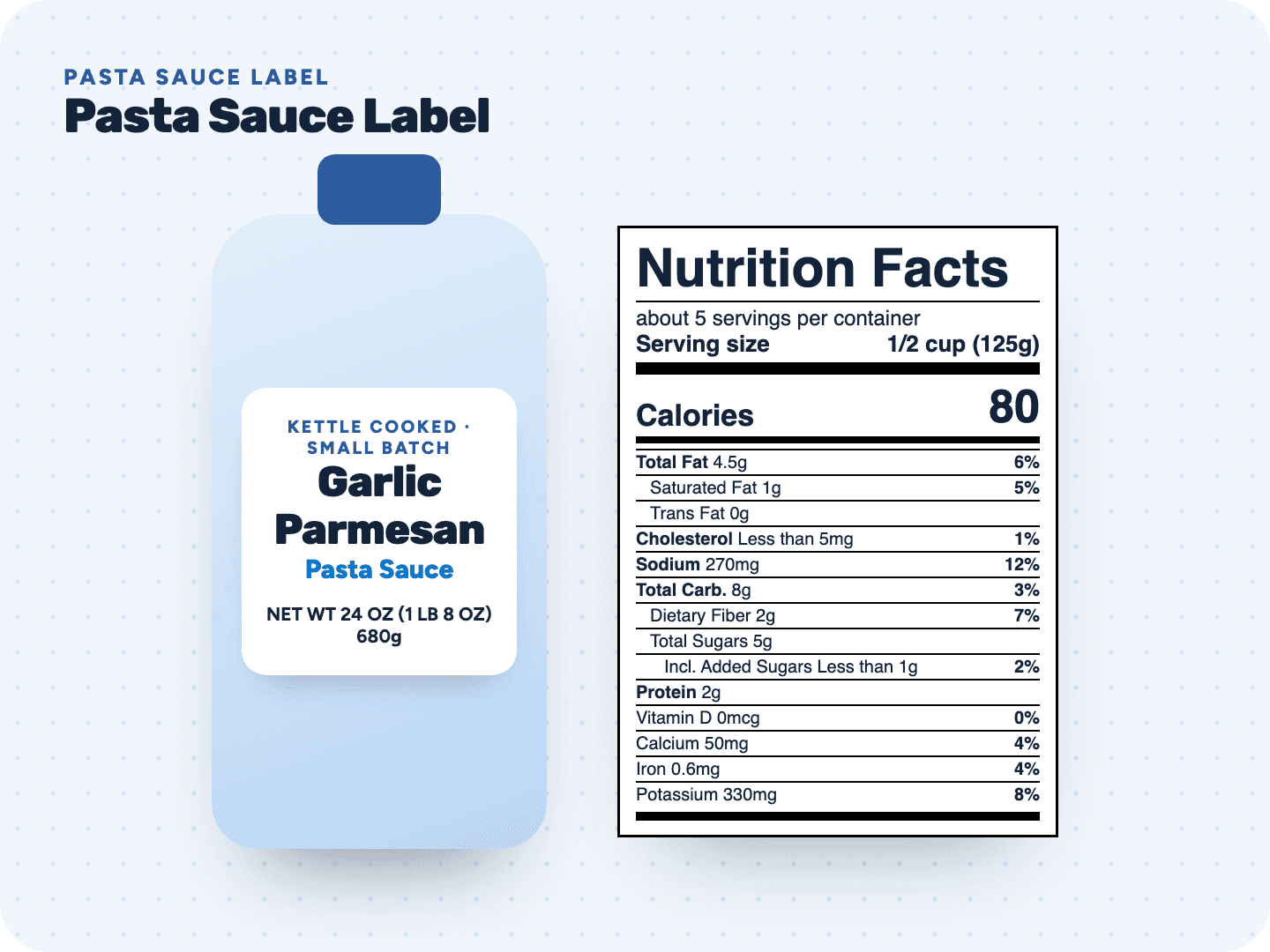
What has to be on your pasta sauce label
The jar's front carries the name and the weight. The wrap or back label carries the rest, numbered to match the example.
- 1Name of the sauce21 CFR 101.3"Marinara sauce", "Pasta sauce", "Tomato basil sauce", "Arrabbiata sauce". Your brand goes above it; the name says what is in the jar.
- 2Net weight21 CFR 101.7Sauce is thick and chunky, so it goes by weight. At 1 lb or more, the pounds follow in parentheses: NET WT 24 OZ (1 LB 8 OZ) 680g.
- 3Nutrition Facts21 CFR 101.9Per cup measure near 125 g, with the grams. Sodium and added sugars are the lines shoppers compare between jars.
- 4Ingredient list21 CFR 101.4Heaviest first, measured as the sauce is made. Canned tomato sauce, puree or a cheese you buy in shows its own ingredients in parentheses.
- 5Allergen statementFALCPAParmesan, ricotta or cream: milk. Anchovies in a puttanesca: anchovy. Pine nuts or walnuts stirred in: name the nut.
- 6Name and address21 CFR 101.5Whoever made, packed or distributes the sauce, plus city, state and ZIP. Sauce made by a co-packer under your brand? "Distributed by" plus your address.Co-Packer →
Things that are different for pasta sauce
Pasta sauce jars and the label that fits
A tall jar has room for the standard panel. Squat jars and deli tubs need a wider or shorter one. Measure the flat area and switch styles in the tool.
| Container | Typical label area | Style that usually fits |
|---|---|---|
| 16 oz deli tub (fresh, refrigerated) | 4 in round lid | Simplified |
| 16 oz squat jar | 6 × 2.5 in | Tabular (wide) |
| 24 oz sauce jar | 3 × 4.5 in | Standard (vertical)Most common |
| 32 oz jar | 3.5 × 5 in | Standard (vertical)Avery 5168 |
Start from a garlic parmesan sauce that's already filled in
Three pounds of fresh tomatoes plus a base of canned tomato sauce, simmered down to 72 oz: exactly three 24 oz jars. We entered that cooked weight, so every serving carries its share of the batch. Leave out the parmesan and the Contains line disappears; swap the sugar for a grated carrot and the added sugars line goes to zero.
| Ingredient | Amount | Unit |
|---|---|---|
| Tomatoes✓ USDA match | 3 | lb |
| Tomato sauce✓ USDA match | 3 | cups |
| Olive oil✓ USDA match | 1/4 | cup |
| Onion✓ USDA match | 1 | cup |
| Garlic✓ USDA match | 10 | cloves |
| Parmesan✓ USDA match | 1/2 | cup |
| Fresh basil✓ USDA match | 1/2 | cup |
| Granulated sugar✓ USDA match | 1 | tbsp |
| Dried oregano✓ USDA match | 1 | tsp |
| Cayenne pepper✓ USDA match | 1/4 | tsp |
Pasta sauce label questions
The same parts as any pasta sauce: "Marinara sauce" as the name, the net weight, Nutrition Facts per 1/2 cup or whatever cup measure is closest to 125 g of your sauce, the ingredients by weight, a Contains line if needed, and your name and address. A classic marinara with no cheese usually has no major allergens at all.
Yes. Sugar you stir in is an added sugar, even a spoonful per batch. In the sample, one tablespoon across three jars comes out at less than 1 g of added sugars per serving. The natural sugars from tomatoes and onions count in total sugars only.
Not as a shelf-stable acidified sauce. FDA expects a scheduled process set by a qualified expert, plant registration and a process filing for each jar size. A sauce that is stored, shipped and sold under refrigeration falls outside the acidified food rules, but the label parts stay the same.
Yes: download our blank Nutrition Facts templates for free (fillable PDF, Word, SVG, PNG), or start from the garlic parmesan sauce above, which is already complete. Change it to your recipe at no cost; you pay $29 only for the print files. Blank Nutrition Facts Label Template →
Three, one per recipe, because the numbers and the allergens differ: the cream in a vodka sauce adds milk. The 3-label bundle costs $69, and credits never expire.
Make your pasta sauce label now
Free preview, no account. $29 when you're ready to print.