Pasta Label
Pasta label checklist: the pasta's name, the net weight, an ingredient list, a Contains line for wheat and egg, your name and address and, unless you are exempt, Nutrition Facts per 2 oz (56 g) of dry pasta. Dried pasta has FDA standards behind its names: "spaghetti" and "egg noodles" each come with a recipe and a shape. Enter your dough and the panel is built from USDA data.
- Free preview
- $29 per label
- Ready to print
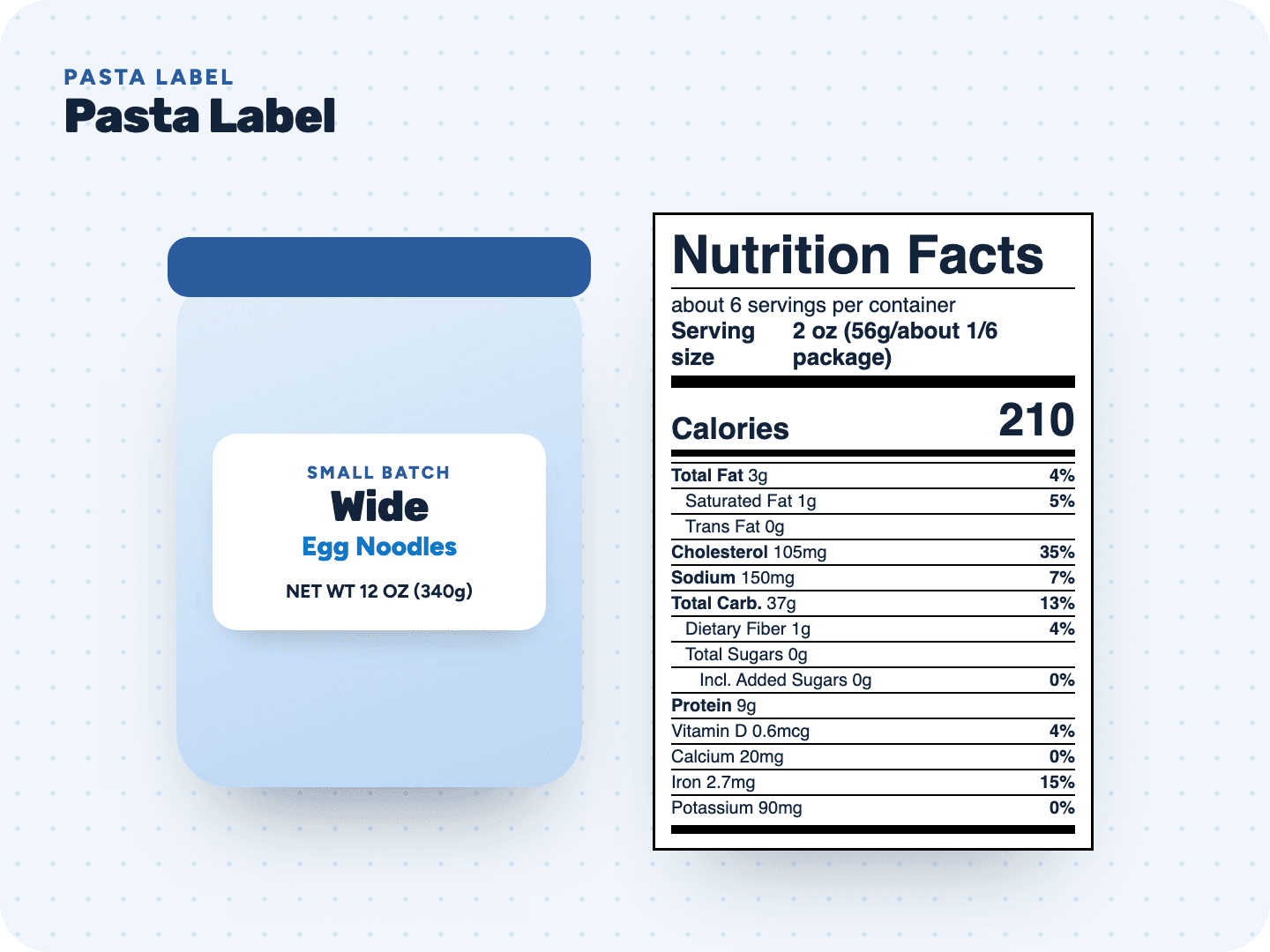
What has to be on your pasta label
Six parts, front and back. The numbers match the bag on the left.
- 1Product name21 CFR 139.110, 139.150Dried pasta uses its FDA name, set by shape: "spaghetti" for cords 0.06 to 0.11 inch thick, "macaroni" for tubes up to 0.27 inch, "egg noodles" for ribbons made with egg. An Italian shape name or your brand can sit above it.
- 2Net weight21 CFR 101.7Ounces and grams in the bottom 30% of the front: NET WT 12 OZ (340g). From 1 lb up, add the pounds: NET WT 16 OZ (1 LB) 454g.
- 3Nutrition Facts21 CFR 101.9(b)(9), (h)(4)Per serving of dry pasta, the way you sell it, not cooked. FDA allows an extra column for the cooked pasta when the label gives cooking directions, but the dry values are the ones you must show.
- 4Ingredient list21 CFR 101.4Heaviest first. Enriched flour or enriched semolina shows its added vitamins and iron in parentheses, as in the sample.
- 5Allergen statementFALCPASemolina, durum and farina are all wheat, so nearly every pasta says Contains wheat. Egg noodles add egg; a spinach or basil pasta usually adds nothing.
- 6Name and address21 CFR 101.5Who made or packed it, with city, state and ZIP. Selling a co-packer's pasta under your brand? Use "Made for" or "Distributed by".Co-Packer →
Things that are different for pasta
Pasta bags and boxes and the label that fits
Clear bags show off the pasta, so the label is often a sticker on the back. Measure the flat space, then try the styles in the tool.
| Package | Typical label area | Style that usually fits |
|---|---|---|
| 8 oz cello bag | 3 × 3 in | Standard (vertical) |
| 12 oz bag | 3.5 × 4 in | Standard (vertical)Our example |
| 16 oz box | 5 × 2.5 in side panel | Tabular (wide) |
| Gift tube of long pasta | 4 × 1.5 in | Small package (linear) |
Start from egg noodles that are already filled in
Flour, eggs and a pinch of salt, rolled, cut into wide ribbons and dried. The label uses the batch weight after drying, 20.7 oz, which leaves the noodles at about 12% moisture. Switch the flour for semolina and the ingredient list follows; leave out the eggs and you are making plain pasta, not noodles.
| Ingredient | Amount | Unit |
|---|---|---|
| Unbleached all-purpose flour✓ USDA match | 4 | cups |
| Eggs✓ USDA match | 6 | large |
| Salt✓ USDA match | 1/2 | tsp |
Pasta label questions
For dry pasta the reference amount is 55 g. Long pasta and noodles are usually shown as 2 oz (56 g), short shapes as a cup measure with grams, and large shapes like lasagna sheets as pieces. Weigh your own shape: a cup of elbows and a cup of shells are not the same weight.
When it is dried, ribbon-shaped and its egg or yolk solids make up at least 5.5% of the total solids. Our sample, six eggs to four cups of flour, has about 14%. Fresh egg pasta falls outside the dried pasta standards, so name it for what it is, like fresh egg fettuccine.
For the pasta as you sell it, so dry. FDA allows a second column for the cooked pasta, but the dry values must be there, and they are what our tool calculates. Start a label →
Its allergens have to be declared, in the ingredient list or in a Contains statement. Wheat is in semolina, durum and regular flour, so most pasta labels add Contains wheat, or Contains egg, wheat for egg noodles. Our tool writes that line from your recipe.
Our blank Nutrition Facts templates are free in fillable PDF, Word, SVG and PNG, and the egg noodles on this page load into the free preview. Change the recipe to yours, then pay $29 when you want the print files. Blank Nutrition Facts Label Template →
Make your pasta label now
Free preview, no account. $29 when you're ready to print.