Sauerkraut Label
Sauerkraut label essentials: the name, the net weight of kraut and brine, an ingredient list that is often just cabbage and salt, a look at allergens, who made it and where and, unless an exemption covers you, Nutrition Facts per 1 oz of drained sauerkraut with a visual unit like 3 tbsp. Enter your batch and get the label for your jar or pouch, ready to print.
- Free preview
- $29 per label
- Ready to print
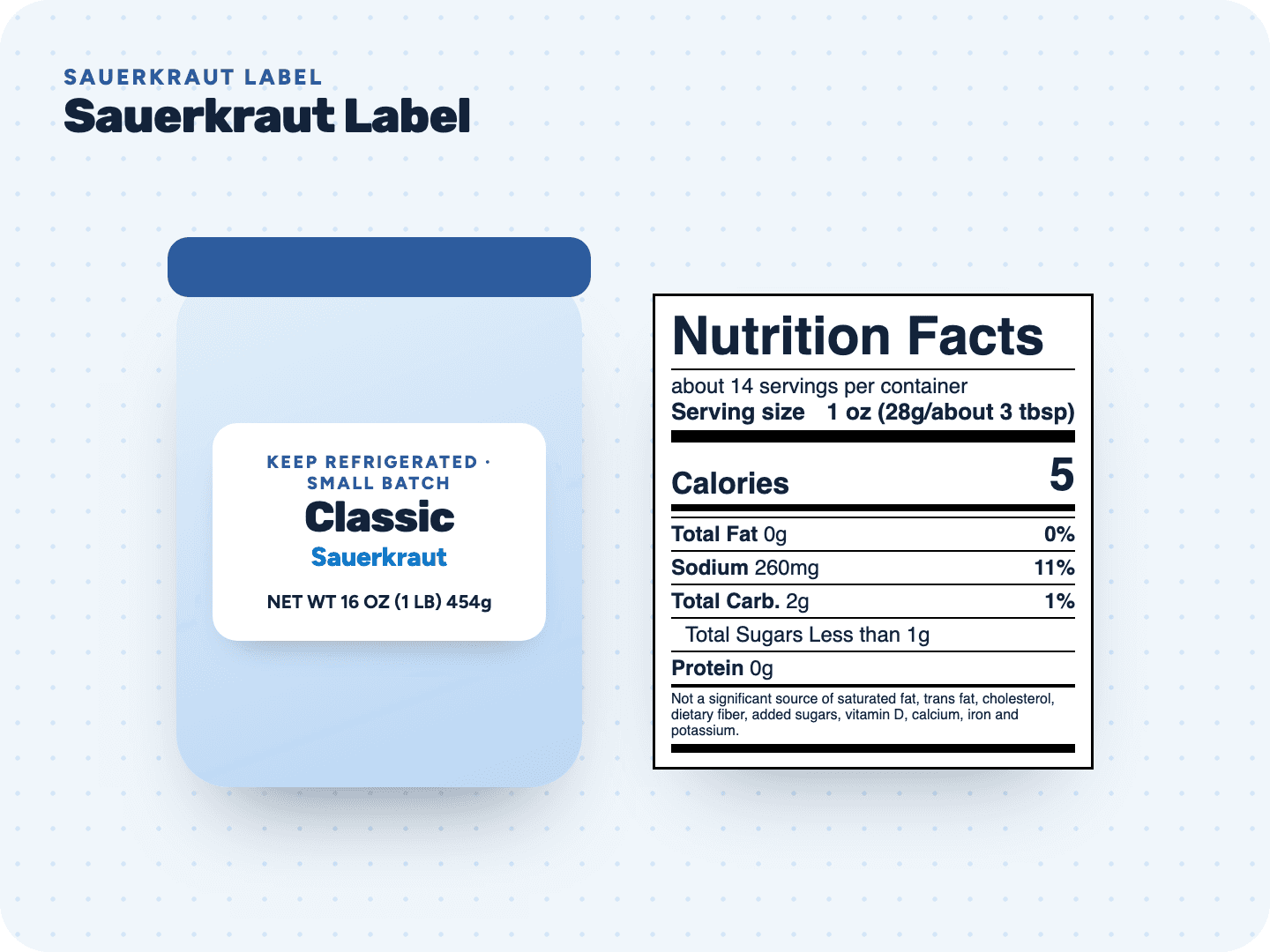
What has to be on your sauerkraut label
Six items split over the jar: two up front, four on the back. Values come from the classic kraut sample.
- 1Name21 CFR 101.3"Sauerkraut", "Garlic dill sauerkraut", "Red cabbage sauerkraut". Your brand sits above it.
- 2Net weight21 CFR 101.7(a)Kraut in its brine is a mix of solid and liquid, so it goes by weight: everything in the jar, in ounces and grams.
- 3Nutrition Facts21 CFR 101.9Per 1 oz of drained sauerkraut, with a visual unit in tablespoons. Sodium is the line that stands out.
- 4Ingredient list21 CFR 101.4Heaviest first. Added a brine of salt water? Water and salt both go in. Caraway, juniper, carrots or garlic each get their own name.
- 5Allergen checkFALCPACabbage and salt carry none of the nine. A fermented vegetable with fish sauce or shrimp paste must name the fish or the shellfish.
- 6Name and address21 CFR 101.5The fermenter or packer, plus city, state and ZIP. Cottage food sellers: check your state for extra required lines.
Things that are different for sauerkraut
Sauerkraut jars, pouches and the label that fits
Wide-mouth jars give you a generous wrap; pouches need a panel on the back. Try each format in the tool before you print.
| Container | Typical label area | Style that usually fits |
|---|---|---|
| 8 oz half-pint jar | 5.5 × 1.75 in | Tabular (wide) |
| 16 oz wide-mouth jar | 6 × 2.5 in | Tabular (wide)Sample |
| 16 oz refrigerated pouch | 3.5 × 4 in | Standard (vertical) |
| 32 oz quart jar | 3.5 × 5 in | Standard (vertical)Avery 5168 |
Start from a classic sauerkraut that's already filled in
Five pounds of shredded cabbage and three tablespoons of salt, about 2.4% salt by weight. The serving is drained kraut, so for servings per container we counted a 16 oz jar as about 14 oz of drained sauerkraut; drain and weigh one of yours. Add a spoonful of caraway or dill seed and it joins the ingredient list by weight.
| Ingredient | Amount | Unit |
|---|---|---|
| Cabbage✓ USDA match | 5 | lb |
| Salt✓ USDA match | 3 | tbsp |
Sauerkraut label questions
Not always. Small businesses that make no nutrition claims can be exempt from Nutrition Facts, and cottage food laws set their own label rules. The name, net weight, ingredients and your address are needed either way. Our free quiz checks the federal exemption in a minute. Do I Need a Nutrition Label? →
Something a shopper can scoop: tablespoons work well. With USDA's 142 g per cup, 1 oz is about 3 tbsp, so the label reads 1 oz (28g/about 3 tbsp). Weigh a level spoonful of your own drained kraut to check.
Every claim on a label has to be truthful and not misleading, and wording like that is a claim about your product. Our tool makes the regulated panel and does not check claims, so make sure you can back up what you print. Start a label →
Yes. You can download blank Nutrition Facts and ingredient templates at no cost (fillable PDF, Word, SVG, PNG), and the classic kraut above is ready to edit. Make it yours in the free preview and pay $29 for the downloads. Blank Nutrition Facts Label Template →
Make your sauerkraut label now
Free preview, no account. $29 when you're ready to print.