Kimchi Label
Kimchi label requirements start where most kimchi labels slip: the allergens. Fish sauce has to be declared as the fish it is made from, like anchovy, and salted shrimp as shrimp. Around that sit the name, the net weight, the ingredients, the maker's name and address and, unless an exemption applies, Nutrition Facts per 1 oz. Enter your recipe and we build the Contains line for you.
- Free preview
- $29 per label
- Ready to print
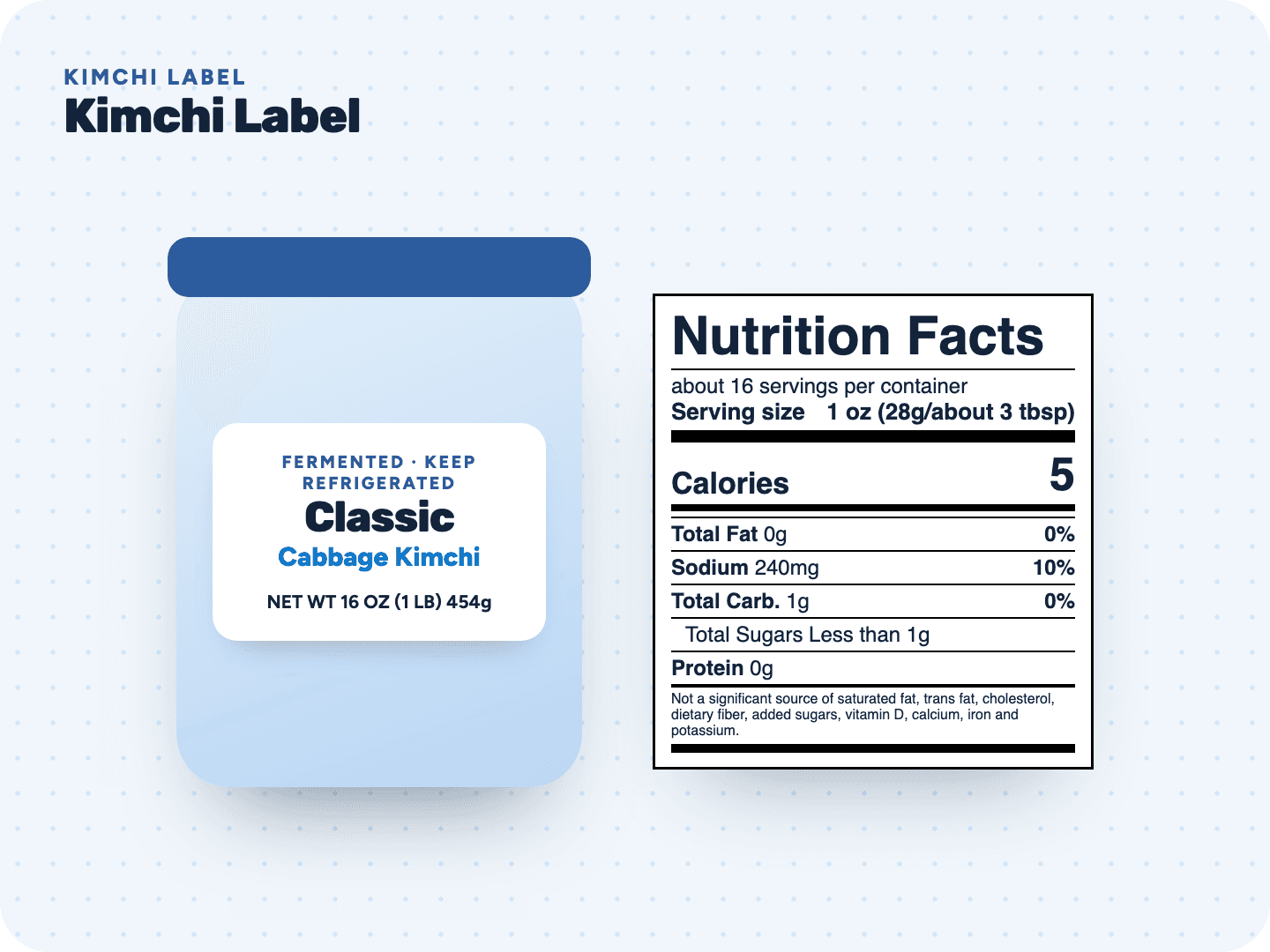
What has to be on your kimchi label
Two parts up front (name and weight), four on the back. Every number comes from the sample recipe.
- 1Name21 CFR 101.3"Kimchi", "Cabbage kimchi", "Radish kimchi", "White kimchi". Your brand goes above it.
- 2Net weight21 CFR 101.7(a)Vegetables with their juice are a mix of solid and liquid, so kimchi goes by weight, in ounces and grams.
- 3Nutrition Facts21 CFR 101.9Per 1 oz with a visual unit, like 1 oz (28g/about 3 tbsp). Sodium is the number to get right.
- 4Ingredient list21 CFR 101.4Heaviest first. Fish sauce shows its own ingredients in parentheses; so do salted shrimp, a rice flour paste or a store-bought chili paste.
- 5Allergen statementFALCPAName the fish and the shellfish: Contains: Anchovy, Shrimp. A wheat flour paste instead of rice flour adds wheat.
- 6Name and address21 CFR 101.5The kitchen that made or packed it, plus city, state and ZIP. Selling a co-packed kimchi under your brand? Add your address after "Distributed by".
Things that are different for kimchi
Kimchi jars and the label that fits
Kimchi jars range from a small sampler to a half-gallon. Find yours below, then compare the formats in the tool.
| Jar | Typical label area | Style that usually fits |
|---|---|---|
| 8 oz jar | 5 × 1.75 in | Tabular (wide) |
| 16 oz jar | 6 × 2.5 in | Tabular (wide)Sample |
| 32 oz jar | 3.5 × 5 in | Standard (vertical)Avery 5168 |
| 64 oz half-gallon jar | 4 × 6 in | Standard (vertical) |
Start from a cabbage kimchi that's already filled in
Our library's red pepper (cayenne) stands in for gochugaru. Using Korean chili flakes or salted shrimp from a supplier? Enter each as a custom ingredient using its Nutrition Facts, typed or read from a photo of the bag. Leave out the fish sauce and the Contains line disappears.
| Ingredient | Amount | Unit |
|---|---|---|
| Napa cabbage✓ USDA match | 4 | lb |
| Carrots✓ USDA match | 1 | cup |
| Green onions✓ USDA match | 1 | cup |
| Fish sauce✓ USDA match | 3 | tbsp |
| Salt✓ USDA match | 2 | tbsp |
| Garlic✓ USDA match | 8 | cloves |
| Cayenne pepper✓ USDA match | 1/4 | cup |
| Granulated sugar✓ USDA match | 1 | tbsp |
| Ginger root✓ USDA match | 1 | tbsp |
Kimchi label questions
Only if it contains one of the nine major allergens. Kimchi made with cabbage, radish, chili, garlic, ginger and salt has none. Swap the fish sauce for our library's soy sauce, brewed with wheat, and the line reads Contains: Wheat, Soy. Tamari made without wheat brings soy only. Nutrition Labels Database →
Tablespoons work well. USDA weighs a cup of kimchi at 150 g, so 1 oz is about 3 tbsp: 1 oz (28g/about 3 tbsp). Weigh a level spoonful of your own to check.
We build the part the law dictates (Nutrition Facts, ingredients, the Contains line) and export it at actual size as vector PDF, SVG or 600 dpi PNG. The logo and front art are yours or your designer's job; they place our file at 100% scale.
Yes. Blank Nutrition Facts and ingredient templates are a free download (fillable PDF, Word, SVG or PNG), and the cabbage kimchi above is ready to adapt. Adapt it for free; the print-ready files cost $29. Blank Nutrition Facts Label Template →
Make your kimchi label now
Free preview, no account. $29 when you're ready to print.