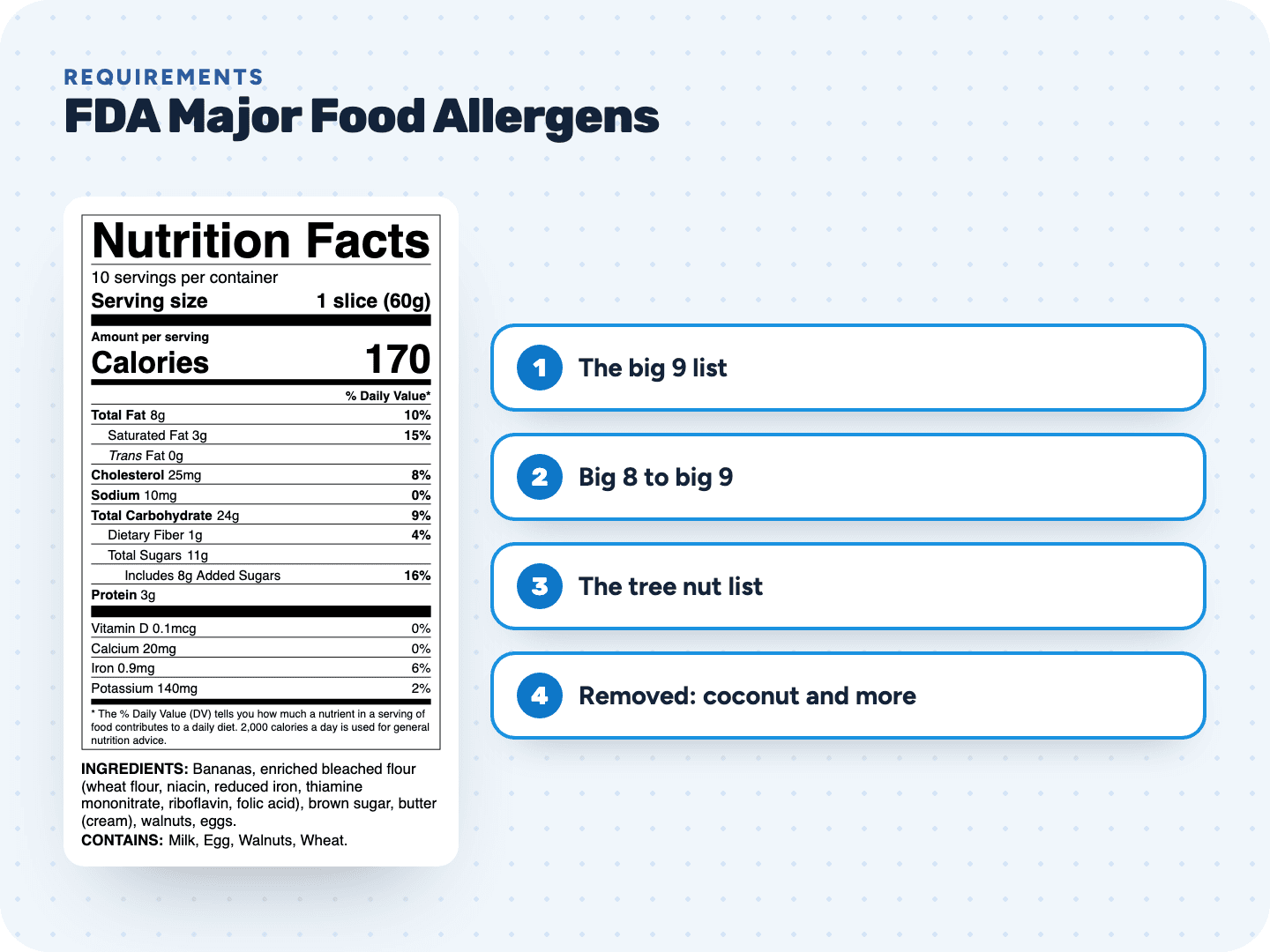
The FDA allergen list: 9 major allergens and what each covers
The list sits in the definition of "major food allergen" in the FD&C Act. FDA's guidance spells out how wide each entry reaches. Some are broader than the everyday word, and some are narrower.
| Major allergen | What FDA counts | Not covered |
|---|---|---|
| Milk | Milk from domesticated cows, goats, sheep and other ruminants | |
| Eggs | Eggs from domesticated chickens, ducks, geese, quail and other fowl | |
| Fish | Bony fish (cod, salmon, tuna, tilapia), cartilaginous fish (shark, rays, skates) and jawless fish | |
| Crustacean shellfish | Crab, lobster, shrimp and other crustaceans | Molluscan shellfish: oysters, clams, mussels, scallops |
| Tree nuts | Only the 12 entries on FDA's tree nut list (below) | Coconut and 11 other nuts, removed |
| Peanuts | Peanuts | |
| Wheat | Any species in the genus Triticum, which FDA says includes common, durum and club wheat, spelt, semolina, einkorn, emmer, Khorasan and triticale | Barley, rye and oats |
| Soybeans | Soybeans | |
| Sesame | Sesame |
From the big 8 to the big 9
The Food Allergen Labeling and Consumer Protection Act of 2004 (FALCPA) named eight foods. FDA notes that, when the law passed, those eight accounted for 90 percent of food allergies and serious allergic reactions in the U.S.
The FASTER Act of 2021 then wrote sesame into the same definition as the ninth. Since then every FDA requirement for major food allergens, on labels and in manufacturing, covers sesame as well. You will still hear "big 8" in older material: it means the list without sesame.
The nickname is common enough that USDA's Food Safety and Inspection Service titles its allergy page "Food Allergies: The 'Big 9'".
FDA's tree nut list
"Tree nut" has no single botanical definition, so FDA keeps a table of the tree nuts it treats as major food allergens: the ones where a robust body of scientific evidence supports it.
| Common or usual name | Scientific name |
|---|---|
| Almond | Prunus dulcis |
| Black walnut | Juglans nigra |
| Brazil nut | Bertholletia excelsa |
| California walnut | Juglans californica |
| Cashew | Anacardium occidentale |
| Filbert/Hazelnut | Corylus spp. |
| Heartnut/Japanese walnut | Juglans ailantifolia var. cordiformis |
| Macadamia nut/Bush nut | Macadamia spp. |
| Pecan | Carya illinoinensis |
| Pine nut/Pinon nut | Pinus spp. |
| Pistachio | Pistacia vera |
| Walnut (English, Persian) | Juglans regia |
What came off the list: coconut and 11 other nuts
FDA's fifth edition of its allergen guidance shortened the tree nut list. These are no longer major food allergens:
- Coconut
- Beech nut
- Butternut
- Chestnut
- Chinquapin
- Cola/kola nut
- Ginkgo nut
- Hickory nut
- Palm nut
- Pili nut
- Shea nut
- Lichee nut
- They stay in the ingredient list by their usual name, like "coconut" or "chestnuts", unless an exemption applies, such as a coconut flavor declared as "natural flavor"
- They come out of the "Contains" statement, which is reserved for major food allergens
- Manufacturers no longer need to treat them as major food allergens in their manufacturing controls
- An old label that still lists coconut in its Contains line is out of date. FDA says a sticker over it is an option
Where the list reaches further than people expect
- Goat, sheep and other ruminant milk counts as milk. FDA wants the animal named: "goat milk" in the ingredients, or "Contains goat milk"
- Duck, goose and quail eggs count as eggs, named the same way: "duck egg", or "Contains duck egg"
- Lactose and ghee often carry some milk protein. When they do, they are declared as milk
- Milk protein made by fermentation, for example in engineered yeast, still counts as derived from milk and must be declared
- Major food allergens in dietary supplements count, in capsules, powders and softgels alike
Allergens that are not on the list
FDA counts more than 160 foods that can cause allergic reactions. The labels of foods made with those don't have to name the allergen source the way the law requires for the nine, but each ingredient still appears in the ingredient list by its common or usual name.
| Not a major allergen | What the label still has to do |
|---|---|
| Oysters, clams, mussels, scallops | List them in the ingredients by name |
| Coconut and the other removed nuts | List them in the ingredients, keep them out of the Contains line |
| Barley, rye, oats (gluten) | Listed as ingredients; "gluten-free" is a separate voluntary claim with its own rule |
| Sulfites | Declared when the food has 10 parts per million or more total sulfites |
| FD&C Yellow No. 5 | Declared on every product that contains it |
| Cochineal extract and carmine | Declared on the label |
Can the list grow? FDA can't change the nine in the law; that took an act of Congress for sesame. FDA can, by regulation, require labeling of other allergens hidden in spices, flavorings, colorings and incidental additives. It has also published guidance on how it evaluates the public health importance of allergens beyond the nine.
Putting the list to work on your label
The list tells you what to look for. How you declare each one has its own pages:
Allergen labeling requirements: the two ways to declare →Allergen statement: how to write the Contains line →"May Contain" Allergen Labeling →Our label maker checks your recipe against all nine, sub-ingredients included, and asks which nut, fish or shellfish you used so the Contains line names it. Coconut is not flagged as a tree nut, in line with FDA's current list. If an ingredient brings in an allergen we can't see, like a sauce with soy, tap it and it joins the Contains line.
Allergen Warning Label Maker →