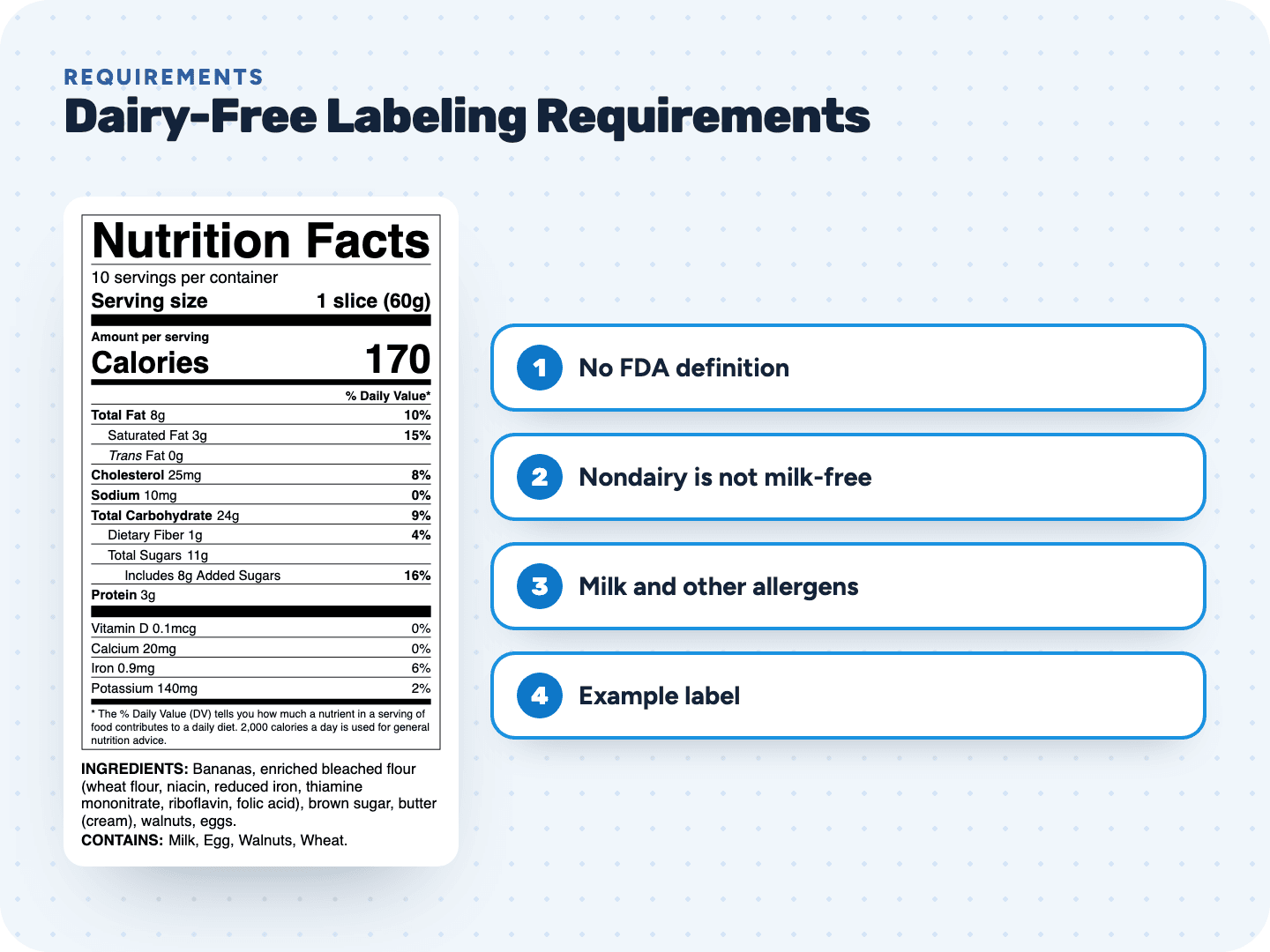
FDA has no definition of dairy-free
Search FDA's food regulations (21 CFR) for "dairy-free" and you find nothing. Unlike "gluten-free" or "sugar free", it has no legal threshold or test. What applies is the general rule in the FD&C Act: a food is misbranded if its labeling is false or misleading in any particular.
- No milk from cows, goats, sheep or other animals, in any form
- No butter, cream, cheese, yogurt, whey, casein, caseinates, ghee or lactose
- Lactose-free milk is still milk, so it can't be in a dairy-free food
FDA's draft guidance on plant-based milk alternatives encourages truthful statements like "dairy-free" or "non-dairy" that tell shoppers the product comes from plants and contains no milk. It also says "dairy-free milk" is not an adequate name on its own: name the plant, like "almond milk" or "oat milk".
Nondairy is not the same as milk-free
FDA's ingredient rule mentions "nondairy" for one reason: a food sold as nondairy can still contain milk protein. Some creamers and whipped toppings use sodium caseinate, a protein made from milk. When a food called nondairy contains a caseinate, the ingredient list must say where it comes from, as in the regulation's own example:
In the ingredient list: "sodium caseinate (a milk derivative)". In the allergen declaration: "Contains: Milk".
- "(a milk derivative)" after the caseinate is required on a food labeled nondairy
- The milk allergen declaration is required too. Caseinate is milk protein
- A food like this should not say "dairy-free". The words look alike, the rules don't
Milk allergen rules and the allergens that replace it
Dairy-free products swap milk for something else, and that something is often another major allergen: almonds, cashews, soy. The allergen rules apply in full:
- Any milk ingredient anywhere, including in a flavor or a sub-ingredient, is declared as milk. Goat or sheep milk is declared as "goat milk" or "sheep milk"
- Tree nuts are named by kind: "Contains: Almonds", "Contains: Cashews"
- Soy milk means soy is declared
- Coconut is not on FDA's list of tree nuts that count as major allergens, so coconut milk products don't get a tree nut Contains line
Example: chocolate almond milk
Ingredients: Almond milk (filtered water, almonds, calcium carbonate, sea salt, sunflower lecithin, gellan gum), sugar, cocoa, vanilla extract (vanilla bean extractives in water, alcohol). Contains: Almonds.
- The name says the plant: "Chocolate almond milk". "Dairy-free" may sit on the front as an extra statement
- No milk ingredient anywhere, so the dairy-free statement is truthful
- Almonds are a tree nut and are declared by name
- The serving is 1 cup (240 mL), the FDA reference amount for milk-substitute beverages
Our tool builds this ingredient list, the Contains line and the Nutrition Facts from your recipe, and it flags milk in butter, ghee, cheese, whey and every other dairy ingredient in its library. It does not judge the dairy-free claim itself, so check the recipe and your production line before you print it.
Start a label →Other food label claims and disclosures
Dairy-free is optional. A few other disclosures are not, depending on what you use and where it comes from.
| Disclosure | Who sets the rule | The short version |
|---|---|---|
| Bioengineered food | USDA AMS, 7 CFR 66 | Foods with ingredients from the List of Bioengineered Foods (corn, soybean, canola, sugarbeet and others) may need "Bioengineered food" or "Contains a bioengineered food ingredient", a symbol, a link or a text message option |
| Country of origin on imported food | U.S. Customs, 19 CFR 134 | An imported article or its container must show the English name of its country of origin to the final buyer |
| Food additives | FDA, 21 CFR 101.4 and 101.22 | Listed by name in the ingredient list. Colors and preservatives have their own naming rules |
- Bioengineered food labeling requirements don't apply to very small food manufacturers (annual receipts under $2,500,000), restaurants and similar retail food establishments, or food certified organic
- Imported food labeling requirements: every statement FDA requires must be in English
- Food country of origin labeling requirements for imports come from Customs, not FDA: the English name of the country, unless an exception applies
- FDA food additive labeling requirements are part of the ingredient list: each additive by its common name, with a function for preservatives
Our tool makes the Nutrition Facts, ingredient list and allergen statement. A bioengineered disclosure or country of origin goes on your artwork.
FDA Ingredient Labeling Requirements →