What every egg carton must show
| Label part | Egg carton detail | Rule |
|---|---|---|
| Product name | "Eggs", or "Brown eggs", "Large white eggs". Grade and size words come from USDA standards | 21 CFR 101.3 |
| Net quantity | Count works for eggs: "12 eggs" or "One dozen". FDA allows weight, measure, numerical count or a mix | 21 CFR 101.7(a) |
| Safe handling statement | Word for word, in a hairline box, with the heading in bold | 21 CFR 101.17(h) |
| Name and address | The packer or distributor, with city, state and ZIP | 21 CFR 101.5 |
| Nutrition Facts | Per egg, unless an exemption fits | 21 CFR 101.9 · 101.12(b) |
| State license number | Only if your state asks for it. Federal rules let a state require the packer's name, address and license number | 7 CFR 57.35(a)(2) |
A carton of plain shell eggs is a single food, so there is no recipe to break down. The work is in the safe handling box, the cold chain and, for bigger flocks, the paperwork with FDA and USDA.
The safe handling statement, word for word
SAFE HANDLING INSTRUCTIONS: To prevent illness from bacteria: keep eggs refrigerated, cook eggs until yolks are firm, and cook foods containing eggs thoroughly.
- Required on all shell eggs, whether they are sold inside your state or across state lines
- The words "SAFE HANDLING INSTRUCTIONS" in bold type
- Set off in a box drawn with hairlines
- Prominent and conspicuous, on the principal display panel, the information panel or the inside of the carton lid
- Printed inside the lid? Then "Keep Refrigerated" must also appear on the principal display panel or the information panel
Two cases are different. Shell eggs processed to destroy all viable Salmonella before they reach consumers are exempt. And eggs that are not sold straight to consumers, such as eggs going to a repacker or to restaurants, may carry the statement on the carton or in labeling such as invoices or bills of lading.
Our tool makes the Nutrition Facts panel for your carton. The safe handling box is part of your carton artwork: copy the sentence above exactly as it is written.
Start a label →Refrigeration at 45 °F, from farm to shelf
| Where the eggs are | What the rule says | Source |
|---|---|---|
| At a store or other retail establishment | Placed under refrigeration promptly on receipt, then stored and displayed at an ambient temperature of 45 °F or less | 21 CFR 115.50 |
| On a farm with 3,000 or more laying hens | Held and transported at 45 °F or less, starting 36 hours after the egg is laid | 21 CFR 118.4(e) |
| Packed in cartons for consumers | Stored and transported at 45 °F or less, and labeled with the safe handling instructions | 9 CFR 590.50(a) |
Eggs treated to destroy Salmonella are exempt from the store refrigeration rule. A producer-packer with a flock of 3,000 or fewer layers is exempt from USDA's temperature and labeling section, but must still print FDA's safe handling statement.
What changes with the size of your flock
| Your situation | FDA egg safety rule (21 CFR 118) | USDA shell egg surveillance (7 CFR 57) |
|---|---|---|
| Fewer than 3,000 hens | Not covered | No registration, and exempt from the restricted egg rules |
| 3,000 or more hens, selling all eggs directly to consumers | Not covered | Above 3,000 hens: register if you grade and pack eggs for consumers |
| 3,000 or more hens, selling to stores or packers | Covered: a written Salmonella Enteritidis prevention plan, 45 °F refrigeration, and farm registration with FDA within 30 days of becoming an egg producer | Above 3,000 hens: register if you grade and pack eggs for consumers, including eggs packed for stores; packers who pack for consumers are inspected at least once each calendar quarter |
Watch the exact number. FDA's rule starts at 3,000 or more laying hens. USDA's exemptions cover flocks of 3,000 hens or less. A flock of exactly 3,000 is inside FDA's rule and outside USDA's registration.
Restricted eggs are checks, dirties, leakers, incubator rejects, inedibles and loss. Except for small flocks and a few other exempt sales, eggs sold to consumers may not contain more of them than the tolerance in the U.S. Consumer Grade B standard.
The USDA grade shield and the numbers on the carton
USDA grading of shell eggs is voluntary: a packer applies for it and pays fees for the service. The shield with "USDA" may only go on eggs graded under USDA's program, by a USDA grader or under the supervision of a USDA quality assurance inspector. Using, imitating or simulating the shield is treated as a claim that the eggs were officially graded.
- The shield shows "USDA" and the grade, such as "A Grade"
- The size, such as "Large", sits in the shield or prominently on the main panel of the carton
- The plant number of the official plant, with the letter "P" in front, is on every carton
- Each carton, package or egg carries a lot number: the consecutive day of the year the eggs were packed, such as 132, unless USDA approved another system
- Cartons with a USDA grade say that refrigeration is required, such as "Keep Refrigerated"
- Eggs from a layer house that tested positive for Salmonella Enteritidis cannot get the shield unless the eggs themselves tested negative
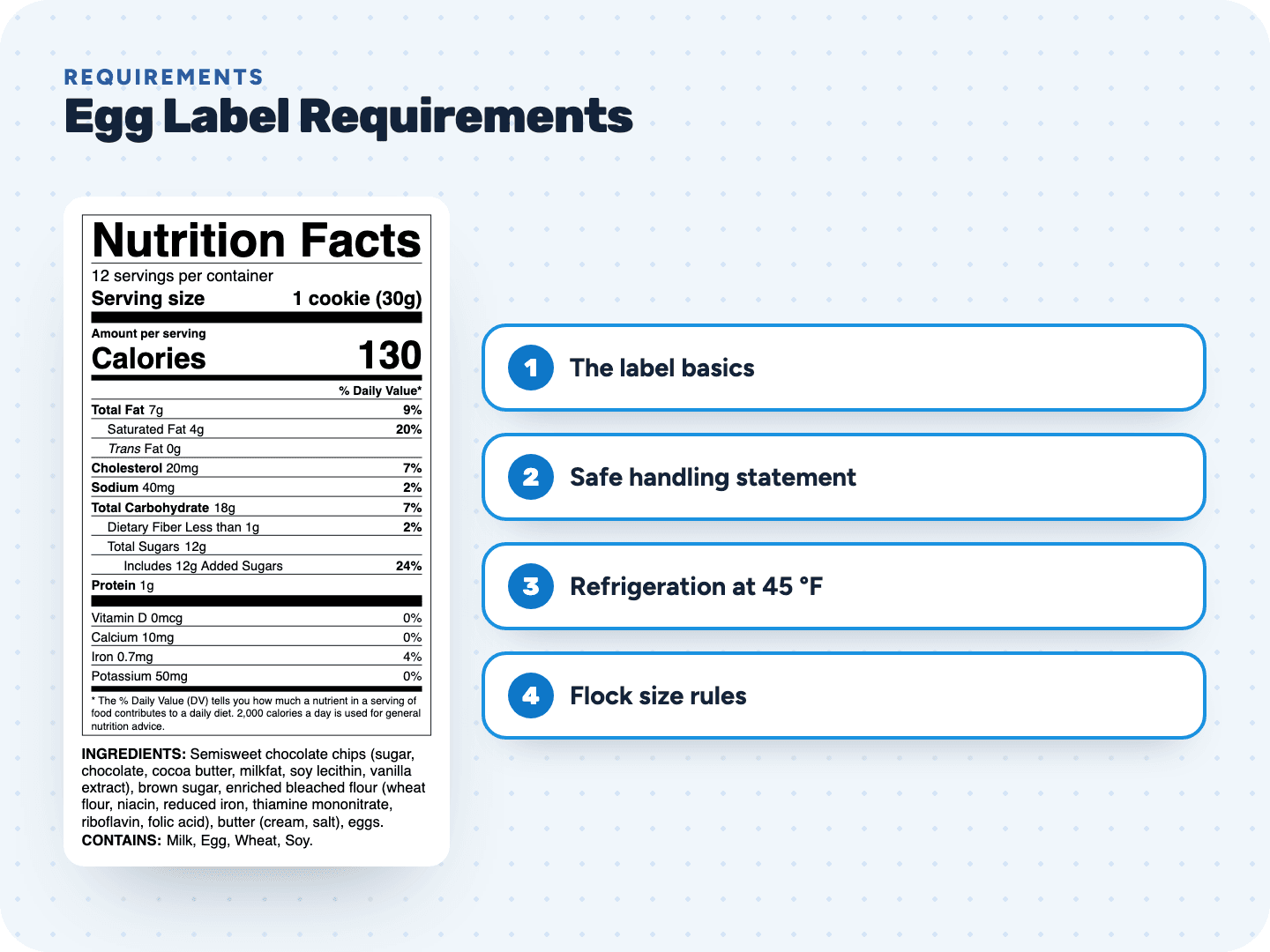
Nutrition Facts for a carton of eggs
Eggs have a reference amount of 50 g, and FDA's table sets the serving at 1 egg for every size: 1 large egg (50g), 1 extra large egg (56g), 1 jumbo egg (63g). The grams are the egg without its shell. Eggs are not on FDA's voluntary list for raw fruits, vegetables and fish, so a carton follows the usual Nutrition Facts rules, small business exemptions included.
- Cholesterol is the big number: 185 mg per large egg, 62% of the Daily Value
- Protein 6 g, fat 5 g, and carbohydrates round to 0 g
- Vitamin D 1 mcg, 6% of the Daily Value
- A dozen large eggs is 12 servings
State egg laws on top of the federal rules
Many states have their own egg laws, often run by the state department of agriculture. They can add a license, inspections, fees or wording on the carton. Ask your state before you print cartons.
Federal law puts limits on that for eggs that move between states. A state may not require grade, quality or weight class standards that differ from USDA's, and, except in noncontiguous states such as Alaska and Hawaii, may not require a label showing the state of origin. A state may require the name, address and license number of the packer on each container.