What every hot sauce bottle must show
| Label part | Hot sauce detail | Rule |
|---|---|---|
| Product name | Says what it is: "Hot sauce", "Pepper sauce", "Mango hot sauce". A heat level can sit next to it | 21 CFR 101.3 |
| Net quantity | Hot sauce is a liquid, so fluid ounces with milliliters: "5 FL OZ (148 mL)", in the bottom 30% of the front | 21 CFR 101.7 · 15 U.S.C. 1453 |
| Ingredient list | Heaviest first. Name the vinegar ("distilled vinegar") and open up anything store-bought | 21 CFR 101.4 |
| Allergens | Named in the list or in a Contains line | 21 U.S.C. 343(w) |
| Name and address | City, state and ZIP. "Distributed by" when a co-packer bottles it for you | 21 CFR 101.5 |
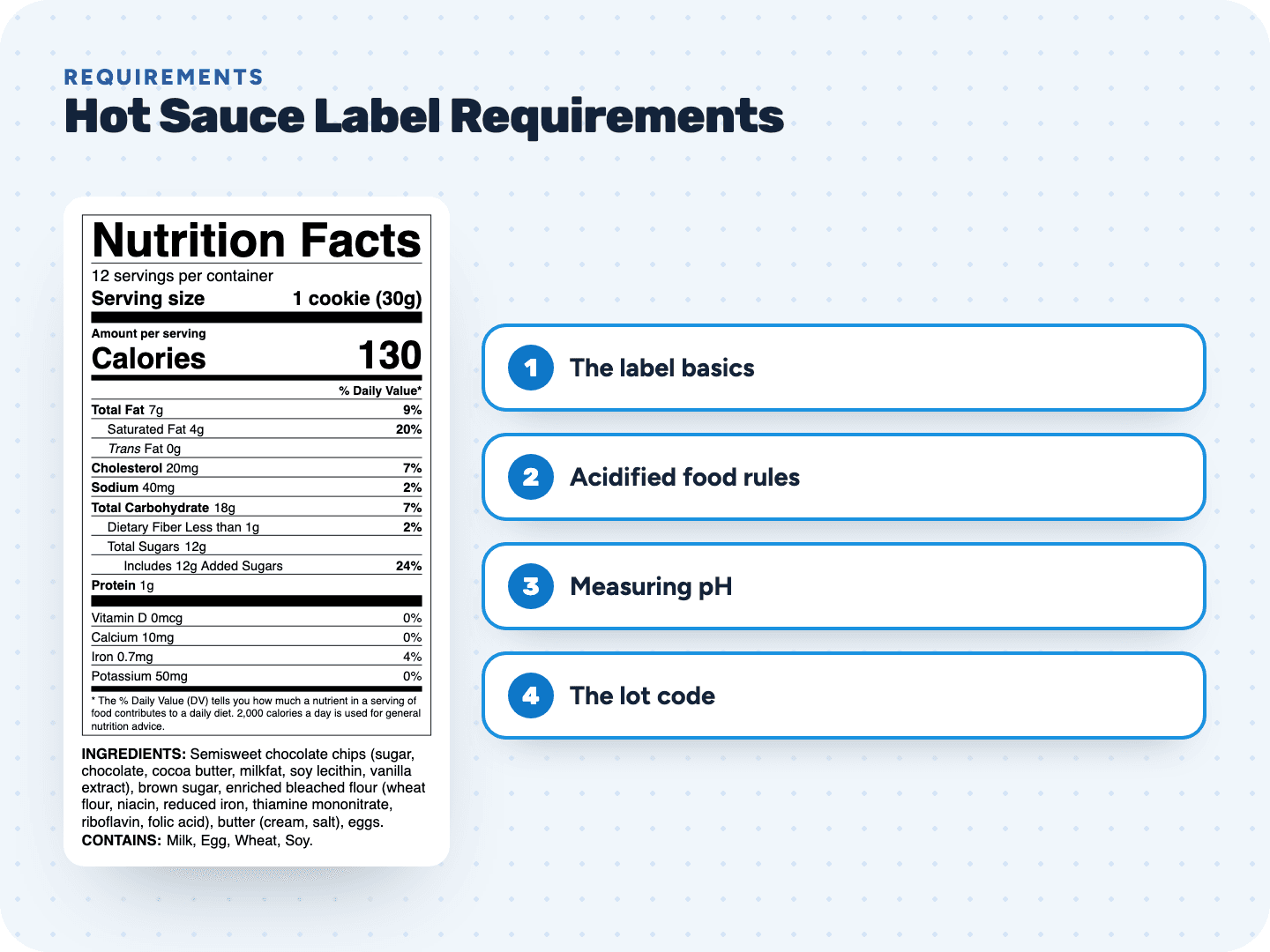
| Nutrition Facts | Per 1 tsp (5 mL), unless an exemption fits | 21 CFR 101.9 · 101.12 |
| Lot code | On every shelf-stable acidified bottle | 21 CFR 114.80(b) |
Hot sauce and FDA's acidified food rules
FDA's definition of acidified foods lists peppers by name: low-acid foods brought to a finished equilibrium pH of 4.6 or below by adding acid or acid foods, with a water activity above 0.85. A bottle of chiles and vinegar sold from a shelf fits that description exactly.
| How you sell it | Covered by 21 CFR 114? |
|---|---|
| Shelf-stable bottle, pH 4.6 or below thanks to vinegar or citrus | Yes |
| Kept cold from your kitchen to the store fridge | No: foods stored, distributed and sold under refrigeration are excluded |
| Dry chili flakes, powders and rubs | No: the definition only covers foods with a water activity above 0.85 |
- Register the plant on Form FDA 2541 within 10 days of first making acidified foods
- File a scheduled process on Form FDA 2541e for each sauce and each bottle size, before you pack it and within 60 days of registering
- Work under a supervisor who passed an FDA-approved course in acidification and pH control
- Keep pH, processing and distribution records for 3 years
- Report spoilage or a process deviation that could hurt someone to FDA when the lot has left your plant
pH meter or test strips?
If your finished sauce sits above pH 4.0, FDA requires a pH meter (a potentiometric method) for the finished pH. Test strips and titration are fine for checks during the batch, as long as you relate them to the meter reading. At pH 4.0 or below, any suitable method works for the final product.
Watch the ingredients that pull pH up. Peppers, garlic, onions and fruit like mango are all less acidic than vinegar, so a new pepper variety or a bigger fruit share can move the number. The finished pH has to reach 4.6 or lower within the time your scheduled process sets, and stay there.
The lot code on every bottle
- Permanently visible to the naked eye, on the bottle, cap or label
- Identifies, in your own code, the plant, the sauce, and the year, day and period of packing
- Printed or embossed on the container, or perforated or marked on a label that is securely attached
- The period part changes every 4 to 5 hours, at each shift change, or with each batch inside one shift
FDA defines a lot as the product made during the period one code stands for. Your records then tie each code to its pH readings and its first customers, so a problem can be traced to one run of bottles.
Small bottles: label area and type size
For a round bottle, FDA measures the front panel as 40% of the bottle's height times its circumference, leaving out the neck and shoulders. That area sets the minimum height of the net quantity line.
| Front panel area | Net quantity at least |
|---|---|
| 5 sq in or less | 1/16 inch tall |
| Over 5, up to 25 sq in | 1/8 inch tall |
| Over 25, up to 100 sq in | 3/16 inch tall |
| Over 100, up to 400 sq in | 1/4 inch tall |
| Over 400 sq in | 1/2 inch tall |
Example: a bottle body 3 inches tall and 6 inches around has a front panel of 0.4 × 3 × 6 = 7.2 square inches, so the net quantity needs letters at least 1/8 inch tall. On a front panel of 5 square inches or less, the bottom 30% placement rule no longer applies.
Mini bottles in a sampler or gift set: when a bottle has less than 12 square inches of total surface for labeling, it may skip Nutrition Facts, as long as the label makes no nutrition claims and gives an address or phone number where buyers can get the nutrition information.
Example: mango hot sauce, 5 fl oz
Ingredients: Peppers, distilled vinegar, mango, lime juice, garlic, salt.
- Sodium is 35 mg per teaspoon. That is not zero, so this sauce cannot use the exemption for foods with insignificant amounts of every nutrient (the one plain coffee uses). It needs a panel unless another exemption fits
- Thirteen of the fifteen nutrients round to zero. Eight or more is enough for the shorter simplified format
- Real mango is in the bottle, so "Mango hot sauce" needs no "flavored" in the name
- No Contains line: none of the 9 major allergens is in this recipe
Where allergens hide in hot sauce
- Fish sauce, anchovies, or Worcestershire made with anchovies: name the fish, as in "Contains: anchovy"
- Shrimp paste: crustacean shellfish, named as shrimp
- Soy sauce: soy, and wheat when it is brewed with wheat
- Sesame oil or seeds in a chili oil: sesame is the ninth major allergen and is labeled like the other eight
- Peanuts in a satay-style chili sauce