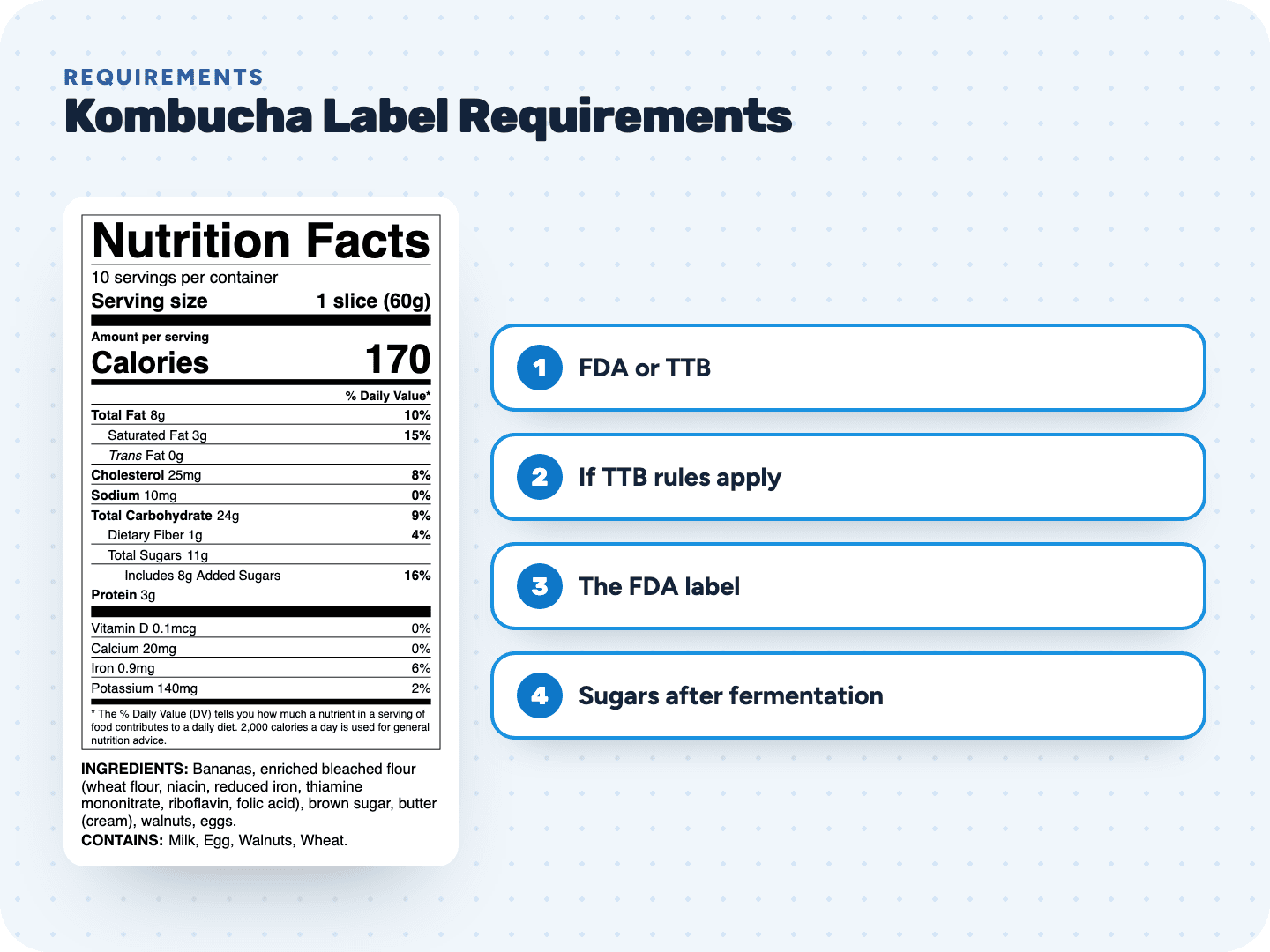
FDA or TTB: the 0.5% line
| Your kombucha | Who regulates it | What that means |
|---|---|---|
| Below 0.5% alcohol by volume at all times: brewing, bottling and after | FDA, plus state and local rules | A food label: name, net contents, ingredients, allergens, name and address, Nutrition Facts |
| At or above 0.5% at any time, including from fermentation in the bottle | TTB, plus state and local rules | Production on TTB-qualified premises, tax and formula rules, and the alcohol health warning |
The trap is the shelf. Kombucha bottled at 0.3% can keep fermenting and pass 0.5% weeks later in a store. TTB counts that kombucha as an alcohol beverage, even though it left your kitchen under the line.
If your kombucha is 0.5% alcohol or more
- It must be made on premises qualified with TTB under the Internal Revenue Code
- It must meet TTB's labeling, formula and tax requirements
- The container needs the health warning statement required by the Alcoholic Beverage Labeling Act
- If it is classified as a malt beverage, the Federal Alcohol Administration Act permit, labeling and advertising rules apply too
Those labels follow TTB's rules, not FDA's. Our tool makes FDA Nutrition Facts and food labels, so the rest of this page covers kombucha that stays under 0.5%.
Kombucha labeling requirements under FDA
- A name that says what it is: "Kombucha", "Ginger kombucha", "Raspberry lemon kombucha"
- Net contents in fluid ounces on the front, in the bottom 30% of the panel, like "16 FL OZ (1 PT) 473 mL"
- An ingredient list in order by weight: water, tea, sugar and every flavor, juice or herb you add
- Major allergens declared, if any ingredient contains one
- Your business name, city, state and ZIP
- Nutrition Facts per 12 fl oz (360 mL), the FDA reference amount for most drinks, unless you are exempt
Nutrition Facts for a fermented drink
The culture eats part of the sugar you add. A calculation from the recipe counts sugar that is no longer in the bottle, so it overstates sugars and calories. Lab analysis of the finished kombucha gives the real numbers.
Added sugars have their own FDA rule for fermented foods. If fermentation lowers the added sugars, you may declare the lower amount only if you keep records:
- Scientific data specific to your type of food that shows the added sugars left after fermentation, with a written explanation of why the data is enough
- Or records of the added sugars you put in, declared as is, but never more than the Total Sugars on the label
- Or an FDA petition for another way to comply
With lab values for your finished kombucha, our tool still does the work: enter them as a custom ingredient, the way you would a supplier spec sheet, and it applies FDA rounding, %DV and the layout.
Juice, flavors and claims on kombucha
- Named or pictured fruit, or a juice-like look, means a percent juice statement, like "Contains 5% raspberry juice". A bottle that only says "raspberry flavored", with no juice wording or juice-like look, can skip it
- Raw juice added after fermentation: if neither the juice nor the kombucha is treated for a 5-log reduction, the boxed WARNING for untreated juice applies
- Flavors are listed as "natural flavor" or "artificial flavor", and a flavor named on the front follows FDA's characterizing flavor rules
- "Sugar free", "zero sugar" or "low calorie" must meet FDA's claim definitions