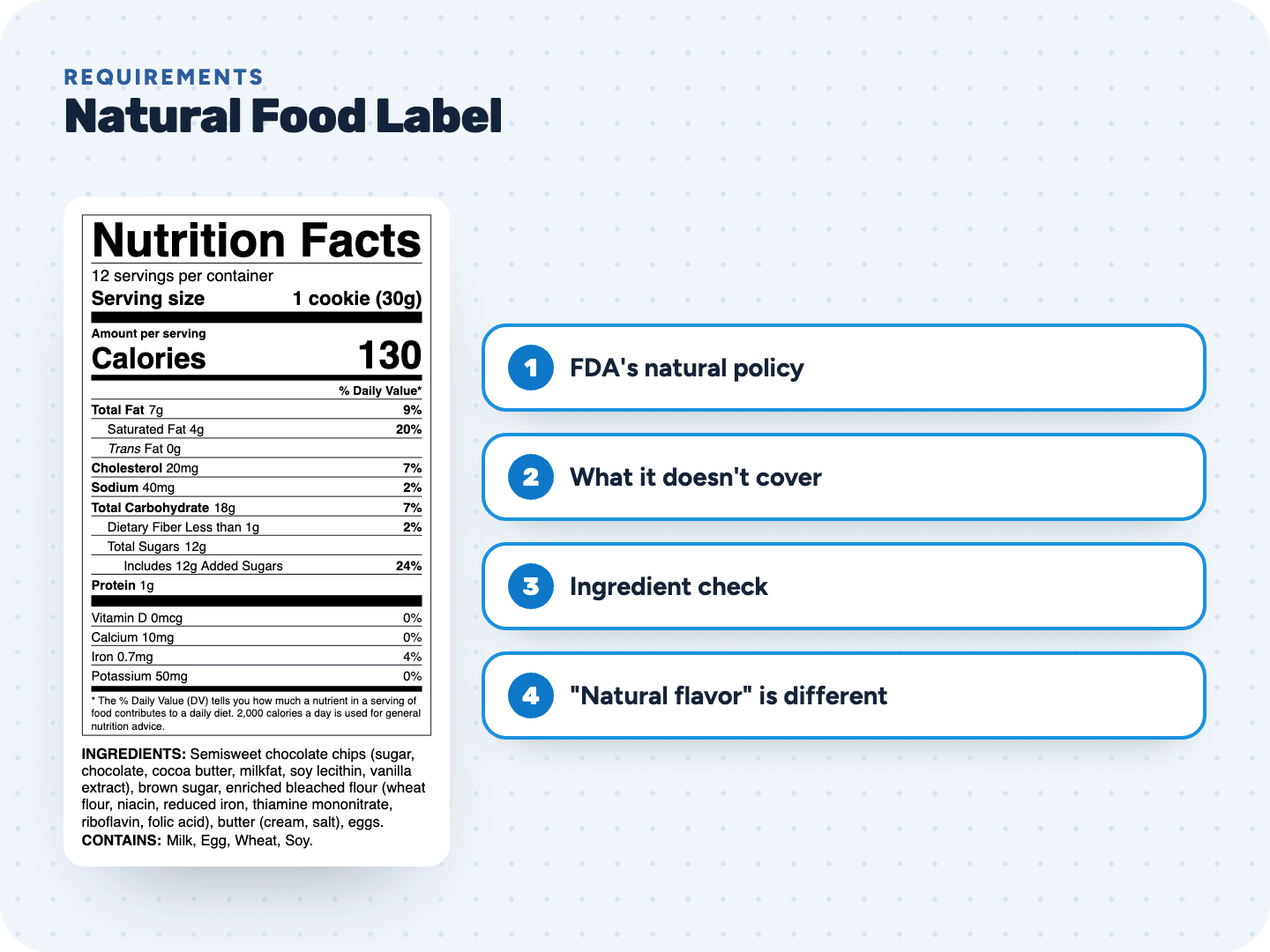
What FDA says "natural" means
That sentence is a policy, not a regulation. FDA says so itself: it has never done rulemaking to set a formal definition. There is no list of approved ingredients, no threshold and no FDA logo for natural.
What the natural policy leaves out
FDA spells out three things its policy was never meant to settle. "Natural" says nothing about any of them:
| Topic | Covered by the natural policy? |
|---|---|
| Farming methods, such as pesticide use | No |
| Processing, such as heat treatment, pasteurization or irradiation | Not explicitly |
| Nutrition or other health benefits | No |
FDA also notes that federal courts have asked it whether foods with genetically engineered ingredients or high fructose corn syrup may be labeled "natural". Its page asked the public for input on whether and how to define the term, and gives no answer to those questions. So for both, the honest status is: undecided by FDA.
All natural food label: an ingredient-by-ingredient check
Read your full ingredient list, sub-ingredients included, and ask these questions. By the wording of FDA's policy, each yes works against a natural claim:
| Question | Where it shows up | Rule behind it |
|---|---|---|
| Is any color added? | "Color added", "colored with beet juice", "Red 40": the policy counts all color additives, from any source | 21 CFR 101.22(k) |
| Is there an artificial flavor? | Listed as "artificial flavor": a flavor not derived from a spice, fruit, vegetable, herb, meat, dairy or similar source | 21 CFR 101.22(a)(1), (h)(1) |
| Is there a chemical preservative? | Declared with its function, like "potassium sorbate (preservative)" | 21 CFR 101.22(a)(5), (j) |
| Is anything synthetic that shoppers wouldn't expect in this food? | Store-bought parts like syrups, coatings and mixes, once you open them up into their own ingredients | FDA natural policy |
Our tool helps with the reading part: it writes the ingredient statement heaviest first and puts each store-bought ingredient's own ingredients in parentheses, so a color or preservative inside a mix doesn't stay hidden. It does not judge whether a natural claim fits.
Build your ingredient list: Ingredient label maker →"Natural flavor" in the ingredient list is a different thing
"Natural flavor" has a real regulatory definition, unlike "natural" on the front. It is an extract, essential oil, distillate or similar product made from a spice, fruit, vegetable, herb, meat, seafood, dairy or another listed source, used for flavor rather than nutrition. A food may list "natural flavor" and still not meet FDA's natural policy because of a color or preservative elsewhere in the list.
- In the ingredient list, natural flavor may be declared simply as "natural flavor"
- A protein hydrolysate used for flavor may not hide behind "natural flavor"; it needs its own name
- When the named flavor comes from a natural flavor rather than enough of the real fruit, the name changes: "natural strawberry flavored shortcake" or "strawberry flavored shortcake"
"Natural" and "no artificial colors" are separate claims
FDA now says it does not intend to take action against "no artificial colors" style claims on foods that contain none of the certified colors listed in 21 CFR part 74, even if colors from natural sources are used. That letter is about the "no artificial colors" claim only. It does not mention "natural", and FDA's natural policy still reads "all color additives regardless of source".
| Claim | Food colored with beet juice, no certified colors |
|---|---|
| "No artificial colors" | Covered by FDA's enforcement discretion letter |
| "Natural" or "all natural" | A color additive is in the food, which the natural policy counts against the claim |
Natural, organic and non-GMO compared
| Natural | Organic | Non-GMO | |
|---|---|---|---|
| Who sets the rules | FDA policy, no regulation | USDA National Organic Program, 7 CFR part 205 | FDA guidance for absence claims; USDA rules for bioengineered disclosure |
| Certification | None exists | Required, except for operations exempt under 7 CFR 205.101 | Optional, through private programs; USDA does not certify it |
| Covers farming methods | No | Yes | Only whether bioengineering was used |