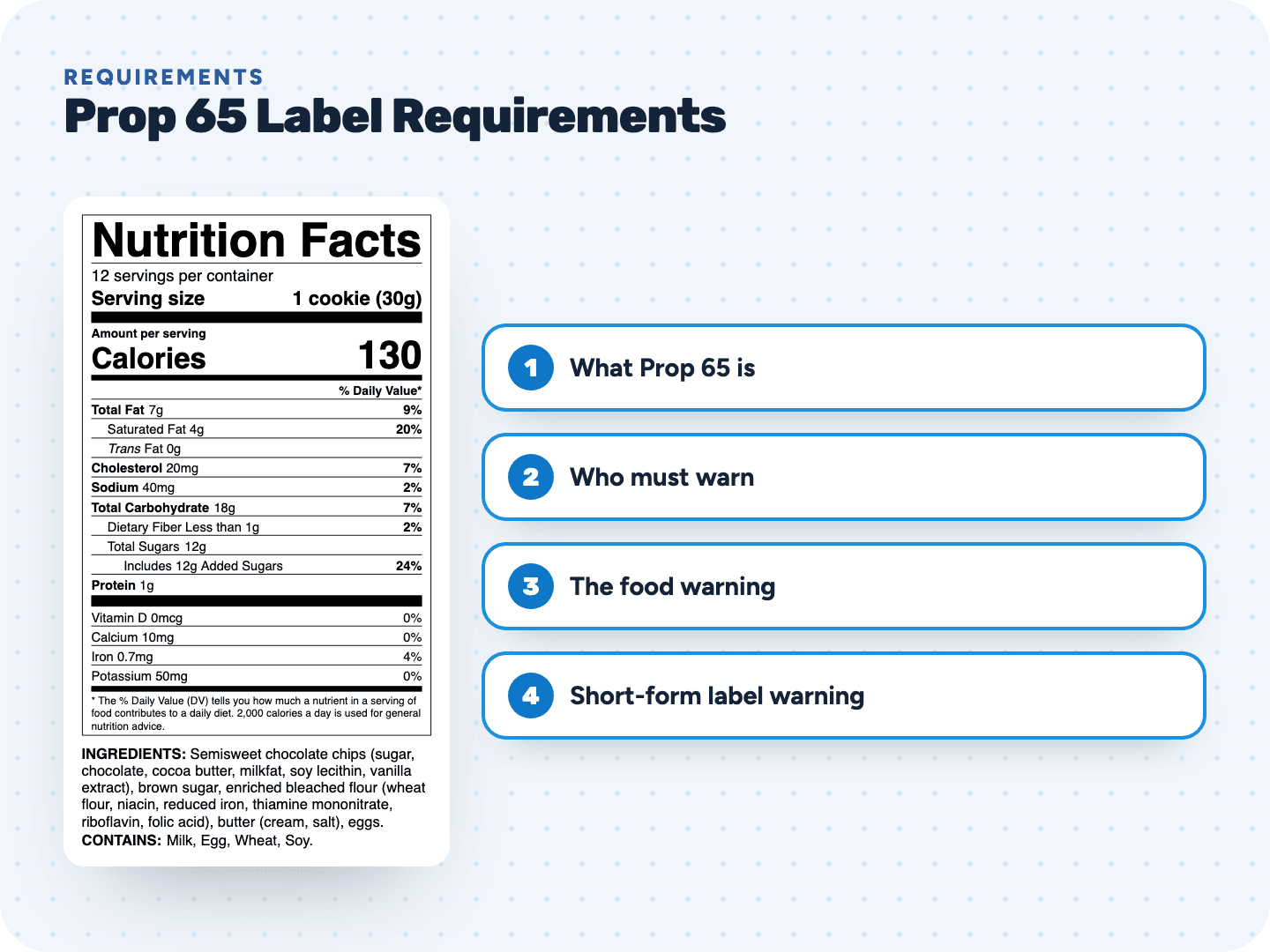
What Proposition 65 is
Proposition 65 is a California law, officially the Safe Drinking Water and Toxic Enforcement Act of 1986. It is not an FDA rule, so it applies on top of federal food labeling. California keeps a list of chemicals known to cause cancer, birth defects or other reproductive harm, about 900 of them, including chemicals that can be in food.
| Question | Answer |
|---|---|
| Who runs it | OEHHA, California's Office of Environmental Health Hazard Assessment |
| Who enforces it | The California Attorney General, district attorneys, city attorneys of cities over 750,000 people, and any individual acting in the public interest |
| Maximum penalty | Up to $2,500 per violation per day |
| When a warning is needed | For a listed chemical, unless the exposure poses no significant risk of cancer or is significantly below levels observed to cause birth defects or other reproductive harm |
Who has to give the warning
The law applies to businesses with ten or more employees. OEHHA's regulation counts every full-time and part-time employee on the date of the exposure: the rules "will apply to any person who has ten or more full-time or part-time employees on the date in question."
Within the supply chain, the regulation puts the job mainly on the manufacturer, producer, packager, importer, supplier or distributor. They can either put the warning on the product label or labeling, or send a written notice with the warning materials to the retailer's authorized agent, renewed every year while the product is sold in California.
- A retailer has to warn itself only in set cases: for example when the product is sold under its own brand, when it added or created the listed chemical, or when it covered or altered a warning
- A retailer that received warning materials must put them up and keep them up, including for online sales
- A maker and its buyer may agree in writing who provides the warning, as long as the shopper gets it before the exposure
The safe harbor food warning, word for word
Food, including dietary supplements, has its own safe harbor wording. It starts with "WARNING:", "CA WARNING:" or "CALIFORNIA WARNING:" in capital letters and bold print, followed by the text for the type of chemical. For a listed carcinogen, the regulation sets these exact words:
| Chemical type | The warning ends with |
|---|---|
| Carcinogen | "known to the State of California to cause cancer" |
| Reproductive toxicant | "known to the State of California to cause birth defects or other reproductive harm" |
| One chemical listed for both | "known to the State of California to cause cancer and birth defects or other reproductive harm" |
Each version names at least one chemical and ends with the food web address. When you warn about a single chemical, you may drop the words "chemicals including". Warnings for both a carcinogen and a reproductive toxicant name a chemical for each.
The short-form warning for food labels
On the label itself, you may use a short-form warning instead. It keeps the bold signal word and names one chemical (or one per type). Two of the allowed texts for a carcinogen:
- Cancer risk from exposure to [name of chemical]. See www.P65Warnings.ca.gov/food.
- Can expose you to [name of chemical], a carcinogen. See www.P65Warnings.ca.gov/food.
- Matching versions exist for reproductive toxicants, for both types, and for a chemical listed as both
- The short form goes on the product label, in a type size that is prominent compared with the other words on the label
- In no case smaller than 6-point type
One difference from other consumer products: OEHHA's general product warnings include a yellow triangle with an exclamation point, but the food warning sections do not list that symbol.
Where the warning goes: label, shelf or website
| Method | What the rule asks |
|---|---|
| On the food label | Set off from other information and enclosed in a box |
| Shelf sign, shelf tag or posted sign | Product-specific, at each point where the product is displayed |
| Online sale | On the product page, through a clearly marked "WARNING" link on that page, or otherwise prominently before the purchase is complete |
| Catalog | In the catalog, clearly tied to the item |
If the label, sign or shelf tag gives consumer information in another language, such as a Spanish ingredient list, the warning must also be in that language, as well as in English.
Acrylamide and naturally occurring chemicals
Acrylamide has its own warning options in the food section. The regulation describes it as a chemical formed in some foods during cooking or processing at high temperatures, and lets a business use either the general food warning or one of the acrylamide-specific texts set out in the regulation.
Chemicals that occur naturally in a food are treated differently. Eating a food is not an exposure to the extent the business can show the chemical is naturally occurring, such as minerals from the soil the food was grown in. Only the part that comes from human activity counts, and the business must use quality controls that keep natural contaminants to the lowest level currently feasible.
What Nutrition Label Studio does and does not do here
We do not make Prop 65 warning labels, test food for listed chemicals or tell you whether a warning is needed. That call depends on lab data and exposure levels, and is yours to make, with a lab or a Prop 65 adviser where needed.
What we do make are the regulated panels that usually sit on the back of the package: the Nutrition Facts or Supplement Facts panel and the ingredient statement with the 9 major allergens in a Contains line. If you need a Prop 65 warning too, your designer places it as its own boxed statement on the artwork.
California Food Label Requirements →