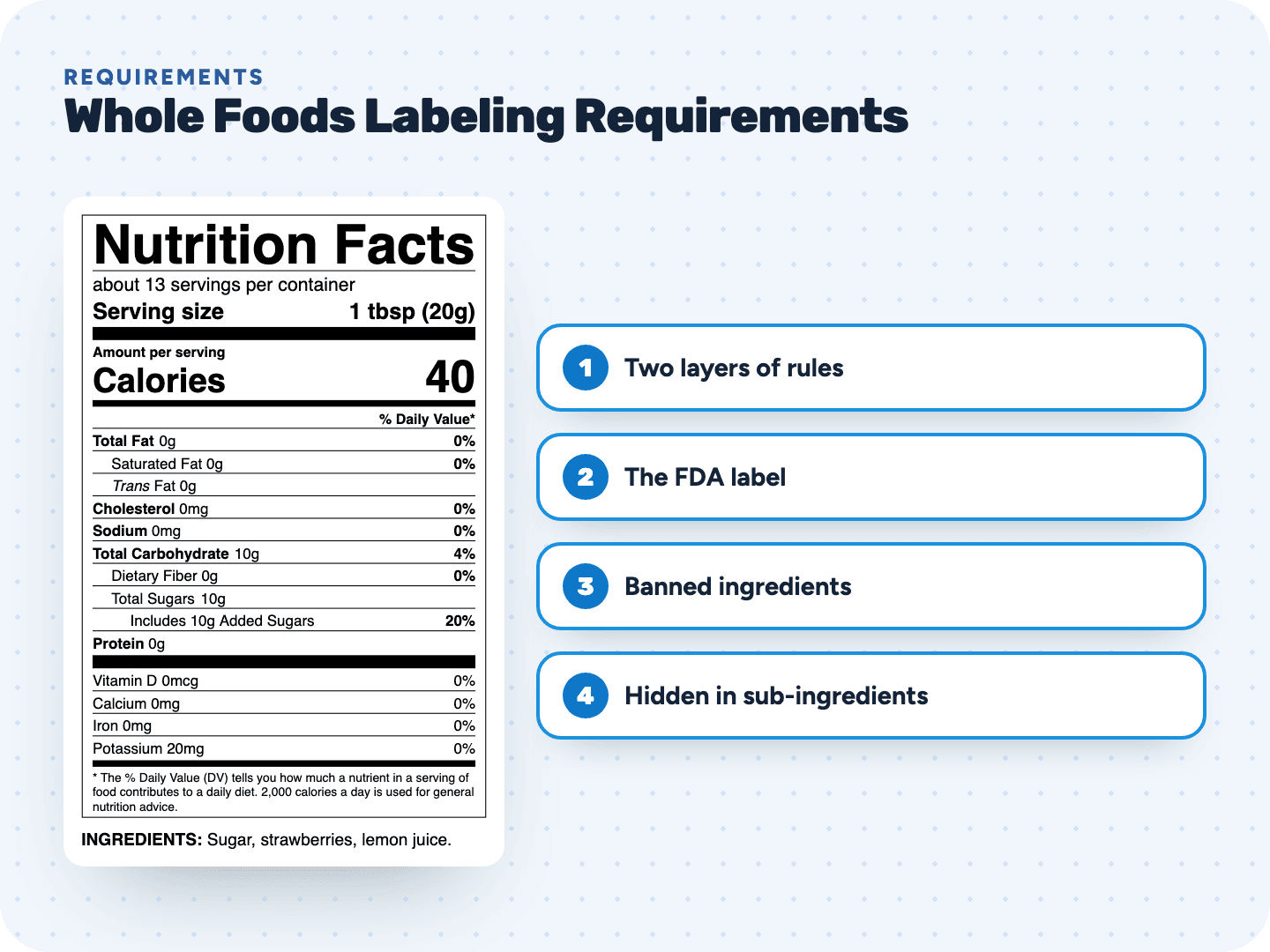
Two layers: FDA rules and Whole Foods standards
| FDA labeling rules | Whole Foods Market standards | |
|---|---|---|
| Set by | Federal law: the FD&C Act and 21 CFR 101 | The retailer, for what it agrees to sell |
| Applies to | Every packaged food sold in the US | Brands that want a place on its shelves |
| Covers | What the label must say, and how | Which ingredients may be in the product at all |
| Where to read it | eCFR and fda.gov | wholefoodsmarket.com, plus the Supplier Portal for what is not public |
A label can follow every FDA rule and still list an ingredient the store will not sell, like sucralose or sodium benzoate. So you check two things: is the label right, and is the recipe acceptable to the retailer.
The FDA label every Whole Foods product needs
- A name on the front that says what the food is: "Maple pecan granola", not only your brand name
- The net quantity on the front, in the bottom 30% of the panel, in ounces and grams
- An ingredient list in descending order by weight. An ingredient made of other ingredients, like chocolate chips, lists its own ingredients in parentheses
- The major food allergens by name: milk, eggs, fish, crustacean shellfish, tree nuts, peanuts, wheat, soybeans and sesame. Tree nuts, fish and shellfish name the type: "Contains: Pecans"
- The name and place of business of the maker, packer or distributor
- Nutrition Facts, with FDA rounding and % Daily Values
Small brands often hope to skip Nutrition Facts. The small retailer exemption covers food offered for sale by a business that sells directly to consumers and has small sales. On a large grocer's shelf, the seller is the grocer, so that exemption does not fit.
A small manufacturer can look at the low-volume exemption instead: fewer than 100 full-time equivalent employees and fewer than 100,000 units of that product sold in the US in 12 months, with a notice filed with FDA. Below 10 employees and 10,000 units a year, no notice is needed unless you import. Both exemptions end the moment the label or your advertising carries a nutrition claim or other nutrition information.
Whole Foods ingredient standards: what is banned
Whole Foods Market says it bans more than 300 ingredients from all the food it sells, from the bakery to the bulk bins. Its public list includes these groups:
| Group | Examples on the Whole Foods list |
|---|---|
| Sweeteners | High-fructose corn syrup, aspartame, sucralose, saccharin, acesulfame-K, neotame, advantame, allulose |
| Fats | Hydrogenated oils, partially hydrogenated oils, olestra |
| Colors | Certified FD&C colors such as FD&C Red No. 40 and FD&C Yellow No. 5, plus carmine and cochineal |
| Preservatives | Sodium benzoate, potassium sorbate, calcium propionate, BHA, BHT, TBHQ, EDTA salts |
| Flour and leavening | Bleached flour, bromated flour, benzoyl peroxide, azodicarbonamide, sodium aluminum phosphate, sodium aluminum sulfate |
| Flavors and enhancers | Monosodium glutamate, synthetic vanillin, synthetic ethyl vanillin, synthetic smoke flavor |
| Sulfites | Sulfur dioxide, sodium metabisulfite and other sulfites, allowed only in wine, mead and cider |
Not everything that preserves or colors food is out. Whole Foods allows certain preservatives, such as citric acid and cultured dextrose, and weighs others case by case. Most exempt colors, from sources like dehydrated beets and grape skin extract, are allowed.
Read the list as a floor, not a finish line. Whole Foods adds a note for suppliers: the public list is meant for shoppers, it does not include all of its requirements and ingredient restrictions, and a product with none of the listed ingredients is still not guaranteed a place on the shelf.
Where banned ingredients hide on your label
FDA makes you list the ingredients inside each ingredient you buy. That is where most surprises show up. Many common store-bought versions list:
| You bake or cook with | Its label lists | On the Whole Foods list as |
|---|---|---|
| All-purpose flour | Enriched bleached flour | Bleached flour |
| Baking powder | Sodium aluminum sulfate | Sodium aluminum sulfate |
| Self-rising flour | Bleached flour and sodium aluminum phosphate | Both, separately |
| Dried apricots | Sulfur dioxide | Sulfur dioxide |
| Sweetened shredded coconut | Sodium metabisulfite | Sodium metabisulfite |
| Mayonnaise | Calcium disodium EDTA | Calcium disodium EDTA |
| Bottled barbecue sauce | High fructose corn syrup, sodium benzoate | Both, separately |
Sulfites are a special case. Even when they arrive through an ingredient, FDA requires you to declare them once the finished food holds 10 ppm or more. The sulfur dioxide from dried apricots then sits in plain sight on your ingredient list, and Whole Foods says it does not allow sulfites on dried fruit.
Ask every supplier for the full ingredient statement of what you buy: chocolate chips, dried fruit, flavors, sauces. Then compare each line with the retailer's current standards yourself.
How to become a Whole Foods supplier
- Register for the Whole Foods Market Supplier Portal, confirm your email, then fill in the Potential Supplier Form about your business and products
- Make sure the product meets the Quality Standards before you apply. Some of the details, including food safety requirements, are only visible after you register
- Send complete and accurate information. Whole Foods says it gets so many new product inquiries that it cannot guarantee a response
- Small brands not yet sold at Whole Foods can apply for LEAP, the Local and Emerging Accelerator Program: mentorship, education and possible financial support for grocery and Whole Body brands
- LEAP products still have to meet every requirement before they reach a shelf, including business requirements such as liability insurance, production in a certified commercial facility and transparent sourcing
- Already working with a Forager or Category Merchant? Ask them about the Local Producer Loan Program for small, local and emerging producers
What Nutrition Label Studio does for a Whole Foods label
Nutrition Label Studio is an independent tool. It is not affiliated with, endorsed by or connected to Whole Foods Market. We make the FDA part of your label from your recipe, so the label side of your application is done right.
- Nutrition Facts with FDA rounding and % Daily Values, as a vector PDF, SVG or 600 dpi PNG for your package artwork
- The ingredient statement in order by weight, with sub-ingredients in parentheses
- The allergen line with the specific tree nut, fish or shellfish named
- A calculation report with your recipe, the USDA source of every ingredient and how each number was rounded, to show a buyer, co-packer or inspector
What the tool does not do: compare your recipe with Whole Foods Market's ingredient standards or any other retailer's rules, check claims, or test your product. That check stays with you.
Nutrition Label Documentation: The Calculation Report →