Vermont Food Labeling Requirements
Vermont food labeling requirements for home-based producers come from the Vermont Department of Health. Every packaged product shows your name and address, the product name, the ingredients from most to least, the net weight or volume, and allergen information. Selling under a license exemption? Add "Made in a home kitchen not inspected by the Vermont Department of Health" in at least 10-point type. Cottage food operators can sell up to $30,000 a year without a license.
Required on every Vermont home-based food label
This is the Health Department's label list for home-based food. Producers selling under a license exemption add the home kitchen statement.
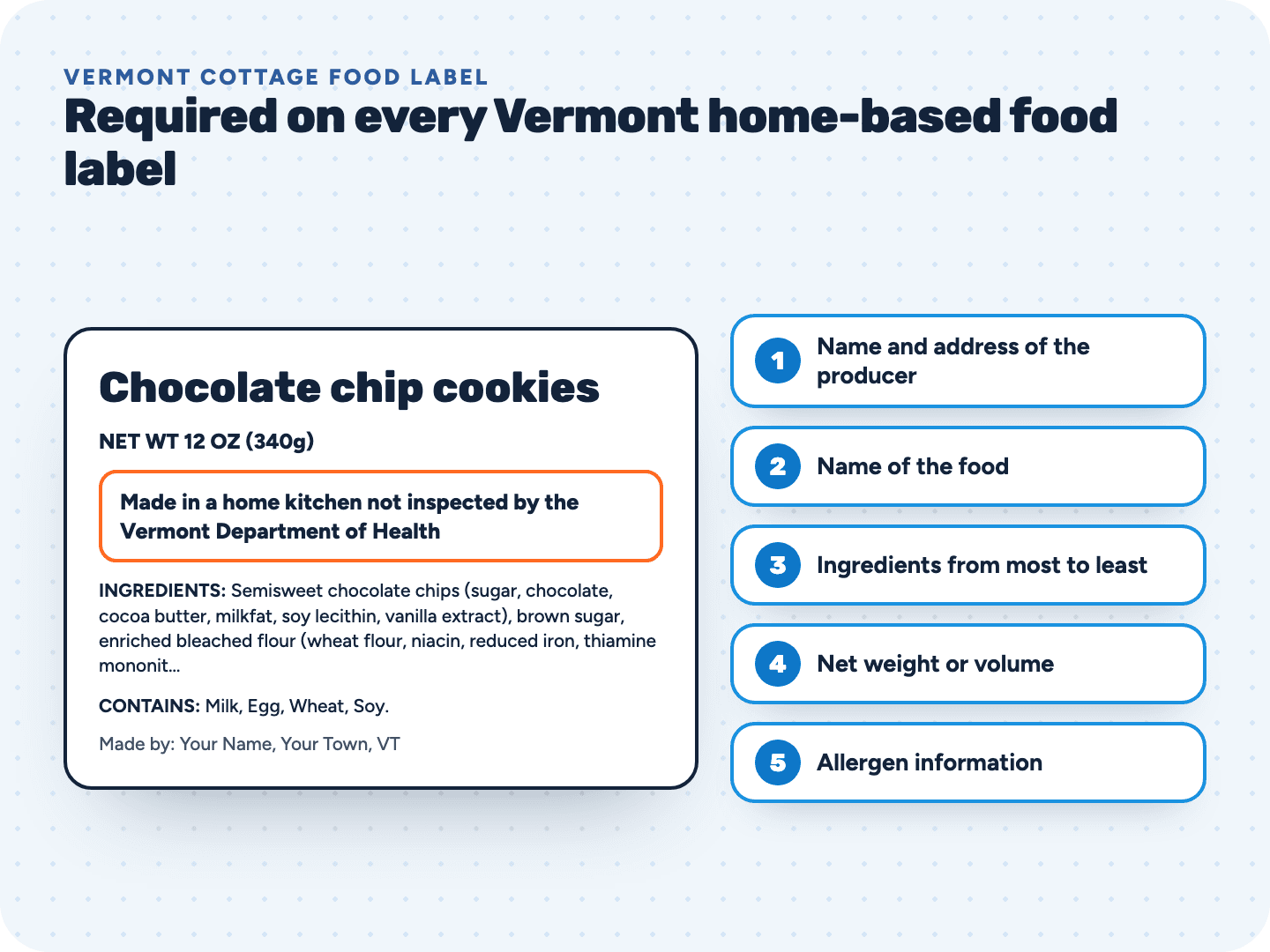
- 1Name and address of the producerManufactured Food Rule 6.2.1Use the physical address of your home kitchen, not a PO box, so the business can be found in a recall or traceback.
- 2Name of the foodWhat it is, like "Maple Sugar Cookies" or "Apple Cider Jelly".
- 3Ingredients from most to leastEvery ingredient, from the one used in the greatest amount to the smallest.
- 4Net weight or volumeHow much is inside, like "Net Wt 8 oz (227 g)" or "12 fl oz".
- 5Allergen informationAs federal labeling requires, for the nine major allergens. Put them in parentheses, like "Flour (Wheat)", or in a "Contains" line after the ingredients.
- 6Nutrition labels with a claimNeeded if you make a nutrient content or health claim, like "sugar-free", "low fat" or "reduces risk of heart disease", or give other nutrition information.
- 7The home kitchen statement (exempt only)"Made in a home kitchen not inspected by the Vermont Department of Health" in at least 10-point font, in a color that contrasts with the label background.
- Bulk display instead of a labelVermont ruleFood sold from bulk containers doesn't need a label on every piece. A clearly visible sign, placard or table tent at the service location with the label information works instead.
License exemptions, caps and steps
Where this comes from
- Vermont Department of Health: Home-Based Food Licenses and ExemptionsOfficial page: label items, the home kitchen statement, the $30,000 and $10,000 exemptions
- Vermont Act 42: Exemptions for food manufacturing establishmentsAmends 18 V.S.A. 4301, 4353 and 4358: cottage food definition, caps, license fees
Vermont label questions
Not if your gross cottage food sales stay at $30,000 a year or less. Take the Health Department's online training, file the exemption form every year, and label each package with the home kitchen statement. Above that, you need a Home Bakery License. Cottage Food Law →
No. The Health Department says to use the physical address of your home kitchen, because the address is there to find the business in a recall or foodborne illness traceback.
Almost never. The Health Department says nearly all home-based and exempt producers are exempt based on sales and volume. You need one once you make a claim like "sugar-free" or "low fat".
No. The exemption only covers food made in the kitchen of your own home or a kitchen on your own property. Food made in a rented kitchen, even a licensed one, needs a license.
No. Prepared meals sold direct to customers need a Home Caterer License, and maybe a Temporary Food Service License for events.
No. If your product fits the definition, you can go ahead. If you're unsure, you can ask the Health Department to review it with its Cottage Food Product Review Request Form.
See your label before you pay anything
Free preview, no account. $29 when you're ready to print.